




Read More: New York MTA to Begin Fare-Free Bus Pilot
New York MTA Begins Bus Stop Hub Approach
The MTA will deploy EAGLE teams to local and Select Bus Service (SBS) bus stop hubs with high rates of fare evasion.
August 4, 2023
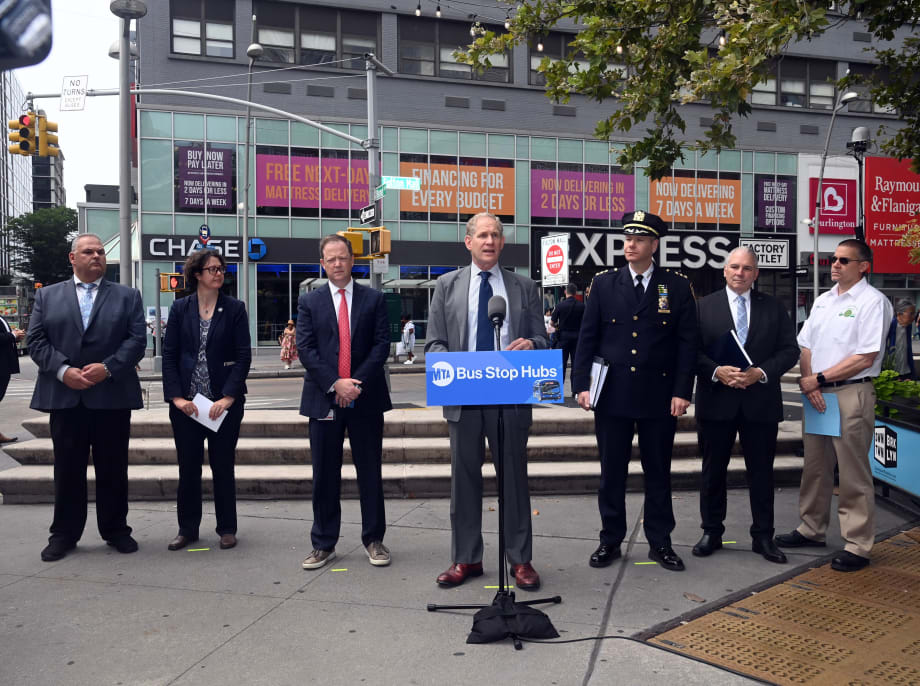
The goals of the Bus Stop Hub approach are to improve bus customer awareness of opportunities to pay lower fares, raise visibility, improve equity of fare evasion inspection on buses in all five boroughs, and increase the effectiveness of Eagle Team fare inspectors/
Photo: MTA
3 min to read
The Metropolitan Transportation Authority (MTA) announced the start of its Bus Stop Hub approach as part of the Authority’s initiative to implement the recommendations of the Blue-Ribbon Panel Report on Fare and Toll Evasion.
The MTA will deploy EAGLE teams to local and Select Bus Service (SBS) bus stop hubs with high rates of fare evasion. With NYPD support, officers will both educate members of the community on fare payment options and issue summonses.
“The hundreds of millions of dollars the MTA loses to fare evasion every year could be used to reinvest into the transit system in the form of more service that’s instead totally lost. It’s not fair to the millions of riders who do the right thing and swipe or tap in every day,” said MTA CEO Janno Lieber. “I want to thank the NYPD for their support and Governor Hochul and the State Legislature for their investment so we can take this modernized approach to combating fare evasion at its root causes.”
In 2022, the MTA lost an estimated $315 million to fare evasion on buses. Customers evade the fare on buses by walking past the farebox without paying, boarding through a back door, short-changing the farebox, or failing to purchase a ticket for Select Bus Service.
New strategies are also recommended to encourage better distribution of information about ways to save on fares with the Fair Fares and Reduced-Fare programs.
Bus Stop Hub Goals
The goals of the Bus Stop Hub approach are to improve bus customer awareness of opportunities to pay lower fares, raise visibility, improve equity of fare evasion inspection on buses in all five boroughs, and increase the effectiveness of Eagle Team fare inspectors.
Bus stop hubs were chosen with an approach that balances data and equity, as recommended by the Blue-Ribbon Panel and includes density of bus stops within an approximate 10-minute walking radius, ridership of at least 10,000 riders per day, fare evasion rates, and presence within equity areas.
Earlier this week, the MTA began deploying a high concentration of EAGLE Team inspectors to Bus Stop Hubs to engage with customers on ways to save when paying the fare.
This effort ensures better distribution of information about ways to save on fares with the Fair Fares and Reduced-Fare programs.
EAGLE Team inspectors are charged with inspecting fares on local and SBS bus routes. The Authority is also partnering with the NYPD to ensure safety of EAGLE Team staff and has seen a decrease in bus operator assaults on lines that have enforcement.
Governor Hochul’s FY24 budget allows the MTA to hire over 100 new EAGLE Team staff in the next year. Currently, the MTA has 140 EAGLE Team members involved in Bus Stop Hub efforts.
More Bus

Indian River Transit’s Community-Focused Approach Earns National Recognition
Named APTA’s 2026 Outstanding Public Transportation System in its size category, Florida’s Indian River County transit system continues to grow ridership through fare-free service and a focus on evolving community needs.
Read More →
ENC Lands MATA Contract and More in Biz Briefs
In this edition of Biz Briefs, we spotlight the latest developments shaping the future of mobility.
Read More →
From Surviving to Thriving: Building Stronger Transportation Organizations
Bus Business Consultants founder Brian Dickson shares lessons on leadership, organizational health, and creating options for long-term success in a changing transportation industry.
Read More →
Everett Transit, Community Transit Outline Consolidation Agreement
The proposed agreement calls for a 50% increase in bus service in Everett, a new microtransit zone, continued paratransit service, and the transfer of Everett Transit operations to Community Transit.
Read More →
SEPTA Details Accelerate Vision for Transit System
The plan outlines investments in trolley modernization, new Metro and Regional Rail vehicles, accessible stations, and more frequent bus and rail service.
Read More →
Report: Transit Bus Manufacturing Supports 34,100 Jobs, $5.1B in GDP
The “Buses Mean Business” report examines the transit bus manufacturing industry’s economic footprint, supply chain, and rising demand for vehicle replacements.
Read More →
Biz Briefs: New Flyer Delivers in Columbus, Houston, Beep and Freebee Merge, and More
In this edition of Biz Briefs, we spotlight the latest developments shaping the future of mobility.
Read More →
People Movement: Dan Dipert Coaches Adds Third-Generation Leader, Keolis Names New Valley Metro VP/GM, and More
In this edition, we also cover recent appointments and announcements at the Wabtec, SilverRide, HNTB, and more, showcasing the individuals helping to shape the future of transportation.
Read More →
New York MTA Plans Largest Bus Fleet Upgrade in More Than a Decade
The agency is seeking manufacturers for 650 new CNG buses to replace aging vehicles, improve reliability, and advance its broader fleet modernization strategy.
Read More →
Building a Flexible Path to Transit Electrification
John Hroncich discusses BAE Systems’ modular and scalable approach, lessons learned from decades of real-world operations, and how agencies can identify electrification strategies that fit their fleets.
Read More →