




RELATED: Rail service planning, prep for high-profile events
NHL's Seattle expansion team to subsidize public transit for games
Additionally, the team has partnered with operator of the Seattle Monorail to make capital improvements to the system.
February 27, 2020

Seattle Monorail Services/VIA
4 min to read
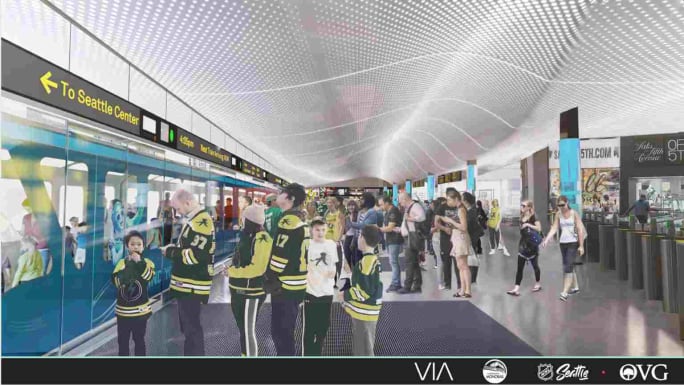
NHL Seattle will make a private capital investment of up to $6 million at the Seattle Monorail's Westlake station to achieve upgrades. SMS/VIA
NHL Seattle, the professional ice hockey expansion team based in Seattle, announced they will offer subsidized public transit for all fans attending hockey games at the team's new arena opening in 2021. Additionally, the team has partnered with Seattle Monorail Services (SMS), operator of the Seattle Monorail, to make capital improvements to the system.
NHL Seattle becomes the first Seattle-based sports franchise and only the third professional sports organization in the U.S. to offer a free public transit benefit for fans. Only the NBA’s Phoenix Suns and the Golden State Warriors have similar programs-and Seattle’s is by far the most ambitious. The only exception will be fans who already receive ORCA card (the regional transit pass card) subsidies from employers.
As part of the partnership with SMS, the current Monorail operator, and NHL Seattle will make a private capital investment of up to $6 million at the Westlake station to achieve upgrades including improved platforms, modernized electronic fare gates (making ORCA card use even easier) and additional elevator access.
These improvements were informed by the Station Configuration Evaluation Report completed by VIA Architecture in 2018. A major recommendation from the study was to increase capacity by decreasing the amount of time it takes to load and unload passengers from each train. Monorail station improvements seek to accomplish the following:
Once the improvements are implemented at Westlake Station, passengers will be able to exit and enter the monorail through all eight doors.
Vertical access to street level, Link Light Rail, and parking will be improved with access to Westlake Center’s retail elevator and escalators during peak ridership periods in addition to the existing elevator and stairwell which already provide direct access to 5th Avenue and the Downtown Transit Tunnel.
At Seattle Center Station, during peak ridership periods, the platform will be able to be reconfigured to allow boarding from both exterior platforms, currently where passengers are used to exiting from, to maximize capacity and keep lines moving quickly.
Operationally, at both stations, SMS is working towards a solution where passengers will be able to tap their ORCA cards or redeem their monorail tickets at automated fare gates; passengers who need to purchase their tickets will be able to do so at ticket kiosks.
SMS/VIA
"The Monorail is generally thought of as a tourist attraction or ride," says Lance Lopes, NHL Seattle executive VP and general counsel. "We plan to re-introduce people to the idea that the Monorail is still what it was designed to be — high-speed transit. It's an existing last-mile high-speed connection from downtown to the arena that any number of sports teams would love to have in their cities."
The NHL team's decision to include free public transit via ORCA with season ticket packages and single-game tickets is anticipated to encourage fans to be part of a better flow to and from games. It's phase one of a three-part plan to be unveiled in coming months.
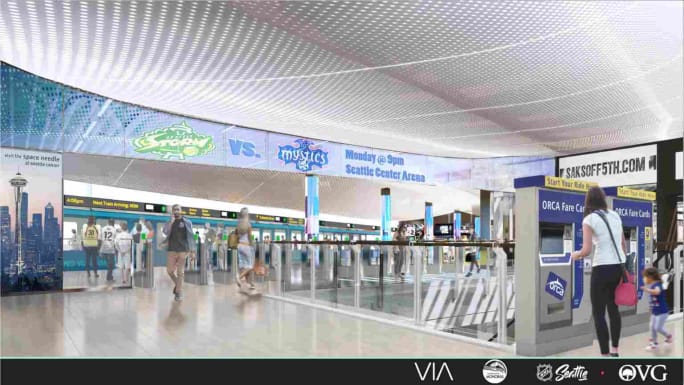
SMS/VIA
"We expect around 25% of fans to use public transit in our first year," said Rob Johnson, vice president of transportation for NHL Seattle who notes total transit boarding in the central Puget Sound region increased by 2.4 million people year over year, the largest increase among the top 50 urbanized areas in the nation. "The use of public transit can become a unique part of the fan experience [including 90-second bursts of fun information] and will likely be the quickest and most reliable way to get to and from our games. It's about a system which will both be efficient and build culture."
Tom Albro, SMS owner, promises that the monorail "will be able to recognize your form of ticket [and bar code] to eliminate waiting in line. He also pledges that both of the landmark monorail trains will be running during games and concerts, speeding up the load on/load off even more. The trains can handle 325 fans per trip, basically every two minutes per direction.
More Management

From Surviving to Thriving: Building Stronger Transportation Organizations
Bus Business Consultants founder Brian Dickson shares lessons on leadership, organizational health, and creating options for long-term success in a changing transportation industry.
Read More →
Everett Transit, Community Transit Outline Consolidation Agreement
The proposed agreement calls for a 50% increase in bus service in Everett, a new microtransit zone, continued paratransit service, and the transfer of Everett Transit operations to Community Transit.
Read More →
Strada360’s Steve Lassey on Turning Transit Data Into Better Decisions
From breaking down data silos to preparing for AI, Strada360 CEO Steve Lassey discusses how transit agencies can use technology to improve operations, customer information, and long-term decision-making.
Read More →
People Movement: Phil Washington Joins HNTB, Denver RTD Launches CEO Search, and More
In this edition, we also spotlight recent personnel moves at STV, the Eno Center for Transportation, and more, highlighting the people taking on new roles across the transportation industry.
Read More →
SEPTA Details Accelerate Vision for Transit System
The plan outlines investments in trolley modernization, new Metro and Regional Rail vehicles, accessible stations, and more frequent bus and rail service.
Read More →
FTA Ends Direct Oversight of MBTA Safety Actions
The federal agency closed its remaining special directive to the Massachusetts Department of Public Utilities following a safety review that began in 2022.
Read More →
Report: Transit Bus Manufacturing Supports 34,100 Jobs, $5.1B in GDP
The “Buses Mean Business” report examines the transit bus manufacturing industry’s economic footprint, supply chain, and rising demand for vehicle replacements.
Read More →
LIT Marks 10-Year Milestone at Annual Summit
Hosted by the COTA from September 10 to 13, the Summit carried the theme “Celebrating 10 Years of Excellence, Leadership, and Impact,” with every part of the program honoring the people, agencies, and partners who built LIT over its first decade.
Read More →
People Movement: Dan Dipert Coaches Adds Third-Generation Leader, Keolis Names New Valley Metro VP/GM, and More
In this edition, we also cover recent appointments and announcements at the Wabtec, SilverRide, HNTB, and more, showcasing the individuals helping to shape the future of transportation.
Read More →
METRO Opens Submissions for 2026 Motorcoach Awards
Nominations are now being accepted for METRO Magazine’s Operator of the Year and Innovative Operator of the Year awards.
Read More →