OCTA Marks 30th Anniversary, Pushes Ahead Toward Future
In addition to working on a transition to zero-emissions vehicles, the agency is also constructing a new streetcar system, testing microtransit, and continuing projects to making traversing the region simpler thanks to funding from its Measure M sales tax.
In addition to working on a transition to zero-emissions vehicles, the agency is also constructing a new streetcar system.
Credit:
OCTA
8 min to read
Orange County Transportation Authority (OCTA) celebrated its 30th anniversary in June by highlighting its dedication and achievements to improving the county’s transit.
Darrell E. Johnson, CEO of OCTA, spoke with METRO about OCTA’s vision coming into a car culture, the 30-year anniversary, and upcoming projects.
Ad Loading...
Celebrating 30 Years
Johnson is aware of the car culture in Orange County, but OCTA involved seven different agencies when it was formed in 1991 that specialized in different areas of transportation.
“There’s no doubt that in the post-war era when Orange County really began to blossom as many suburban communities, the focus was primarily on our freeways and streets and a car culture,” Johnson says. “We recognize that heritage and planned to continue to enhance our freeways and streets to keep up with growth. A full three-quarters of funds from Measure M, this county’s half-cent sales tax for transportation improvements, goes to freeways and streets.”
The population of Orange County was 2.4 million when OCTA was formed. Since then, it has grown by more than 700,000 residents.
The agency is growing along with the population through the addition of its Metrolink commuter rail service and improvements to the OC Bus service and OC ACCESS paratransit services.
OCTA has seen success over the last 30 years. Johnson highlights improving traffic flow on Interstate 5, adding Metrolink commuter rail to the county, and the purchase and operation of 91 Express Lanes.
Ad Loading...
“All this happened under the guidance of our 17-member OCTA board of directors, which includes all five county supervisors and a wide range of elected leaders from across the county, who really understand the regional needs of the county and their individual communities,” Johnson says. “There’s a lot to be proud of, and none of it would be possible without the dedication and hard work of our OCTA employees, including coach operators, maintenance and operations workers, and our professional and administrative staff.”
OCTA continues to communicate with residents and riders through surveys and studies to understand the ways they are traveling. This helps it plan future programs to meet short-term and long-term needs.
“In addition, we are working with cities to provide community circulators and shuttle services to best meet those cities’ individual transit needs,” Johnson says. “OCTA piloted an on-demand microtransit service in two different zones across the county to see how that type of service meets their needs. We’ve learned a lot from the pilot so far and continue to collect valuable information that is helping us plan for the future.”
OC Streetcar
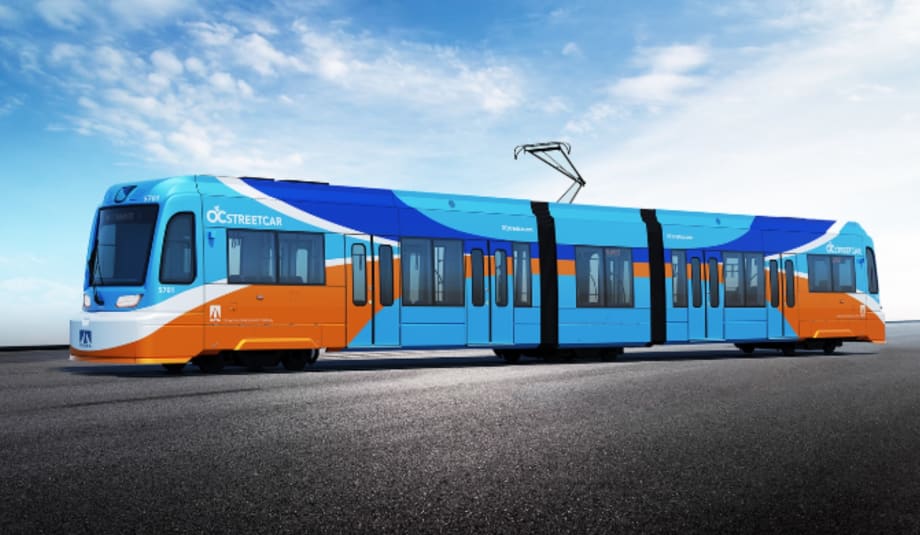
One of the ways OCTA is continuing to progress is with its upcoming streetcar system called OC Streetcar.
“It will be Orange County’s first modern electric streetcar, running along a four-mile route through Santa Ana’s thriving downtown to a new transit stop along Harbor Boulevard in Garden Grove,” Johnson says. “It is a community-based project, with significant input and ideas from residents in the cities it will serve. We continue to engage with residents and business owners every step of the way.”
Ad Loading...
The streetcar fleet will include a total of eight vehicles (six in operation, two reserves). The vehicles make stops at 10 stations. A streetcar will stop at each station every 10 minutes during peak hours and every 15 minutes during non-peak hours.
There have been challenges getting the first rail set into the street. The original launch date was the end of 2020, but Johnson says OCTA is scheduled to begin operations in late 2023.
“We’ve run into some unexpected delays, including some unknown utilities from generations ago and some contaminated soil on the old Pacific-Electric right of way that needed to be removed following all proper safety procedures,” Johnson says. “In addition, culturally sensitive artifacts were discovered along the route, which caused some delay in the construction schedule to appropriately address that.”
The new system will increase transit connectivity by having a streetcar connecting to more than a dozen bus routes. The streetcar vehicles can hold more than 200 people each and it will include bicycle racks.
“We believe that the OC Streetcar option will serve many commuter rail passengers who need the option to reach their ultimate destination, whether that’s work, school or a day of fun and entertainment,” Johnson says. “We think it will provide another important public transportation option for some that are resistant to ride the bus, for instance. And it’s always a good thing when we can introduce even more people to the affordability and convenience of public transportation.”
Ad Loading...
OCTA is working on other projects, which are currently under construction. One is the I-405 Improvement Project. Johnson says this is the largest highway project under construction in California, widening a 16-mile stretch on I-405.
The other project under construction is the I-5 South County Improvement Project. The project will add a regular lane and a carpool lane, along with improvements to local streets and bike lanes, in South Orange County.
In addition to working on a transition to zero-emissions vehicles, the agency is also constructing a new streetcar system
Credit:
OCTA
The road to zero emissions
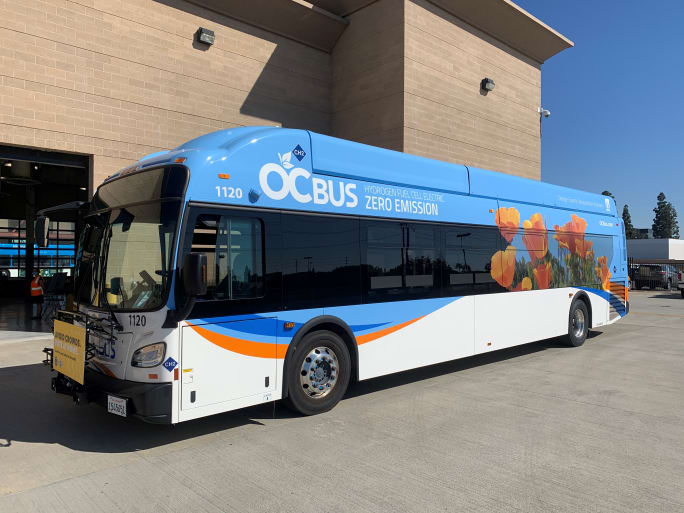
Most of OCTA’s fleet are powered by near-zero emission renewable CNG. Currently, there are more than 500 buses in its fleet and Johnson says the company is pushing towards its goal of OC buses producing no emission at all.
To test technology for Orange County, OCTA launched two pilot programs. One program, launched in January 2020, is to test 10 hydrogen fuel-cell electric buses.
“The pilot programs will help determine which technology — or mix of technologies — will work best for Orange County moving forward,” Johnson says. “The OCTA board approved a contract with New Flyer of America for $10.4 million — with a substantial amount of that coming from grant funding, to begin testing 10 plug-in battery-electric buses. Those buses are expected to go into service later this year.”
Ad Loading...
With the state’s requirement for zero-emission transit within the next 20 years, OCTA approved a zero-emission bus (ZEB) rollout plan in June 2020. According to Johnson, the plan is not a commitment to a specific type of technology since OCTA continues to test emerging technology to determine which ZEBs best meet the company’s needs related to operations, maintenance, and cost.
“Because cost is such a factor, we also are exploring all available funding options. Several of the buses in the pilot program, for instance, are funded by grants through the California Transportation Commission and SB 1, and through the Low Carbon Transit Operations Program (LCTOP) administered by Caltrans,” Johnson says “We’re happy to work toward the goal of zero-emissions because ultimately, it’s good for everybody.”
The importance of OC Go
OCTA has implemented OC Go (Measure M), a 30-year half-cent sales tax for transportation improvements in Orange County through 2041.
Johnson notes the importance of OC Go funds and how those have gone back to the county for street improvements and transportation needs.
“Nearly all freeways in Orange County will benefit from Measure M,” Johnson says. “Major current projects under construction include the I-405 Improvement Project, which is enhancing a 16-mile stretch of the freeway from Costa Mesa to the Orange County border with Los Angeles County, and the I-5 South County Improvement Project, which is making improvements to a busy section of freeway in South Orange County.”
Ad Loading...
Other investments in transit include completing construction and starting service of the OC Streetcar, continuing to fund Metrolink service and improving stations and supporting community shuttles throughout the county.
OC Go also supports two environmental programs, the Environmental Mitigation Program and the Environmental Cleanup Program, which helps improve water quality throughout the county by funding projects to remove litter and debris from roadways and storm drains.
Johnson says OC Go expected to generate $11.6 billion, according to the 2020 update. This is a $1.8 billion decrease from the 2019 forecast due to the impacts of the COVID-19 pandemic.
Recent project milestones funded by OC Go include the completion of the I-5 Central County Improvements Project.
“The project, a partnership between OCTA and Caltrans, was completed last summer. It added a second carpool lane in each direction on the busy stretch of I-5 between SR-55 and SR-57 to help speed up commutes and alleviate bottlenecks through Santa Ana, Orange, and Tustin,” Johnson says. “In addition, the project removed concrete barriers between the carpool and regular lanes in several locations, and restriped the carpool lanes for continuous access, allowing drivers to move freely between all lanes.”
Ad Loading...
COVID-19 pandemic
OCTA saw effects from the COVID-19 pandemic and responded to it by decreasing bus service to Sunday service levels in response to lower ridership and to help protect the health of OCTA employees and the public.
Currently, service is running approximately 70% of what it was prior to the pandemic, with more than 65,000 daily boardings.
“Fortunately, the economy is recovering quicker than anticipated and our sales tax receipts have reflected that as well,” Johnson says. “Early estimates for the Measure M sales tax forecast show that it will likely increase from $11.6 billion to $12.5 billion through 2041. Despite projected revenues being lower than anticipated due to the impacts of COVID-19, OCTA remains committed to fulfilling the promises made to voters through Measure M.”
For operations at OCTA, the company has been gradually returning employees to the workplace, with all employees scheduled to return in September.
“I expect other companies to also give their employees the flexibility to work remotely,” Johnson says. “We will continue to monitor these trends to assess whether there will be long-term changes to ensure that we can continue delivering transportation improvements that best meet the needs of Orange County’s residents, workers, and visitors.”
Ad Loading...
Future programs and services
The future remains bright for OCTA and Johnson says the company continues to plan for the future.
We’ve been expanding our college pass program over the past several years, allowing most community college students throughout Orange County to ride OC Bus for free,” Johnson says. “And we’re expanding on the success of that program with a six-month program to allow passengers ages 18 and under to ride any OCTA bus in Orange County for free.”
The OC Streetcar construction continues, and it plans to provide an additional transit option for those who live, work, or visit the heart of the county.
“Ultimately, how people move and where they go will continue to shift,” Johnson says. “We have to continue providing people with accessible and affordable options, whether they’re relying on public transit, taking short trips on local streets or traveling on freeways throughout Southern California.”
Contract Four is the largest in the Second Avenue Subway Phase 2 project and includes construction of station infrastructure, tracks, and signals for the subway expansion, MTA officials said. Work on Contract Four will begin in 2027.
The new regional transit authority appointed its first board chair and interim executive director while extending reduced fares across CTA, Metra, and Pace for eligible riders.
Reliability-Centered Maintenance helps transit agencies move beyond routine checklists to focus limited resources on the assets and failures that have the greatest impact on safety, reliability, and service.
The 90-day demonstration will deploy coordinated security teams at five light rail stations while testing controlled access and gathering data to guide future investments.
Learn about delivering 1300 gates at 91 stations while managing fare evasion. Explore the large scale deployment, solution customization and real-world results that affect the region. Prepare for deployment in your region now.
Between packed transit stations and team motorcoaches, see how agencies and operators across North America tackled the transportation demands of the 2026 FIFA World Cup.
The stopgap keeps federal transportation programs moving, but missing advance funding could complicate the transit and rail projects agencies are planning next.