




Miss This? California's OCTA Unveils First Siemens S700 Streetcar
California’s OCTA Wave Card Launches with Free Rides and Fare Capping for Riders
Wave users automatically get the best fare and enjoy free rides during the launch promotion. Additional payment options offer flexibility and convenience for all OC bus passengers.
October 14, 2025
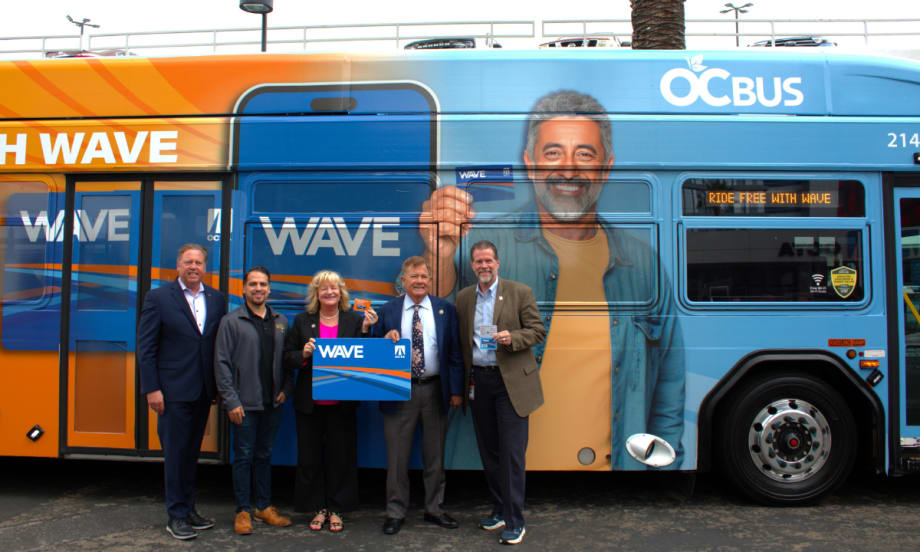
OCTA Board Members and staff get a first look at the Wave card and a bus wrapped with the Wave logo to promote the new program.
Photo: OCTA
3 min to read
The Orange County Transportation Authority (OCTA) is set to launch the new Wave fare payment system on Wednesday, Oct. 15, bringing riders a more flexible way to pay for OC Bus trips.
The new Wave system replaces traditional paper passes with reloadable physical cards and offers payment options through the Wave mobile app, including debit and credit cards. Riders will be able to tap their physical Wave card or virtual card via a mobile device when boarding to pay their fare, making boarding more efficient.
“Wave represents an important step in modernizing our OC Bus system,” said OCTA Chair Doug Chaffee, also Chair of the Orange County Board of Supervisors and Fourth District Supervisor. “Our goal is to make public transit as accessible and convenient as possible.”
New Wave Fare System Simplifies Transit Payments
The Wave system introduces several rider-friendly features designed to make public transit more convenient and provide a more efficient boarding process:
Automatic reloads and online management allow users to add value or set auto-reload options through an online account.
Balance protection means registered riders can easily replace lost or stolen cards without losing funds.
Best-fare guarantee through capping, which ensures riders always get the best price. Riders pay per trip but never more than the cost of a one-day or 30-day pass.
Multiple cards per account: Riders can manage up to eight cards, perfect for families or groups.
An expanded retail network across Orange County makes it easy to purchase and reload Wave cards with cash or credit.
Contactless payments, including debit or credit cards or mobile wallets, are also accepted for added convenience.
More than 500 retail outlets will sell Wave cards — more than five times the number of locations previously. Wave cards are available for a one-time fee of $4 at retail locations, or $2 via the OCTA website at octa.net/wave or by visiting the OCTA headquarters.
Beginning with the Oct. 15 launch, paper day passes will no longer be sold onboard buses. Riders are encouraged to obtain a Wave card or download the Wave app in advance of the launch.
To celebrate the debut of Wave, OCTA is offering:
Free rides from Oct. 15–31 for riders using a Wave card or app.
Automatic entry into a prize drawing to win $100 for those who register their Wave card during the launch period.
Riders who prefer to pay cash may continue to do so on board buses using exact change only. Existing youth and community college pass programs, as well as reduced fares for seniors, will remain unchanged.
Wave Marks a Step Forward in OCTA’s Modernization Efforts
The Wave system is part of OCTA’s broader effort to enhance accessibility, sustainability, and customer service across its transit network. According to an agency release, by simplifying how passengers pay and eliminating the need for paper passes, OCTA is reducing waste, increasing efficiency, and aligning with modern payment technologies used in major transit systems nationwide.
“With Wave, we’re giving riders more control, better value, and a smoother experience,” said OCTA CEO Darrell E. Johnson. “It’s another example of OCTA’s commitment to innovation and the highest level of customer service that keeps Orange County moving.”
More Management

METRO Opens Submissions for 2026 Motorcoach Awards
Nominations are now being accepted for METRO Magazine’s Operator of the Year and Innovative Operator of the Year awards.
Read More →
New York MTA Advances Final Contract for Second Avenue Subway Expansion
Contract Four is the largest in the Second Avenue Subway Phase 2 project and includes construction of station infrastructure, tracks, and signals for the subway expansion, MTA officials said. Work on Contract Four will begin in 2027.
Read More →
Transit Agencies Highlight Safety Gains at National Summit
Leaders from 15 major transit systems shared crime-reduction results and safety initiatives while discussing the role of continued federal support.
Read More →

NITA Names New Leadership, Expands Reduced-Fare Program at First Board Meeting
The new regional transit authority appointed its first board chair and interim executive director while extending reduced fares across CTA, Metra, and Pace for eligible riders.
Read More →
Beyond the Checklist: A Structured Approach to Transit Maintenance
Reliability-Centered Maintenance helps transit agencies move beyond routine checklists to focus limited resources on the assets and failures that have the greatest impact on safety, reliability, and service.
Read More →
APTA 2026 Nominating Committee Selects Leadership Slate, Names Chair and Vice Chair Nominees
Leadership changes will help shape the association’s priorities and its representation of the transportation industry during the 2026–2027 term.
Read More →
DART Launches Major Security, Fare Enforcement Initiative
The 90-day demonstration will deploy coordinated security teams at five light rail stations while testing controlled access and gathering data to guide future investments.
Read More →
Sponsored•September 9, 2026
Advancing Fare Collection Through Technology and Innovation
Learn about delivering 1300 gates at 91 stations while managing fare evasion. Explore the large scale deployment, solution customization and real-world results that affect the region. Prepare for deployment in your region now.
Read More →
Game Day in Motion: Moving Millions During the 2026 World Cup
Between packed transit stations and team motorcoaches, see how agencies and operators across North America tackled the transportation demands of the 2026 FIFA World Cup.
Read More →
Surface Transportation Extension Averts Shutdown, Leaves Transit Funding Gap
The stopgap keeps federal transportation programs moving, but missing advance funding could complicate the transit and rail projects agencies are planning next.
Read More →