



"Transit is for anyone, any purpose, going anywhere you need to go."
Profile: Jeremy Johnson-Miller, Mobility Coordinator, Iowa Department of Transportation
Upon graduation, he accepted a grant-funded position at an agency in Warren County, outside of Des Moines, that helped low-income people find housing. Speaking with his clients, he saw first-hand the connection between transit and housing, healthcare, job, and educational opportunities.
by Laura Lee Huttenbach
June 23, 2017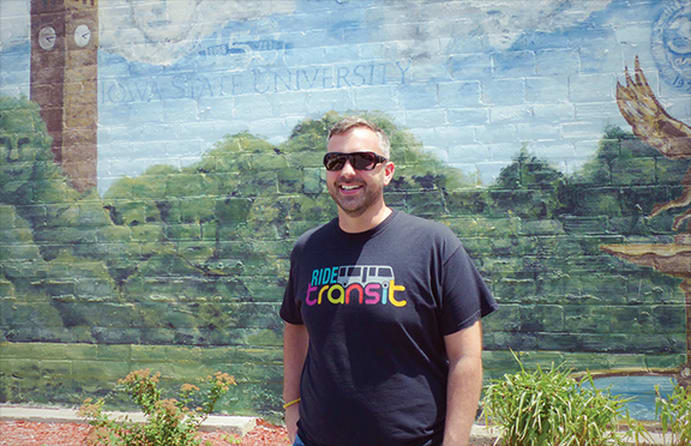
Photo by Laura Lee Huttenbach.
9 min to read
Jeremy Johnson-Miller, Mobility Coordinator at the Iowa Department of Transportation (DOT)
Interview location: At the Iowa DOT and a café in downtown Ames, Iowa
He describes himself with the word, “Passionate."
People Who Move People is a web series profiling individuals who have made an impact in public transit. The series has been initiated and funded by Atlanta-based RouteMatch Software. This article was originally posted on April 26, 2017.
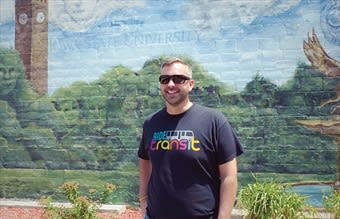
Photo by Laura Lee Huttenbach.
Though Jeremy Johnson-Miller was born in the 1980s, he doesn’t like the title millennial. “I feel like millennials get a bad rap,” he says, noting that they’re often accused of being “entitled, or not hard working. But I’m young. I’m a hard worker, and I’m eager to learn more things.”
I agree with him. “I usually try to avoid any big group generalizations,” I say. “Every person is an individual.”
Jeremy is nodding. “I don’t like labels,” he says. “I think that’s a different way of thinking than a lot of people, and that’s unfortunate.” We are sitting together at a conference room in the Iowa Department of Transportation (DOT) building in the town of Ames, where Jeremy works as the Statewide Mobility Coordinator.
“When you travel outside of Iowa and tell people what you do,” I ask, “What’s the reaction?”
“It’s pretty shocking [to people],” he says. He explains that Iowa is one of the few states that offers public transit options to every single one of its counties. “That’s a rare fact that we can promote,” he says. Thirty-five transit agencies serve Iowa’s 99 counties, and many are in rural areas without the population to operate fixed-route buses. Not only does he have to explain how transit works in Iowa, Jeremy often has to define his job. “If you look up mobility coordinator on Google, you’ll find a hundred different definitions,” he says.
He likes to think of himself as “a social worker for transit.” Basically, he educates residents about transit and promotes transit agencies. For example, he plays the role of “travel trainer,” where he coaches people with disabilities how to ride the bus, an experience that can present a host of challenges — cracks in the sidewalk on the way to the bus stop, using a wheelchair ramp to board the bus, putting fare into the fare box, knowing the route, and pulling the cord for the correct stop. “Some states even have a whole travel training facility, with bus simulators,” says Jeremy, sounding a bit envious. In Iowa, they go straight to the real deal.
Travel training is one of his favorite parts of the job. “I don’t love sitting behind a desk, crunching numbers,” says Jeremy. The bulk of the work of the DOT entails distributing federal money to each of the state’s 35 transit agencies and ensuring that they’re all in compliance with state and federal regulations. But as mobility coordinator, he says, “I can get out and go when I have to.”
Jeremy grew up in Iowa City. The local bus stop was just around the corner from his home, and he became familiar with public transit from a young age. “In the summers, I would ride downtown to meet my aunt for lunch,” he recalls. “Then she would treat us to ice cream or take us to the library. That experience eliminated any fear of being on a bus.” In training people to use transit, he often shares his own experience. “I try to tell people transit can be fun,” he says, conceding that, yes, many people use it to access medical appointments, but that “you can also take it going to meet friends and family for lunch. Transit is for anyone, any purpose, going anywhere you need to go.”
As a geography major at the University of Iowa, Jeremy barely used his car, relying on the public or university transit service to get around town. His favorite extracurricular was the marching band, where he played the clarinet. Upon graduation, he accepted a grant-funded position at an agency in Warren County, outside of Des Moines, that helped low-income people find housing. Speaking with his clients, he saw first-hand the connection between transit and housing, healthcare, job, and educational opportunities. Many people weren’t aware of public transit options and were missing doctor’s appointments when they couldn’t find a ride to the office. “I became curious why this was the case,” says Jeremy, “and what we needed to remedy the situation.”
In his free time, he started attending public meetings on transit and learning as much as he could on his own until one day, he was offered a job as Mobility Coordinator for the Heart of Iowa Regional Transit Agency (HIRTA). I ask if he knew what a mobility coordinator did, and he laughs. “No,” he says. “Nobody knew what it was.” HIRTA had just gotten funding for the position, so Jeremy was the first person to fill it. “Back then, Iowa was ahead of its time on mobility coordination,” says Jeremy. “There was no definition.” This gave Jeremy the enviable task of creating his own job description.
He would go to every fair or gathering in the community and hand out educational materials on public transit. He would park the HIRTA bus in public places and turned it into a donation center for canned goods or school supplies. “It was a valuable service as well as PR,” he says. In several counties, ridership skyrocketed. “Knowing that I contributed to that just by talking to people,” says Jeremy, “it put a fire under me.”

Photo by Laura Lee Huttenbach.
In 2013, his hard work in Iowa earned national recognition when the FTA named him Mobility Manager of the Year for the region of Iowa, Nebraska, Missouri, and Kansas. By having a presence on the national stage, Jeremy got to know transit professionals in other agencies and organizations. “That’s how I met the people at Easter Seals,” he says, referring to the organization that advocates for people with disabilities and has created a new certification course for travel training. (Some employees at Easter Seals, in fact, were the ones to connect me to Jeremy. “He’s such a passionate young man,” Carol Wright, Director of the Transportation Group at Easter Seals, told me. “And a very good travel trainer.”)
For someone who loves his job as much as Jeremy does, it’s easy to assume his professional path was deliberate. But it wasn’t. “I never considered a career in public transit,” he tells me. “Not a lot of people plan to be in public transit. It’s a career that finds you."
At the Community Transportation Association of America (CTAA) Expo in Portland in April 2016, Jeremy heard a quote that still plays on repeat in his head. “I can’t remember who said it,” says Jeremy, “But it was, ‘Transportation isn’t about getting from Point A to Point B. It’s what happens after Point B.’” He inhales deeply. “As transportation providers, we get them from Point A to Point B, but we never think about where they’re going or what their life really is all about. I’ve never been able to explain why I do what I do, but focusing on what happens after Point B is really important to a person’s life.”
By way of example, Jeremy tells me about some work he did in a town 20 miles south of Des Moines. “That particular community didn’t have a lot of options in terms of [healthcare],” recalls Jeremy. “They had the basic family doctor, but they didn’t have a lot of the newer technology that’s needed for certain illnesses. That was one of the biggest issues that stood out for me. They couldn’t even get 20 minutes to the next town over.”
By educating residents on their transit options and making sure there was a service, he saw how individual lives improved. And, as Jeremy reminds me, we can’t forget the ripple effect that impacting one life can have. If a grandmother can maintain her independence and get to where she needs to go in order to stay healthy and happy, her family and friends — the community — will benefit. “You’re serving the whole situation, her whole life,” says Jeremy. “Not just that one trip.”
At noon, Jeremy and I wait at the stop outside the DOT for the big red CyRide bus. We are less than a mile from Iowa State University’s Central Campus, and Cy the Cardinal is the mascot for both the university and the transit agency in Ames. As a proud alumnus of the University of Iowa — Iowa State’s rival — Jeremy isn’t delighted to be supporting Cy the Cardinal.
After we board, I mention that I’m glad the bus has air conditioning. It’s the middle of July, and standing outside in Ames feels like I am preheating in a broiler. “You should visit in the winter,” suggests Jeremy, and tells me that the snow sometimes piles higher than him — at 6-foot-4-inches. When school is in session, he tells me, students pack the buses. But in the summer, Ames turns into a ghost town. He explains that transit agencies operating in a university setting sometimes struggle because, “they’re considered a small urban [system], but they have the ridership of a large urban.” Funding, he says, is determined by regional designation based on population — so you have rural, small urban, or large urban systems. Ames is “kind of stuck in between,” says Jeremy.
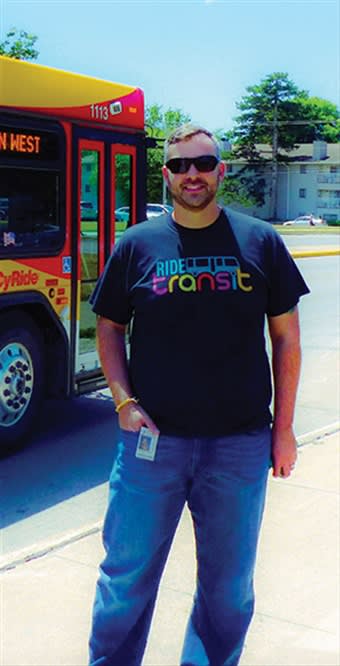
Photo by Laura Lee Huttenbach.
Over lunch and for the rest of our time together, Jeremy uses his platform to sing the praises of bus drivers. Often, he says, driving is only a minor part of the driver’s job. “We’re trying to get funding for our drivers to do a seizure training,” he tells me. When a passenger has a seizure — which is not an uncommon occurrence — not knowing what else to do, the driver will call 911. By the time the ambulance arrives, often the passenger has recovered and doesn’t want to pay for a pricey hospital visit. With training in how to recognize different types of seizures, the driver can make a more informed decision about whether or not to call an ambulance.
“In many cases, our drivers are like first responders,” says Jeremy, adding that in rural areas, they are the link between isolated or elderly people and their loved ones. “If a regular passenger isn’t on the bus, the driver will let the social worker know,” says Jeremy, so a family member can go and check on the person.
It is my first time in Iowa, and in my limited experience, its residents have been the most consistently friendly people of any state I have ever visited. Several people have told me about the “Iowa Wave,” which happens in smaller towns when residents wave to every passing car or pedestrian, and people are so nice to me that I begin to wonder if Iowa revokes residency of unpleasant people. In terms of overall kindness, Jeremy is a fitting representative for both transit and his home state. He loves his current job, he says, because he is able to help agencies across the state do what they don’t have time to do on their own — talk about the good work that they’re doing. “At bigger agencies, they have a budget to hire a social media director,” says Jeremy. “Here in Iowa, a lot of our systems are stretched so thin … they would rather put their funding toward operations than hire a bunch of staff members to do different projects. I think that’s where my job comes in.” It all gets back to what happens after Point B, he says, smiling. “I feel like I’m making a difference.”
More Management

METRO Opens Submissions for 2026 Motorcoach Awards
Nominations are now being accepted for METRO Magazine’s Operator of the Year and Innovative Operator of the Year awards.
Read More →
New York MTA Advances Final Contract for Second Avenue Subway Expansion
Contract Four is the largest in the Second Avenue Subway Phase 2 project and includes construction of station infrastructure, tracks, and signals for the subway expansion, MTA officials said. Work on Contract Four will begin in 2027.
Read More →
Transit Agencies Highlight Safety Gains at National Summit
Leaders from 15 major transit systems shared crime-reduction results and safety initiatives while discussing the role of continued federal support.
Read More →

NITA Names New Leadership, Expands Reduced-Fare Program at First Board Meeting
The new regional transit authority appointed its first board chair and interim executive director while extending reduced fares across CTA, Metra, and Pace for eligible riders.
Read More →
Beyond the Checklist: A Structured Approach to Transit Maintenance
Reliability-Centered Maintenance helps transit agencies move beyond routine checklists to focus limited resources on the assets and failures that have the greatest impact on safety, reliability, and service.
Read More →
APTA 2026 Nominating Committee Selects Leadership Slate, Names Chair and Vice Chair Nominees
Leadership changes will help shape the association’s priorities and its representation of the transportation industry during the 2026–2027 term.
Read More →
DART Launches Major Security, Fare Enforcement Initiative
The 90-day demonstration will deploy coordinated security teams at five light rail stations while testing controlled access and gathering data to guide future investments.
Read More →
Sponsored•September 9, 2026
Advancing Fare Collection Through Technology and Innovation
Learn about delivering 1300 gates at 91 stations while managing fare evasion. Explore the large scale deployment, solution customization and real-world results that affect the region. Prepare for deployment in your region now.
Read More →
Game Day in Motion: Moving Millions During the 2026 World Cup
Between packed transit stations and team motorcoaches, see how agencies and operators across North America tackled the transportation demands of the 2026 FIFA World Cup.
Read More →
Surface Transportation Extension Averts Shutdown, Leaves Transit Funding Gap
The stopgap keeps federal transportation programs moving, but missing advance funding could complicate the transit and rail projects agencies are planning next.
Read More →