



Report Examines NJ TRANSIT Reliability, Funding Challenges
The Garden State Initiative analysis examines the roles of Amtrak infrastructure, fleet management, and agency operations while recommending a more performance-based approach to improving reliability.

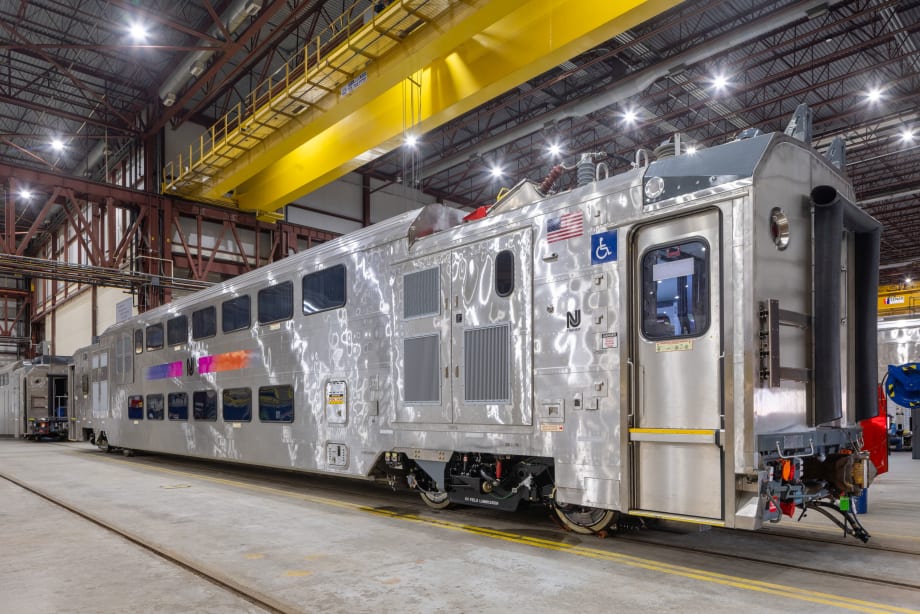
During the study period, NJ Transit's operating budget grew by roughly 20%, and the recently adopted FY2027 budget reaches a record $3.5 billion — 46% higher than in 2020. Yet, mechanical reliability declined significantly over the same period.
Alstom
- The GSI report highlights that, despite increased funding, NJ Transit's operational challenges persist due to internal management issues rather than infrastructure alone.
- NJ Transit has seen a 46% budget increase since 2020, but mechanical reliability has continued to decline, undermining the effectiveness of additional funding.
- The study suggests that public discourse often misattributes service disruptions solely to Amtrak without addressing NJ Transit's internal challenges.
*Summarized by AI
The Garden State Initiative (GSI) released a new report, “NJ Transit: An Economic Analysis of Reliability, Funding, and Reform,” which found that while Amtrak-owned infrastructure contributes to service disruptions, New Jersey’s commuter rail system also faces significant internal operational and fleet management challenges that cannot be solved through additional funding alone.
Authored by GSI Contributor and Seton Hall Associate Professor of Economics Danielle Zanzalari, the report analyzes NJ Transit performance data from 2020 through 2024. It concludes that the agency’s declining mechanical reliability has continued despite substantial increases in operating funding.
During the study period, NJ Transit’s operating budget grew by roughly 20%, and the recently adopted FY2027 budget reaches a record $3.5 billion — 46% higher than in 2020. Yet, mechanical reliability declined significantly over the same period.
“Public discussion often centers on Amtrak, and our research confirms that Amtrak-related disruptions certainly impact on-time performance,” said Zanzalari, author of the report. “But the data also show that NJ Transit faces a separate mechanical reliability challenge that cannot be explained by Amtrak alone. If New Jersey wants a more reliable transit system, policymakers should pair continued infrastructure investment with stronger operational management, better asset planning, and clear performance measures.”
Key Findings of the Report
Using original empirical analysis, the report identifies four major findings:
- Amtrak is part of the problem — but not the entire problem.
- Higher spending has not, by itself, produced more reliable service.
- Reliability depends on how transportation resources are managed, not simply how much is spent.
- New Jersey should adopt a more performance-based approach to transit investment and accountability.
Rather than recommending across-the-board spending increases, the report highlights reforms implemented by transit agencies in Boston, Virginia, and New York that prioritize preventive maintenance, objective performance metrics, and strategic asset management to improve reliability.
“Reliable public transportation is essential to New Jersey’s economy, and commuters deserve a system they can depend on,” said Audrey Lane, president of the Garden State Initiative. “This report demonstrates that improving reliability isn’t simply a question of spending more money. It requires directing investments where they will have the greatest impact, measuring results, and holding the system accountable for delivering dependable service to riders.”
The report concludes that New Jersey should distinguish between infrastructure challenges that require continued coordination with Amtrak and operational issues that fall within NJ Transit’s control. Doing so would let policymakers target investments more effectively while improving accountability for measurable reliability improvements.
The Garden State Initiative
GSI is an independent, nonpartisan 501(c)(3) research and educational organization dedicated to promoting a prosperous New Jersey through sound public policy.
The organization develops data-driven research and practical policy solutions that advance affordability, economic opportunity, and long-term fiscal sustainability for all New Jerseyans.
Quick Answers
The report focuses on the economic analysis of reliability, funding, and reform of NJ Transit, highlighting internal operational and fleet management challenges.
*Summarized by AI
More Rail

Stadler, CapMetro Sign Long-Term Rail Fleet Support Agreement
Beginning in 2027, Stadler will provide on-site technical expertise, spare parts support, training, and obsolescence management to help extend the reliability and longevity of CapMetro’s GTW fleet.
Read More →
Biz Briefs: Alstom Lands Canadian Contract, LYT to Supply California TSP, and More
In METRO's latest installment, we take a look at recent news from Complete Coach Works, Beep, FlixBus, and more partnerships making headlines across the transportation sector.
Read More →
CATS Gold Line Marks 5 Years of Service, 2.8M Passenger Trips
With a six-mile expansion planned, the Charlotte streetcar is positioned to connect more neighborhoods and major transit hubs across the region.
Read More →
Why Simulating Pedestrian Movement Has Become Essential for Modern Rail Stations
Pedestrian microsimulation is helping rail planners identify bottlenecks, test station designs, and prepare complex transit hubs for growing passenger volumes.
Read More →
Amtrak Begins Major Construction at New York’s Sunnyside Yard
The new maintenance facility will support Amtrak’s Airo trainsets while improving maintenance efficiency and turnaround times in New York.
Read More →
Chicago Leaders Unveil Plans for O’Hare Airport Express Train
The privately developed project would offer a 15-minute trip between downtown and O’Hare’s Terminal 2, with trains operating every 15 minutes on a dedicated track. The service would use battery-electric trains and three existing freight rail rights-of-way.
Read More →
OCTA Maps Out 30-Year Strategy to Protect Coastal Rail Corridor
The draft feasibility report identifies strategies to protect the coastal rail line for decades as the agency continues near-term stabilization and sand placement efforts.
Read More →
The Business Voice Behind Public Transportation
As chair of APTA’s Business Members Board of Governors, Ray Melleady explains how more than 850 business members are partnering with transit agencies to advance funding, innovation, and industry-wide collaboration.
Read More →
FRA Announces $5.3B in Rail Investments, Including $2B for Amtrak
Funding will support grade-crossing improvements, infrastructure upgrades, and new Amtrak equipment in 23 states.
Read More →
Finding the ‘Happy Medium’: Optimizing Maintenance Without Sacrificing Reliability
The key to maintenance optimization isn’t doing less work—it’s doing the right work at the right time on the right assets.
Read More →