



San Diego MTS Ridership Continues Growth
The transit agency recorded 81,181,071 boardings during Fiscal Year 2025 (July 2024–June 2025), a 7.1% increase from the 75,663,343 trips taken in Fiscal Year 2024.

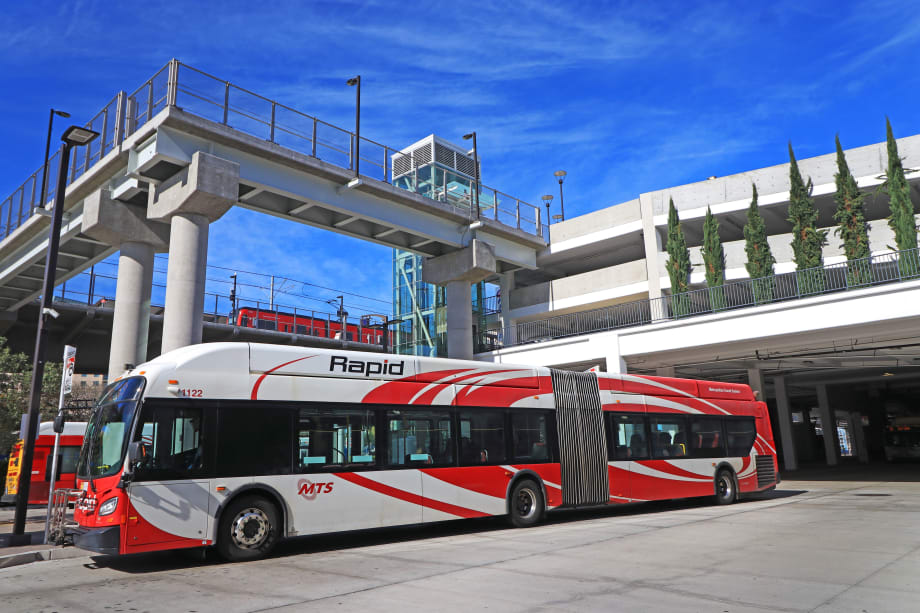
The annual ridership growth marks a significant post-pandemic milestone for MTS, with annual boardings now at 95.1% of the pre-pandemic peak in fiscal year 2019 (85,357,495 trips).
Photo: MTS
The San Diego Metropolitan Transit System (MTS) announced annual ridership surpassed 80 million passenger trips for the first time since the pandemic.
The transit agency recorded 81,181,071 boardings during Fiscal Year 2025 (July 2024–June 2025), a 7.1% increase from the 75,663,343 trips taken in Fiscal Year 2024.
“Surpassing 80 million trips shows that more San Diegans are choosing transit than ever before,” said Stephen Whitburn, MTS board chair. “It’s a testament to the investments we’ve made in reliability, safety, and service quality — and to the dedicated MTS team that works every day to keep our region moving.”
MTS Ridership Bouncing Back
During the pandemic, MTS experienced a steep decline in ridership as hundreds of thousands of San Diegans stayed home.
Since that time, ridership has continued to rebound year after year. This is due in part to the agency’s efforts to attract more riders by expanding its services, increasing Trolley service frequency, and bolstering security. These efforts have resulted in intense customer satisfaction and high community value ratings from riders.
The annual ridership growth marks a significant post-pandemic milestone for MTS, with annual boardings now at 95.1% of the pre-pandemic peak in fiscal year 2019 (85,357,495 trips).
“We’ve recovered more than 95% of our pre-pandemic ridership, which speaks volumes about the trust our riders place in MTS and the value of public transit in San Diego,” said Sharon Cooney, MTS CEO. “This milestone shows just how far we’ve come since the pandemic’s lowest point, and we’ll continue building on that momentum to reach even more riders in the years ahead.”
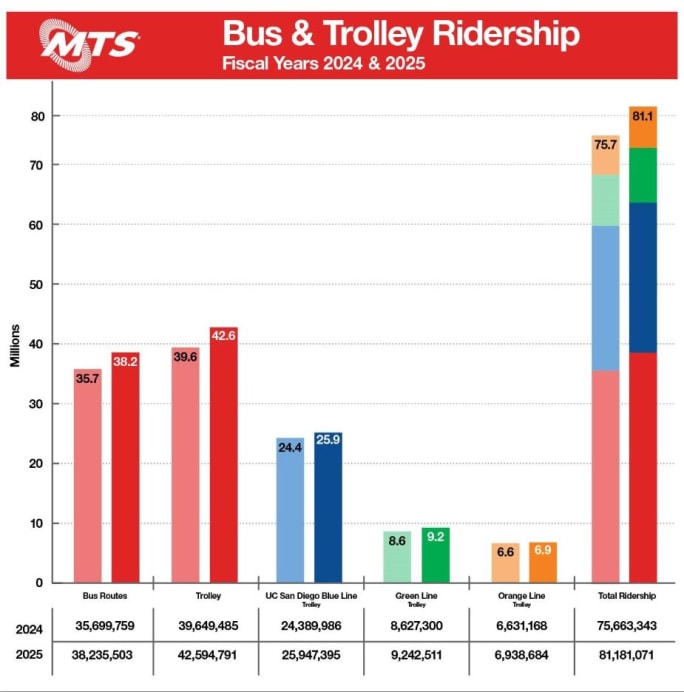
MTS ridership totals for Fiscal Years 2024 and 2025, broken down by bus service and Trolley service. Copper Line and MTS Access [paratransit] totals are not broken down in the chart above but are included in the total ridership column. Copper Line ridership is 464,981, with service starting in September 2024. Paratransit ridership is 314,099 for 2024 and 350,777 for 2025, a 11.7% increase.
Photo: MTS
Ridership Milestones
In October 2024, MTS logged 7,720,681 passenger trips, the highest ridership month in the fiscal year.
During a week in the same month, the agency reported an average of 281,972 passengers per day, the highest week on record since the onset of the pandemic.
Other ridership milestones for MTS include:
Twelve bus routes experienced ridership increases of 15% or higher.
Eleven (11) bus routes surpassed the million-trip mark.
Bus Routes 7 and 13 surpassed 1.9 million boardings. (1,900,135 and 1,900,795 respectively — a 660 boarding difference).
More Management

METRO Opens Submissions for 2026 Motorcoach Awards
Nominations are now being accepted for METRO Magazine’s Operator of the Year and Innovative Operator of the Year awards.
Read More →
New York MTA Advances Final Contract for Second Avenue Subway Expansion
Contract Four is the largest in the Second Avenue Subway Phase 2 project and includes construction of station infrastructure, tracks, and signals for the subway expansion, MTA officials said. Work on Contract Four will begin in 2027.
Read More →
Transit Agencies Highlight Safety Gains at National Summit
Leaders from 15 major transit systems shared crime-reduction results and safety initiatives while discussing the role of continued federal support.
Read More →

NITA Names New Leadership, Expands Reduced-Fare Program at First Board Meeting
The new regional transit authority appointed its first board chair and interim executive director while extending reduced fares across CTA, Metra, and Pace for eligible riders.
Read More →
Beyond the Checklist: A Structured Approach to Transit Maintenance
Reliability-Centered Maintenance helps transit agencies move beyond routine checklists to focus limited resources on the assets and failures that have the greatest impact on safety, reliability, and service.
Read More →
APTA 2026 Nominating Committee Selects Leadership Slate, Names Chair and Vice Chair Nominees
Leadership changes will help shape the association’s priorities and its representation of the transportation industry during the 2026–2027 term.
Read More →
DART Launches Major Security, Fare Enforcement Initiative
The 90-day demonstration will deploy coordinated security teams at five light rail stations while testing controlled access and gathering data to guide future investments.
Read More →
Advancing Fare Collection Through Technology and Innovation
Learn about delivering 1300 gates at 91 stations while managing fare evasion. Explore the large scale deployment, solution customization and real-world results that affect the region. Prepare for deployment in your region now.
Read More →
Game Day in Motion: Moving Millions During the 2026 World Cup
Between packed transit stations and team motorcoaches, see how agencies and operators across North America tackled the transportation demands of the 2026 FIFA World Cup.
Read More →
Surface Transportation Extension Averts Shutdown, Leaves Transit Funding Gap
The stopgap keeps federal transportation programs moving, but missing advance funding could complicate the transit and rail projects agencies are planning next.
Read More →