



Secretary Buttigieg Meets with Transit Employees, Stresses President’s Support
One of President Biden’s first actions to protect the health and safety of Americans was to sign an Executive Order on January 21 promoting safety during the COVID-19 public health emergency in domestic and international travel.
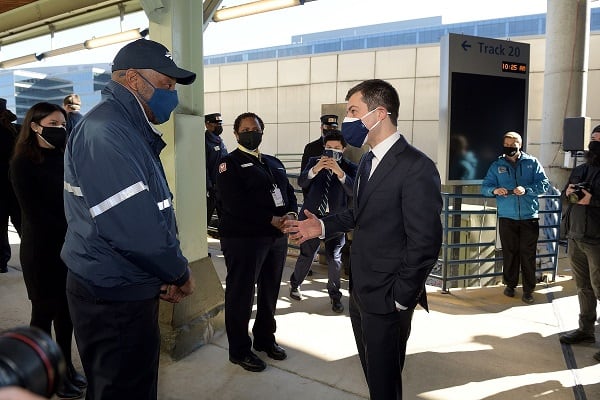
Buttigieg emphasized the health and safety of the American public is the Biden Administration’s number-one priority.
U.S. DOT
U.S. Transportation Secretary Pete Buttigieg met with Amtrak and transit officials as well as front line transit and rail workers at Union Station, where he discussed the importance of the recently announced federal mask requirements for public transportation employees and users to mitigate the risk of COVID-19 and highlighted the Biden Administration’s support for additional COVID-19 relief funding for public transportation.
"We depend on many essential workers for our economy and for our way of life. And while many Americans are wrestling with the complexities of working from home, many other Americans don't have the opportunity, or the option, to work from home, and they are supported by these extraordinary workers who look after the safety, efficiency, and effectiveness of American travel," said Buttigieg. "Above all, I want to say thank you to all of the workers and leadership who have facilitated essential trips, and have delivered essential goods and services during the pandemic, and for their dedication to the safety and prosperity of this country and the traveling public."
Buttigieg emphasized the health and safety of the American public is the Biden Administration’s number-one priority. Mask-wearing, physical distancing, appropriate ventilation, and timely testing can reduce the risk of travelers spreading COVID-19.
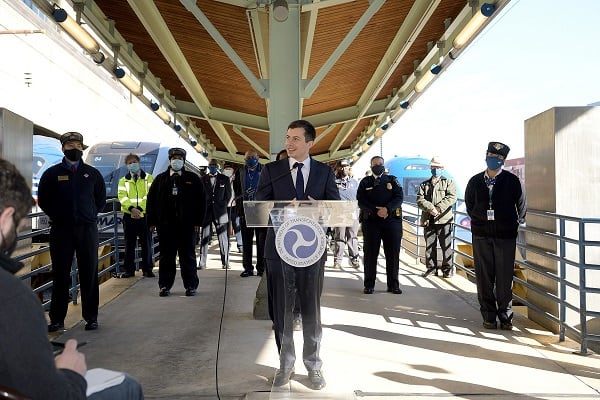
Buttigieg underscored that dependable public transit systems are critical for a robust and equitable economy recovery.
U.S. DOT
One of President Biden’s first actions to protect the health and safety of Americans was to sign an Executive Order on January 21 promoting safety during the COVID-19 public health emergency in domestic and international travel. On January 29, the CDC issued an order requiring masks to be worn throughout the nation’s transportation networks, stating that all transit passengers and workers must wear masks on transit vehicles and in transit facilities. On January 31, the TSA issued a security directive implementing the order, stating that it applies to passenger railroads, intercity bus services, and public transportation. The mask requirement will save lives by helping to control the transmission of COVID-19.
In addition to helping to save lives, the Biden Administration is working to support the nation’s transportation systems that have been hit hard by COVID-19. Buttigieg underscored that dependable public transit systems are critical for a robust and equitable economy recovery. The American Rescue Plan would help keep agencies from having to lay off transit workers and cutting the routes that essential workers rely on every day, while making these transit systems more resilient and ensuring that communities across the country maintain the access to opportunity that public transportation provides.
More Management

METRO Opens Submissions for 2026 Motorcoach Awards
Nominations are now being accepted for METRO Magazine’s Operator of the Year and Innovative Operator of the Year awards.
Read More →
New York MTA Advances Final Contract for Second Avenue Subway Expansion
Contract Four is the largest in the Second Avenue Subway Phase 2 project and includes construction of station infrastructure, tracks, and signals for the subway expansion, MTA officials said. Work on Contract Four will begin in 2027.
Read More →
Transit Agencies Highlight Safety Gains at National Summit
Leaders from 15 major transit systems shared crime-reduction results and safety initiatives while discussing the role of continued federal support.
Read More →

NITA Names New Leadership, Expands Reduced-Fare Program at First Board Meeting
The new regional transit authority appointed its first board chair and interim executive director while extending reduced fares across CTA, Metra, and Pace for eligible riders.
Read More →
Beyond the Checklist: A Structured Approach to Transit Maintenance
Reliability-Centered Maintenance helps transit agencies move beyond routine checklists to focus limited resources on the assets and failures that have the greatest impact on safety, reliability, and service.
Read More →
APTA 2026 Nominating Committee Selects Leadership Slate, Names Chair and Vice Chair Nominees
Leadership changes will help shape the association’s priorities and its representation of the transportation industry during the 2026–2027 term.
Read More →
DART Launches Major Security, Fare Enforcement Initiative
The 90-day demonstration will deploy coordinated security teams at five light rail stations while testing controlled access and gathering data to guide future investments.
Read More →
Advancing Fare Collection Through Technology and Innovation
Learn about delivering 1300 gates at 91 stations while managing fare evasion. Explore the large scale deployment, solution customization and real-world results that affect the region. Prepare for deployment in your region now.
Read More →
Game Day in Motion: Moving Millions During the 2026 World Cup
Between packed transit stations and team motorcoaches, see how agencies and operators across North America tackled the transportation demands of the 2026 FIFA World Cup.
Read More →
Surface Transportation Extension Averts Shutdown, Leaves Transit Funding Gap
The stopgap keeps federal transportation programs moving, but missing advance funding could complicate the transit and rail projects agencies are planning next.
Read More →