



Sound Transit light rail ridership up 26%
The ridership gains within our region are very significant in contrast to recent ridership reductions in many other regions, with Sound Transit services seeing some of the strongest growth in the nation.

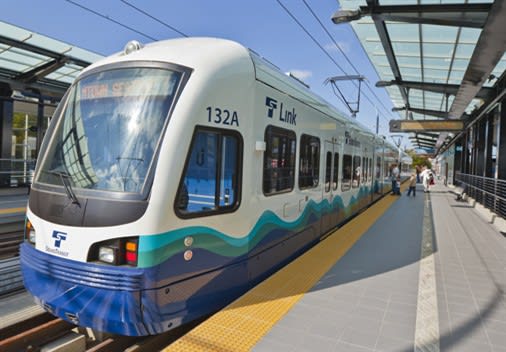
The 26% year-to-date growth includes the fact the agency’s University Link light rail extension did not operate for most of the first quarter of 2016, and the system’s Angle Lake station opened in September 2016.
WSP USA
The 26% year-to-date growth includes the fact the agency’s University Link light rail extension did not operate for most of the first quarter of 2016, and the system’s Angle Lake station opened in September 2016.
WSP USA
Sound Transit’s 2017 ridership continued to show strong growth in the third quarter, with ridership for the year to date up 12% over the first nine months of 2016 and light rail ridership up 26%.
“The more than 26 percent ridership growth we’ve seen on our light rail trains so far in 2017 over last year shows the region’s tremendous demand for congestion-free transit,” said Sound Transit CEO Peter Rogoff. “These gains reinforce the importance of staying on schedule in delivering more than 90 additional miles of voter-approved light rail. To stay on track we will need strong partnerships with the region’s cities, the state legislature and Congress.”
The ridership gains within our region are very significant in contrast to recent ridership reductions in many other regions, with Sound Transit services seeing some of the strongest growth in the nation.
Tacoma Link ridership is up 3% for the year. In the third quarter of 2017, Sounder south line average weekday ridership grew 6.4% over third quarter 2016, with potential for accelerated growth going forward following the September addition of two new round trips in the corridor. Sounder north line average weekday ridership saw a slight dip of 0.2% in the third quarter, while ST Express average weekday ridership remained constant.
Through third quarter of 2017 light rail served approximately 17.5 million riders, and an average of 72,346 each weekday. The 26% year-to-date growth includes the fact the agency’s University Link light rail extension did not operate for most of the first quarter of 2016, and the system’s Angle Lake station opened in September 2016. Looking more narrowly at the third quarters of 2016 and 2017, Link average weekday ridership grew from 67,893 to 76,822, an increase of 13 percent.
Coming extensions — including simultaneous work to expand north, south, east, and west — will dramatically expand access to congestion-free light rail service, with new stations opening every few years. An extension to Seattle’s University District, Roosevelt, and Northgate neighborhoods is on track to open in 2021, followed by an extension to Mercer Island, Bellevue, and Redmond’s Overlake area in 2023. In 2024 the agency is working to open extensions to Federal Way, Shoreline, Mountlake Terrace, Lynnwood, and Downtown Redmond. Thereafter light rail extensions are scheduled to reach Tacoma and West Seattle in 2030; Ballard in 2035; Paine Field and Everett in 2036; and South Kirkland and Issaquah in 2041.
Other coming transit expansions include the 2024 launch of bus rapid transit on I-405 and SR-522 and major expansions to Sounder south line service with the Sound Transit 3 package’s funding for longer platforms and trains, more service and extensions to Joint Base Lewis-McChord and DuPont.
Upcoming regional transit expansions will provide significantly expanded transportation capacity and economic and environmental benefits for residents across the Central Puget Sound as our population keeps growing rapidly and congestion continues to worsen.
More Management

METRO Opens Submissions for 2026 Motorcoach Awards
Nominations are now being accepted for METRO Magazine’s Operator of the Year and Innovative Operator of the Year awards.
Read More →
New York MTA Advances Final Contract for Second Avenue Subway Expansion
Contract Four is the largest in the Second Avenue Subway Phase 2 project and includes construction of station infrastructure, tracks, and signals for the subway expansion, MTA officials said. Work on Contract Four will begin in 2027.
Read More →
Transit Agencies Highlight Safety Gains at National Summit
Leaders from 15 major transit systems shared crime-reduction results and safety initiatives while discussing the role of continued federal support.
Read More →

NITA Names New Leadership, Expands Reduced-Fare Program at First Board Meeting
The new regional transit authority appointed its first board chair and interim executive director while extending reduced fares across CTA, Metra, and Pace for eligible riders.
Read More →
Beyond the Checklist: A Structured Approach to Transit Maintenance
Reliability-Centered Maintenance helps transit agencies move beyond routine checklists to focus limited resources on the assets and failures that have the greatest impact on safety, reliability, and service.
Read More →
APTA 2026 Nominating Committee Selects Leadership Slate, Names Chair and Vice Chair Nominees
Leadership changes will help shape the association’s priorities and its representation of the transportation industry during the 2026–2027 term.
Read More →
DART Launches Major Security, Fare Enforcement Initiative
The 90-day demonstration will deploy coordinated security teams at five light rail stations while testing controlled access and gathering data to guide future investments.
Read More →
Advancing Fare Collection Through Technology and Innovation
Learn about delivering 1300 gates at 91 stations while managing fare evasion. Explore the large scale deployment, solution customization and real-world results that affect the region. Prepare for deployment in your region now.
Read More →
Game Day in Motion: Moving Millions During the 2026 World Cup
Between packed transit stations and team motorcoaches, see how agencies and operators across North America tackled the transportation demands of the 2026 FIFA World Cup.
Read More →
Surface Transportation Extension Averts Shutdown, Leaves Transit Funding Gap
The stopgap keeps federal transportation programs moving, but missing advance funding could complicate the transit and rail projects agencies are planning next.
Read More →