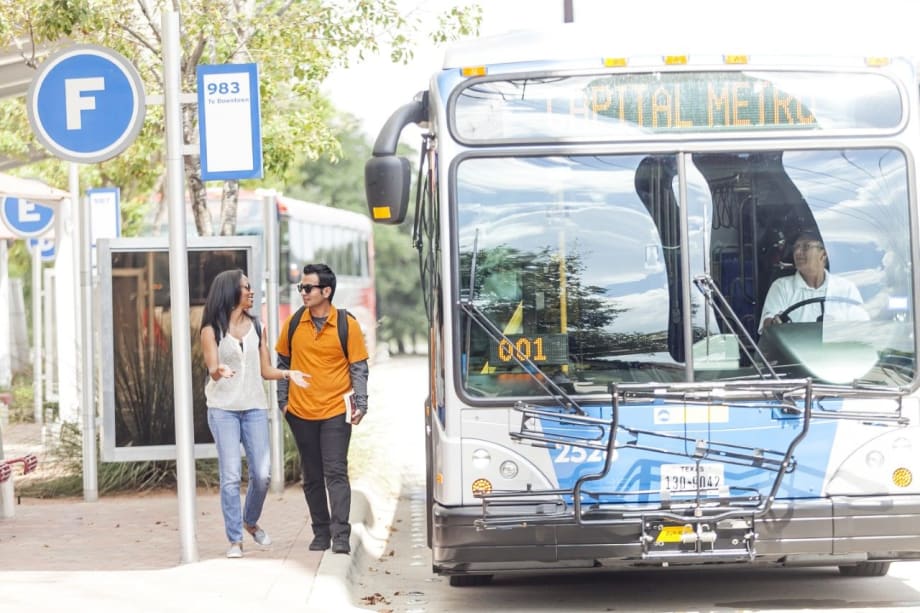
Two propositions to stay with Capital Metro and maintain public transit service in Lago Vista and Manor, Texas, joining a similar victory earlier this year in Leander, Texas, were successful at the ballot box.
Photo: Capital Metro
4 min to read
Voters continued to voice their overwhelming support for public transit by approving 14 out of 19 measures supporting public transit.
The results add to the 15 public transit measures already passed by voters this year, bringing this year’s total to 29 out of 36 wins for public transit, an 80.56% win rate. The number is expected to hold steady as final results come in for the remaining measures, according to APTA’s Center for Transportation Excellence (CFTE).
Ad Loading...
The Nation’s Continued Support
The results add to a string of historic years for transit at the ballot box, with over 85% of measures winning for public transit from 2017 to 2022. At a time when the federal government is more committed than ever to funding transit and infrastructure, voters agree and are stepping forward to help provide a local match.
“Almost one year ago, President Biden signed the historic Infrastructure Investment and Jobs Act to provide state and local communities with long overdue funding for transportation, including public transit. In the year since, communities have met the moment and stepped up with bold visions for their transportation futures and asked voters for local funding to match,” said APTA President & CEO Paul P. Skoutelas. “We’re heartened to see that voters have once again put trust in their communities with overwhelming victories for measures funding public transit across the nation last night and throughout the past year, and we’re excited to see even more communities follow suit in 2023 and 2024.”
Transit’s Most Recent Success
The measures winning at the ballot box represent billions in new funding. Some of the biggest victories for the public transit industry include:
An extension of a half-cent sales tax for 30 years in San Francisco. This measure will allow the local transportation authority to issue up to $1.91 billion in bonds for transportation projects.
A statewide ballot initiative in Massachusetts that would place additional 4% tax on earners over $1 million — in addition to the existing 5% flat-rate state income tax — to generate a total revenue of $1,300,000,000. The revenue can be used for education, roads, bridges, and public transportation.
A $52,630,000 bond to fund a variety of transportation, road, pedestrian enhancement, and transit projects across Arlington County, Va.
Two propositions to stay with Capital Metro and maintain public transit service in Lago Vista and Manor, Texas, joining a similar victory earlier this year in Leander, Texas.
Multiple transportation millage renewals and initiatives in Michigan, including: a levy of 0.478-mill to continue the Bay Area Transit Authority’s bus service in both Grand Traverse & Leelanau County for four years; a six-year renewal of 0.2 of 1-millage for the Huron Transit Corporation in Huron County; a renewal of a 0.95-mill rate to maintain and increase SMART transit services for five years in Macomb County; a 10-year, countywide 0.95-mill rate to fund SMART bus transportation system and expand mass transit in Oakland County; and a four-year 0.996-mill tax for SMART services in Wayne County.
Several countywide sales tax measures in Colorado, such as: an extension of the 0.1% countywide transportation sales tax in Boulder County; a 0.5-cent sales tax increase to fund a new transit authority in Eagle County; and an extension of the Pikes Peak Regional Transportation Authority’s one-cent sales tax for 10 years in El Paso County.
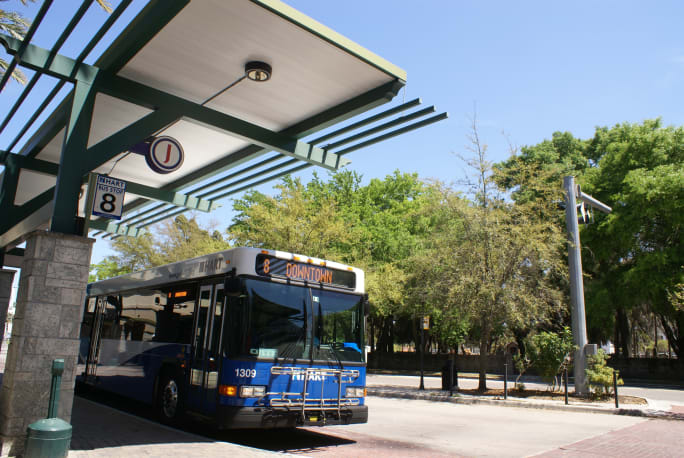
A sales tax measure for transportation in Hillsborough County, Fla. The measure faced legal challenges in the last few weeks, with a judge removing the item from the ballot until the court of appeals issued a stay of that order.
Photo: HART
Not All Measures Succesful
There were also ballot measures that fell short. Those measures include:
Ad Loading...
An early renewal of Fresno County, Calif.’s Measure C sales tax for transportation. The measure needed two-thirds supermajority support to pass and fell short of that mark. The current tax does not expire until 2026 so the County still has time to pursue another renewal without a loss of funding.
An early renewal of Madera County, Calif.’s Measure T sales tax for transportation. The measure needed two-thirds supermajority support to pass, and fell short of that mark. The current tax does not expire until 2026 so the County still has time to pursue another renewal without a loss of funding.
A sales tax measure for transportation in Hillsborough County, Fla. The measure faced legal challenges in the last few weeks, with a judge removing the item from the ballot until the court of appeals issued a stay of that order.
A sales tax measure for transportation in Orange County, Fla.
A sales tax measure for transportation in New Hanover County, N.C.
As of two days after voting day, a sales tax initiative in Sacramento County, Calif., which would raise the county sales tax by one-half of 1% for 40 years and raise $8.5 billion to fund dozens of transportation projects, was still trailing narrowly and had not yet been called.
APTA’s CFTE tracks all of the measures at its website and through its Twitter account.
Contract Four is the largest in the Second Avenue Subway Phase 2 project and includes construction of station infrastructure, tracks, and signals for the subway expansion, MTA officials said. Work on Contract Four will begin in 2027.
The new regional transit authority appointed its first board chair and interim executive director while extending reduced fares across CTA, Metra, and Pace for eligible riders.
Reliability-Centered Maintenance helps transit agencies move beyond routine checklists to focus limited resources on the assets and failures that have the greatest impact on safety, reliability, and service.
The 90-day demonstration will deploy coordinated security teams at five light rail stations while testing controlled access and gathering data to guide future investments.
Learn about delivering 1300 gates at 91 stations while managing fare evasion. Explore the large scale deployment, solution customization and real-world results that affect the region. Prepare for deployment in your region now.
Between packed transit stations and team motorcoaches, see how agencies and operators across North America tackled the transportation demands of the 2026 FIFA World Cup.
The stopgap keeps federal transportation programs moving, but missing advance funding could complicate the transit and rail projects agencies are planning next.