



Transit Ridership Outgrows Driving in Vancouver Region
The agency reported that in 2024, Metro Vancouver recorded 7.7 million more transit trips than in 2023 — a 3% year-over-year increase, outpacing a modest 1% rise in vehicle travel across the region.

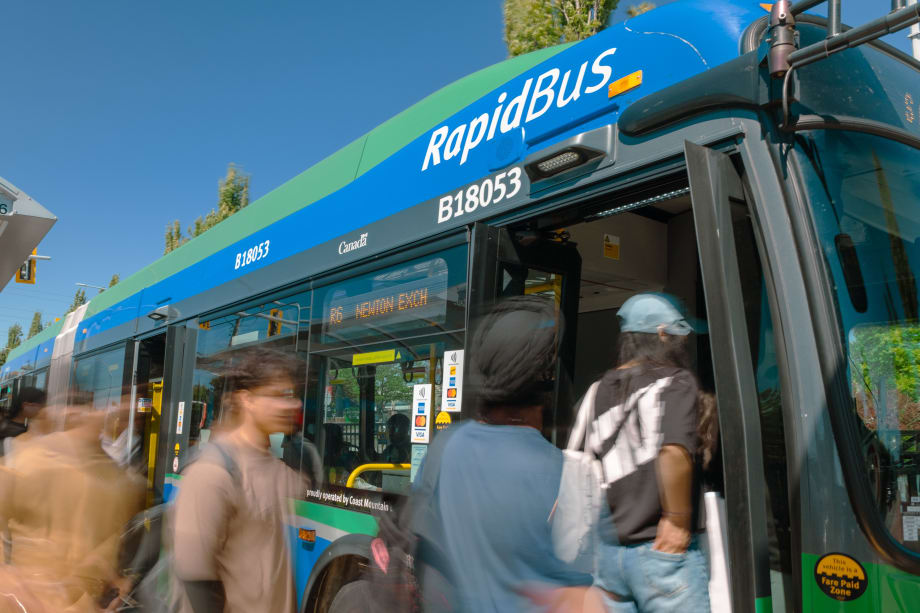
TransLink continues to rank among North America’s top-performing transit agencies. It has the second-highest per capita transit ridership in Canada, ahead of the Greater Toronto and Hamilton Area and second only to Greater Montreal.
Photo: TransLink
New data from TransLink’s 2024 Transit Service Performance Review (TSPR) shows that more Metro Vancouver, Canada, residents opt for transit over driving. This trend reflects growing confidence in the region’s public transportation system.
The agency reported that in 2024, Metro Vancouver recorded 7.7 million more transit trips than in 2023 — a 3% year-over-year increase, outpacing a modest 1% rise in vehicle travel across the region.
“As Metro Vancouver continues to grow, more people are turning to transit instead of driving, which reflects our system’s reliability,” said TransLink CEO Kevin Quinn. “Our 2025 Investment Plan is key to keeping this momentum going and meeting the demand of a growing region.”
The agency said the findings highlight TransLink’s system's resilience and growing appeal.
Driving estimates were calculated using traffic counts from eight major bridges and the George Massey Tunnel, comparing road and transit usage broadly.
A National Leader in Transit Performance
TransLink continues to rank among North America’s top-performing transit agencies. It has the second-highest per capita transit ridership in Canada, ahead of the Greater Toronto and Hamilton Area (GTHA) and second only to Greater Montreal. It also has the third-highest total bus ridership among Canadian and American agencies, despite Metro Vancouver’s relatively smaller population base.
Major events also fueled ridership spikes in 2024.
Notably, Stadium–Chinatown SkyTrain Station saw a 29% increase in ridership, driven by high-profile events at BC Place and Rogers Arena. According to the agency's data, the Taylor Swift concert series alone resulted in record-setting numbers, with a 116% jump in ridership at Stadium–Chinatown and a 64% increase in SeaBus boardings during the same period.
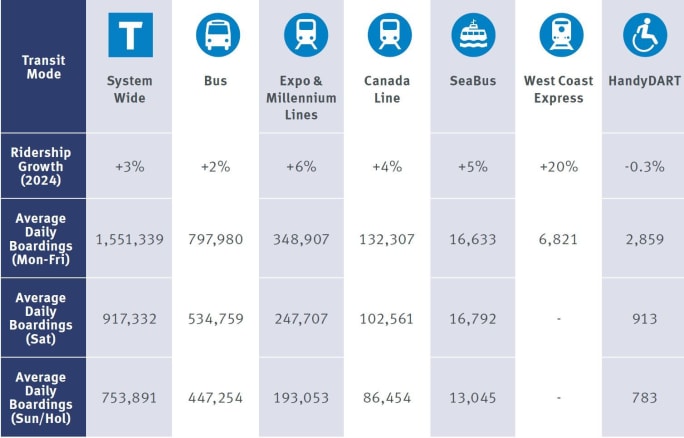
Metro Vancouver ridership by mode.
Photo: TransLink
RapidBus, HandyDart Drive Growth
The RapidBus BRT network was a standout contributor to ridership gains in 2024.
Some highlights include:
Accounting for 15% of all bus boardings despite having just six routes.
Four RapidBus routes ranking among TransLink’s top 10 most used.
The RapidBus system averaged 20,600 daily boardings per route, more than five times the daily boardings of a typical local bus route.
TransLink’s HandyDART paratransit service also demonstrated strong performance and user satisfaction.
Highlights for that service include:
1.17 million trips delivered in 2024.
Customer satisfaction 8.8 out of 10, the second-highest score ever recorded.
99.6% requested trips were fulfilled, with 91% arriving on time.
Primary trip purposes included day programs (36%), medical appointments (16%), and dialysis (14%).
Looking Ahead: 2025 Investment Plan
TransLink’s 2025 Investment Plan, which launches in September, is designed to address service gaps, reduce overcrowding, and expand access in underserved areas.
The plan reflects the agency’s ongoing commitment to providing high-quality, responsive transit service to a rapidly growing population.
As Metro Vancouver's transit network continues to evolve, these numbers underscore a system that is keeping pace with demand and setting a national standard for public mobility, the agency said.
More Management

METRO Opens Submissions for 2026 Motorcoach Awards
Nominations are now being accepted for METRO Magazine’s Operator of the Year and Innovative Operator of the Year awards.
Read More →
New York MTA Advances Final Contract for Second Avenue Subway Expansion
Contract Four is the largest in the Second Avenue Subway Phase 2 project and includes construction of station infrastructure, tracks, and signals for the subway expansion, MTA officials said. Work on Contract Four will begin in 2027.
Read More →
Transit Agencies Highlight Safety Gains at National Summit
Leaders from 15 major transit systems shared crime-reduction results and safety initiatives while discussing the role of continued federal support.
Read More →

NITA Names New Leadership, Expands Reduced-Fare Program at First Board Meeting
The new regional transit authority appointed its first board chair and interim executive director while extending reduced fares across CTA, Metra, and Pace for eligible riders.
Read More →
Beyond the Checklist: A Structured Approach to Transit Maintenance
Reliability-Centered Maintenance helps transit agencies move beyond routine checklists to focus limited resources on the assets and failures that have the greatest impact on safety, reliability, and service.
Read More →
APTA 2026 Nominating Committee Selects Leadership Slate, Names Chair and Vice Chair Nominees
Leadership changes will help shape the association’s priorities and its representation of the transportation industry during the 2026–2027 term.
Read More →
DART Launches Major Security, Fare Enforcement Initiative
The 90-day demonstration will deploy coordinated security teams at five light rail stations while testing controlled access and gathering data to guide future investments.
Read More →
Advancing Fare Collection Through Technology and Innovation
Learn about delivering 1300 gates at 91 stations while managing fare evasion. Explore the large scale deployment, solution customization and real-world results that affect the region. Prepare for deployment in your region now.
Read More →
Game Day in Motion: Moving Millions During the 2026 World Cup
Between packed transit stations and team motorcoaches, see how agencies and operators across North America tackled the transportation demands of the 2026 FIFA World Cup.
Read More →
Surface Transportation Extension Averts Shutdown, Leaves Transit Funding Gap
The stopgap keeps federal transportation programs moving, but missing advance funding could complicate the transit and rail projects agencies are planning next.
Read More →