



TransLink Report Details Pandemic Ridership Trends
According to the agency's 2020 Transit Service Performance Review, annual system-wide boardings were down 52% when compared to 2019.
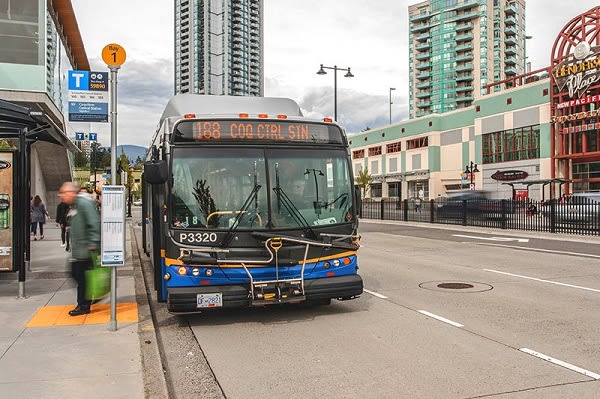
Despite drops in ridership, most of TransLink’s bus ridership (85%) continued to be carried on routes that provide frequent service throughout the day and during peak periods.
TransLink
Canada’s TransLink unveiled its 2020 Transit Service Performance Review (TSPR), detailing the agency’s ridership trends amid the COVID-19 pandemic.
The report focuses on a stable eight-week ridership period between September and November 2020, as more people continued to take public transit despite challenges posed by the pandemic and public health restrictions.
To determine how ridership trends at the regional, sub-regional, modal, and route level measured up to pre-pandemic trends, the report compares early fall 2020 ridership data to that from the same period in 2019. For example, TransLink’s ridership between September to November 2020 was reportedly 41% of ridership volumes during the same period in 2019. Meanwhile, for a year-over-year comparison, the report shows TransLink’s annual system-wide boardings were down 52% in 2020 when compared to 2019.
Despite a major drop in ridership, Gigi Chen-Kuo, Translink’s interim CEO, said emergency relief funding from the federal and provincial governments are ultimately what helped the agency maintain “near-normal service levels, ensuring people had transportation for work and access to essential services.”
“Our ability to provide fast, reliable, and safe service throughout the pandemic has been crucial to B.C.’s recovery, particularly as the economy gradually reopens and more customers return to using transit regularly,” she added.
Here is a closer look at TransLink’s 2020 ridership trends:
Most of TransLink’s bus ridership (85%) continued to be carried on routes that provide frequent service throughout the day and during peak periods. Eight of the top 10 busiest bus routes in 2019 were still among the top 10 routes by boardings.
Ridership on bus routes that serve essential workers remained strong in 2020, including routes that primarily serve industrial areas, such as routes 116, 175, 418, and 640.
Commuter services to Downtown Vancouver and routes that exclusively serve university/college campuses saw significantly lower ridership recovery. The West Coast Express recovered to 17% of 2019 ridership. Bus routes that exclusively serve campus-bound customers recovered to 20% of 2019 volumes.
The Southeast sub-region (Surrey, Langley, North Delta, and White Rock) saw the highest return of bus ridership, with volumes at 55% of 2019 levels — higher than the bus network average of 44%.
HandyDART continued to provide critical access to medical services and other important destinations. While overall HandyDART ridership was down, HandyDART customers made 100% of dialysis appointment trips, 78% of cancer appointment trips, and 57% of general medical appointment trips, when compared to 2019 numbers.
More Bus

More Than a Summer Job: Building the Next Generation of Transit Talent
The Delaware River Port Authority and PATCO have transformed their internship program into a hands-on professional development experience that introduces students to the breadth of transportation careers — and creates a pipeline for future employees.
Read More →
LA Metro Board Awards 220 Battery-Electric Bus Contract to ENC
The contract, which is the largest base award of battery-electric buses by a U.S. transit agency, will be built in Southern California, sustaining good jobs as LA prepares to welcome the world in 2028
Read More →
Public Transit Conference Returning to GFX in 2027, Call for Papers Now Open
The Call for Papers is now open, allowing transit agency professionals and industry experts to help shape the PTC educational program by submitting session ideas for consideration.
Read More →
Indian River Transit’s Community-Focused Approach Earns National Recognition
Named APTA’s 2026 Outstanding Public Transportation System in its size category, Florida’s Indian River County transit system continues to grow ridership through fare-free service and a focus on evolving community needs.
Read More →
ENC Lands MATA Contract and More in Biz Briefs
In this edition of Biz Briefs, we spotlight the latest developments shaping the future of mobility.
Read More →
From Surviving to Thriving: Building Stronger Transportation Organizations
Bus Business Consultants founder Brian Dickson shares lessons on leadership, organizational health, and creating options for long-term success in a changing transportation industry.
Read More →
Everett Transit, Community Transit Outline Consolidation Agreement
The proposed agreement calls for a 50% increase in bus service in Everett, a new microtransit zone, continued paratransit service, and the transfer of Everett Transit operations to Community Transit.
Read More →
SEPTA Details Accelerate Vision for Transit System
The plan outlines investments in trolley modernization, new Metro and Regional Rail vehicles, accessible stations, and more frequent bus and rail service.
Read More →
Report: Transit Bus Manufacturing Supports 34,100 Jobs, $5.1B in GDP
The “Buses Mean Business” report examines the transit bus manufacturing industry’s economic footprint, supply chain, and rising demand for vehicle replacements.
Read More →
Biz Briefs: New Flyer Delivers in Columbus, Houston, Beep and Freebee Merge, and More
In this edition of Biz Briefs, we spotlight the latest developments shaping the future of mobility.
Read More →