



UT Profile: Duluth (Minn.) Transit's U-Pass program a proven success
The program is so successful at University of Minnesota - Duluth, that in 2012 the DTA recognized its five millionth U-Pass passenger.

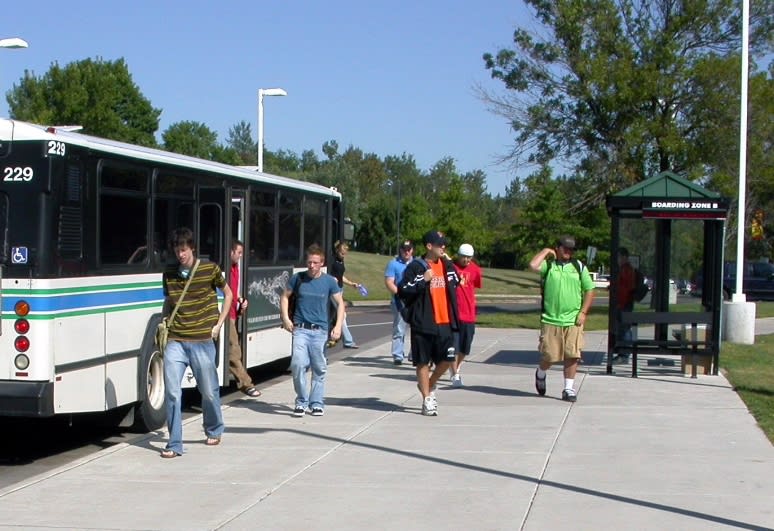
As a college student, your focus should be on studying and figuring out what you want to do with your life. Getting from point A to point B should not be a priority or major concern. However, when you’re in a new town and your family is far away, finding transportation to class, a part-time job or even the grocery store can present a challenge.
The Duluth Transit Authority (DTA) recognized this nearly 13 years ago when it developed the U-Pass Program. Through the program, students at local colleges and universities ride the DTA for Free. It is an added benefit that the universities pay for because they know it helps them and their students.
As more students ride the bus, parking becomes less of an issue and the limited amount of property around campuses can be utilized for expanding academic facilities rather than parking. There is now more than 35% more students on the University of Minnesota – Duluth (UMD) campus than there was in 2000. Even with this increase in student population, they’ve been able to decrease parking by 500 spaces and have no need to build a new parking ramp.
DTA board President John Brostrom was with UMD as the assistant director, program services, when the program began in the fall of 2000. Initially, everyone thought it would take time for the program to gain momentum and acceptance by the students. However, when ridership numbers reached five-year projections in the first year, it was clear it would be a huge success. College student ridership was a mere 4,000 a month before the program began. Now, the DTA transports that amount in less than two days.
“We knew the program would be successful, but we didn't know it'd be this successful,” said Brostrom. “It's been the most effective program UMD has established with an off-campus partner.”
The DTA U-Pass program is successful because it meets a need in the community and provides service to a growing sector of the population. Every fall semester, families from across the region travel to Duluth with their children who are beginning a new chapter in their lives. For many of these young people, it is the first time leaving their hometowns and their first experience using a public transit system.
“Early on we learned that it didn't make any difference if our students were from Burnsville or Baudette — in Baudette there was no mass transit, and in Burnsville, the students drove a family vehicle and most likely never set foot on a transit bus. The great equalizer occurred when they arrived in Duluth to attend UMD and started riding the DTA’s buses,” said Brostrom.
With an enrollment of nearly 11,000 students, UMD is the largest post-secondary school in the DTA’s service area. All of the major colleges and universities in the Twin Ports also participate in the U-Pass program. In fact, the DTA just renewed contracts with the College of St. Scholastica (CSS) and the University of Wisconsin – Superior (UWS). Lake Superior College (LSC) has experienced an increase in enrollment over the past few years and the number of their students using the DTA’s U-Pass Program has also increased significantly. Overall, U-Pass ridership accounts for roughly 17% of the DTA’s total annual ridership.

The DTA's U-Pass program has been so succesful at the University of Minnesota - Duluth that it celebrated its five millionth customer in 2012.
The program is so successful at UMD that in 2012 the DTA recognized its five millionth U-Pass passenger. Just for comparative purposes, total ridership at UMD for the 2007-2008 school year was 420,292 and jumped to 569,361 in 2011-2012. As ridership continues to outpace enrollment, clearly more students are choosing to leave the car at home and ride the bus. These young people are the public transit passengers of the future.
“It was also our hope that students would develop mass transit riding habits that they'd carry with them the rest of their lives — and these habits would have been started at UMD while riding the DTA,” Brostrom said.
LSC has also seen significant increases in ridership. In 2008, ridership was 117,690 and in 2012 it was 184,554, with 2013 on pace to be another banner year. In fact, since last September every month except for January has had record ridership. The DTA is installing a new transit system map along with a new passenger hand schedule rack at the LSC transit hub to accommodate for this increase in demand.
The future of public transit in Duluth is bright. As the DTA’s system grows and evolves, the U-Pass program will be a key component. If student ridership continues to increase at its current pace, the DTA will be recognizing its 10 millionth U-Pass passenger in no time. Currently, the DTA’s total U-Pass ridership numbers are at 6.9 million and should hit seven million in August.
More Bus

New York MTA Plans Largest Bus Fleet Upgrade in More Than a Decade
The agency is seeking manufacturers for 650 new CNG buses to replace aging vehicles, improve reliability, and advance its broader fleet modernization strategy.
Read More →
Building a Flexible Path to Transit Electrification
John Hroncich discusses BAE Systems’ modular and scalable approach, lessons learned from decades of real-world operations, and how agencies can identify electrification strategies that fit their fleets.
Read More →
Bus Tech Talk: Keeping Transit Technicians Ahead of the Technology Curve
LA Metro’s Obed Mejia discusses technician training, evolving maintenance technology, fleet replacement, and strategies for getting the most out of today’s transit fleets.
Read More →
Biz Briefs: RIPTA Unveils New Frontrunners, Clevland RTA Adds New Siemens, and More
In METRO's latest installment, we take a look at recent news from Siemens, Prevost, Dodge, and more partnerships making headlines across the transportation sector.
Read More →
People Movement: Holly Arnold Joins Transdev and More
In this edition, we also cover recent appointments and announcements at Pace, CamTran, MCI, and more, showcasing the individuals helping to shape the future of transportation.
Read More →
The High Cost of Transit Buses: Industry Leaders Look to Procurement Reform
Transit leaders and policymakers examine how standardized bus designs, streamlined procurement, and predictable funding could help agencies stretch budgets and deliver better service.
Read More →
The Business Voice Behind Public Transportation
As chair of APTA’s Business Members Board of Governors, Ray Melleady explains how more than 850 business members are partnering with transit agencies to advance funding, innovation, and industry-wide collaboration.
Read More →
From Surviving to Thriving: Building Stronger Transportation Organizations
Bus Business Consultants founder Brian Dickson shares lessons on leadership, organizational health, and creating options for long-term success in a changing transportation industry.
Read More →
Finding the ‘Happy Medium’: Optimizing Maintenance Without Sacrificing Reliability
The key to maintenance optimization isn’t doing less work—it’s doing the right work at the right time on the right assets.
Read More →
LA Metro, City of West Hollywood, and Partners Advance Smarter Bus Lane Enforcement
The award-winning partnership combines AI-powered detection with human oversight to improve bus reliability, accessibility, and enforcement efficiency.
Read More →