



Washington Looking to Take Los Angeles to the Next Level
METRO Magazine spoke to LA Metro's CEO about some of the changes at Metro, as well as some of the agency’s recently launched projects and his transformative agenda for the notoriously car-friendly county.

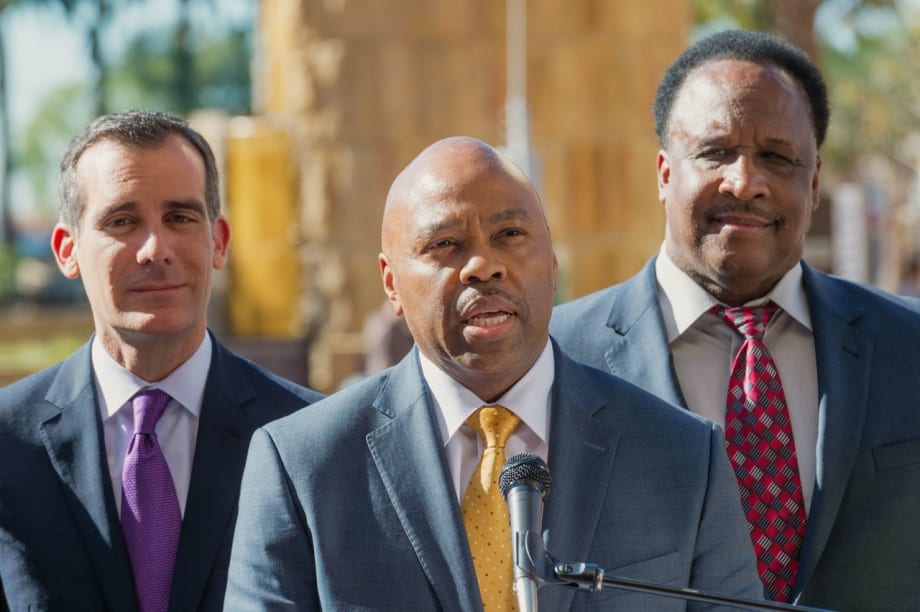
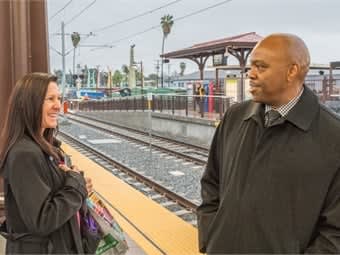
Metro CEO Phil Washington flanked by Los Angeles Mayor Eric Garcetti (on left) and Inglewood Mayor James T. Butts (on right) at a media event in March 2015.
Metro CEO Phil Washington flanked by Los Angeles Mayor Eric Garcetti (on left) and Inglewood Mayor James T. Butts (on right) at a media event in March 2015.
Since taking over as CEO of the Los Angeles County Metropolitan Authority (Metro) in May 2015, Phil Washington has worked hard to transform transportation in the county and make an impact similar to the one he made in Denver with the $2.2 billion Eagle P3 project.
In November, Washington’s $120 billion plan for the future of transportation will go to county voters, who are being asked to increase the countywide sales tax by a half-cent for 40 years and continue the existing Measure R tax for an additional 18 years, meaning both would potentially run through 2057.
The performance benefits of this mass transit blueprint include an increase of 80 million additional transit boardings per year, or 3.2 billion additional riders during the 40-year period. Additionally, if passed, the plan would increase transit mode shares currently at 7% to a projected 20% to 30%, with the major projects estimated to reduce vehicle-miles-traveled by nearly five million daily (regionwide), person-hours-of-delay on the road by 15% and daily-hours-of-truck-delay by 15%, resulting in greenhouse gas reductions of 4%.
METRO Magazine spoke to Washington about some of the changes at Metro, as well as some of the agency’s recently launched projects and his transformative agenda for the notoriously car-friendly county.
What new initiatives did you implement at LA Metro that you had deployed at previous agencies?
One was we created the Office of Extraordinary Innovation. Although we didn’t have that office in Denver, it’s something I wanted to do to see how we can implement innovation here in Los Angeles County. We have also created a Transit Oriented Community (TOC) demonstration program where we are working to identify sites around our stations and work with the community to develop those areas.
We have also started a Leadership Academy, here internally, to prepare our folks to be the next generation of leaders. We have looked internally to make sure that we reward our employees for good safety practices and bringing ideas to the table. We’ve also initiated what I call our Risk Allocation Matrix, or RAM process, where we look within the agency to determine how we can cut costs or increase revenue. That has been very successful. With the 2017 budget, even though we have brought on two new rail lines, we have reduced our operating budget by two percent. So, those RAM savings and revenue-generating ideas have been great across the district. We have actually started several new initiatives, some of which I had in Denver, some I didn’t, but really wanted to start here.
What sort of things are you hoping will come out of the Office of Extraordinary Innovation?
The idea behind the office was to really look around the world and see how we can bring innovation here to L.A. County. The thought was that we needed an entire office dedicated to doing just that, because we talk about innovation in public agencies, but nobody gets around to seeing these ideas through. One of the things I tasked this office to do, early on, was to create an unsolicited proposal policy. That is to say, instead of the private sector just waiting for us to put out an RFP and reacting to that RFP, we want the private sector to come to us with their ideas completely unsolicited. We will then evaluate those proposals and determine whether they make sense to move forward on. That policy has been huge. We have gotten about 40 unsolicited proposals, many of which we are looking to implement. That office has really brought Metro to the forefront, in terms of us being open to ideas from around the world. That is the main thrust of this office. It is also focused on the strategic plan that will help us set the course for the organization for the next 20 to 30 years. So, this office is really busy.
All photos courtesy Steve Hymon/LA Metro
What are some of the innovations that are in the works?
Many of them are technology based. We are working with Uber and Lyft, as well as with technology companies on our fare media. We are receiving quite a few unsolicited proposals to do megaprojects, as well, to accelerate some of our projects we have planned. One of which is the West Santa Ana branch light rail line — a $4 billion project. We are expecting to receive a couple of unsolicited proposals to determine how we can address the Sepulveda Pass as well.
Discuss the Transit Oriented Community approach.
The TOC approach is something we actually applied in Denver, where instead of us just coming into an area and dropping in our stations, we are listening to the community and working with them on what that development should look like. Also, what we are doing within this program is looking at the two-mile radius around our stations to see what value transit brings to that community and how we can leverage it. And, we need to study that. We need to study if we put a station at Crenshaw on the Expo Line, for instance, what happens to that community? Are folks displaced? Do rents go up for small storefront businesses? We need to know what happens, and how we can make the best impact in that community. The demonstration sites we have identified have been well received, and we’re now looking to see how we can develop these areas by partnering with the community.
Talk about the success of the recently opened Expo Line.
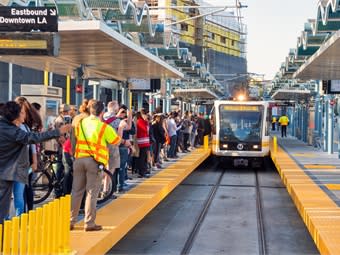
It’s been fantastic. On the first segment of the Expo, ridership estimates were at 30,000 daily. And, on the part we just opened, they were about 34,000 daily. So, 64,000 daily riders is what we expected in 2030. As of July 2016, on the first portion of the Expo Line, we are at 25,000 riders and climbing. And on Expo Two — the part we just opened up — we’re already at 20,000 daily riders. So, we are currently moving 45,000 people every day already, and are looking to reach and exceed our ridership projection for 2030 far sooner than we expected.
Anecdotally, the trains are packed. We are building trains right now. Our manufacturer, Kinkisharyo, is producing four railcars per month, and we’re trying to get them to boost that to five a month. As soon as we test and commission those cars, we are putting them right on the Expo Line, as well as the recently opened Gold Line.
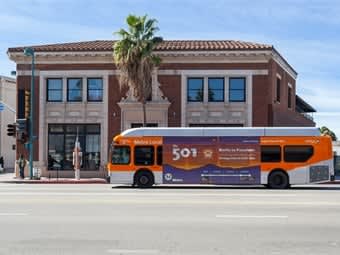
If passed in November, Phil Washington’s $120 billion transportation plan will see 18 megaprojects started or completed in the first 15 years and will include funding to keep LA Metro’s bus system state-of-the-art.
Did the instant popularity of the Expo Line catch Metro off guard at all?
We were really working to make sure that our train manufacturer could get the railcars out, because we knew it was going to be very popular. I can’t say we were totally surprised. Whenever you have a line that goes to the beach, it’s going to be popular. In terms of the days that ridership is up, we are seeing a 50 percent increase on Sundays, which kind of surprised us. What that says is that people are taking their families to the beach and everywhere else that line goes, and trusting us to get them there.
What are some other projects Metro currently has in the works?
We just opened the Gold Line in March, which goes all the way out to Azusa from the former terminus of Sierra Madre, adding six new stations. Ridership has increased on that as well. That’s the line I ride every day, and it’s been fantastic.
We also reached the halfway point for the Crenshaw Line that runs down Crenshaw into the city of Inglewood. Construction is moving along very nicely there. We have a tunnel-boring machine that is drilling about 75 feet per day that is set to break through to the other end in Leimert Park around October. Once that’s completed, we’ll start the second tunnel.
The Regional Connector project in downtown is about 15 to 20 percent into construction and is going well. That particular line will allow for a one-seat ride all the way from Azusa to Long Beach, so that is a real game changer. We are also in the early construction phase of the first section of the Purple Line, which is about three miles. We have a solicitation on the street for section two, which is a two-and-a-half mile stretch. And then, as sort of a change-order for the Crenshaw Line, we’re building the airport station and that project will be moving along pretty quickly.
Talk about your $120 billion plan and what you hope to accomplish.
We unveiled that plan [in March] and believe it will transform this entire region. It’s the most aggressive, most comprehensive transportation plan in this country right now. We have 35 percent of the expected revenue over 40 years going to transit projects, 17 percent going to highway, and we have laid out both the highway and transit projects. Eighteen megaprojects will be completed or started in the first 15 years, and 40 projects will be started or completed in the first 40 years. These projects are all across the county and include finishing up the Purple Line, finishing up the connection to the airport, other projects in the southeast and the Sepulveda Pass, as well as several highway projects.
We believe that this plan will change the face of the county. We just had a report from the L.A. Economic Development Corporation that found that the plan will create 465,000 jobs in the first 40 years. We are at a fork in the road when we talk about transportation infrastructure investment. My hope is that this county will take the right turn at that fork in the road and approve this measure.
The unique thing about this plan was that we used a bottoms-up approach. We went out to all nine subdivisions and asked each one of them to identify and prioritize their own projects. We then evaluated those projects using board-approved criteria. It’s really a plan from the people, for the people.
Everybody talks about the projects, and they are important, but in the plan we also have funding carved out for state of good repair. We don’t want to end up like the legacy systems, especially in the northeast. So, we have funding carved out and dedicated to take care of what we built. We have funding set aside to keep fares affordable for seniors and students. We also have funding for active transportation, such as bike systems and bike trails, and for our bus system to make sure it stays state-of-the-art. So this plan is very comprehensive. And, by the way, we also carved out money to give back to the cities, which is something called local return. So of the $120 billion that will be generated in the first 40 years, over $20 billion of that will go back to the cities, so they can fix and maintain sidewalks, fill their potholes and all of that.
What is your biggest challenge leading up to the November vote?
The biggest challenge is educating people. You have to explain to people that you simply can’t build all the projects in the first five years. The other items in the plan start immediately, like the local return back to cities, which is millions of dollars that they will receive based on population and employment. The biggest challenge is keeping everybody convinced that their projects will come to fruition and that they’ll get something out of this plan.
Unfortunately, in this country nobody cares or thinks about leaving what I call an infrastructure inheritance for our children. We have a ‘right now’ society, and it wasn’t always like that in this country. When the interstate highway system was started, Eisenhower knew it would take 40 years, but he wanted to start it. When you’re talking about building infrastructure, it may take longer than one elected official’s four-year term in office. People have to understand that part of this proposal is that we’re building now and getting the benefits now with these projects that are opening up. But, there has to be some recognition that we’re building for the next 100 years as well.
More Management
People Movement: Dan Dipert Coaches Adds Third-Generation Leader, Keolis Names New Valley Metro VP/GM, and More
In this edition, we also cover recent appointments and announcements at the Wabtec, SilverRide, HNTB, and more, showcasing the individuals helping to shape the future of transportation.
Read More →
METRO Opens Submissions for 2026 Motorcoach Awards
Nominations are now being accepted for METRO Magazine’s Operator of the Year and Innovative Operator of the Year awards.
Read More →
New York MTA Advances Final Contract for Second Avenue Subway Expansion
Contract Four is the largest in the Second Avenue Subway Phase 2 project and includes construction of station infrastructure, tracks, and signals for the subway expansion, MTA officials said. Work on Contract Four will begin in 2027.
Read More →

Transit Agencies Highlight Safety Gains at National Summit
Leaders from 15 major transit systems shared crime-reduction results and safety initiatives while discussing the role of continued federal support.
Read More →
NITA Names New Leadership, Expands Reduced-Fare Program at First Board Meeting
The new regional transit authority appointed its first board chair and interim executive director while extending reduced fares across CTA, Metra, and Pace for eligible riders.
Read More →
Beyond the Checklist: A Structured Approach to Transit Maintenance
Reliability-Centered Maintenance helps transit agencies move beyond routine checklists to focus limited resources on the assets and failures that have the greatest impact on safety, reliability, and service.
Read More →
APTA 2026 Nominating Committee Selects Leadership Slate, Names Chair and Vice Chair Nominees
Leadership changes will help shape the association’s priorities and its representation of the transportation industry during the 2026–2027 term.
Read More →
DART Launches Major Security, Fare Enforcement Initiative
The 90-day demonstration will deploy coordinated security teams at five light rail stations while testing controlled access and gathering data to guide future investments.
Read More →
Advancing Fare Collection Through Technology and Innovation
Learn about delivering 1300 gates at 91 stations while managing fare evasion. Explore the large scale deployment, solution customization and real-world results that affect the region. Prepare for deployment in your region now.
Read More →
Game Day in Motion: Moving Millions During the 2026 World Cup
Between packed transit stations and team motorcoaches, see how agencies and operators across North America tackled the transportation demands of the 2026 FIFA World Cup.
Read More →