



Web Extra: Riding the train or a bike, part of the fun is getting there
Phoenix-based Valley Metro’s Susan Tierney, public information officer, gives an account of how alternatives to the car are becoming more and more accepted by residents and visitors, many of whom took the train and biked to a big baseball game on Earth Day.

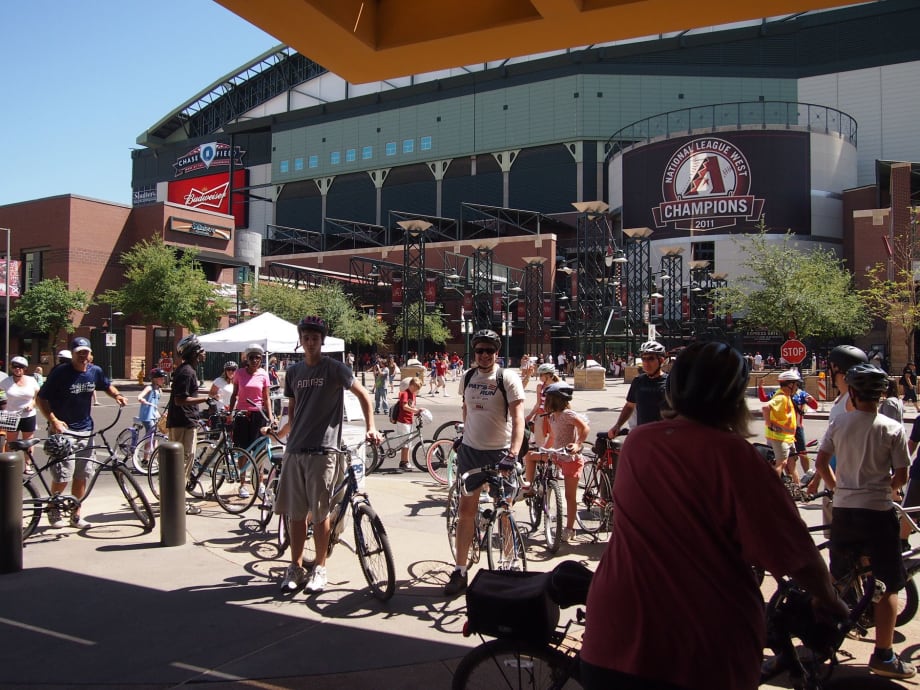
Great Bike Chase riders arrive for events at ballpark on Earth Day.
The excitement builds as passengers walk toward the Valley Metro (Metro) station at the Sycamore Transit Center in Mesa, Ariz., anticipating the 40-minute ride to Chase Field for an Arizona Diamondbacks game against the Atlanta Braves on Sunday, April 22. Passengers from all walks of life join in the camaraderie. They offer tips about which station is closest to their destination and where to board for the return trip home. Coming from all areas of the metropolitan Phoenix area, and even the U.S., most of them join in the common denominator of riding light rail to go to a Major League Baseball game.
Opting to ride light rail on game days is becoming as traditional and American as hot dogs and apple pie. Since the system opening on December 27, 2008, Metro experienced its highest ridership day with the D-backs home opener on April 6, 2012 serving more than 62,000 passengers. Daily boardings in March averaged 43,800, which surpassed system expectations of averaging 26,000 daily passengers.
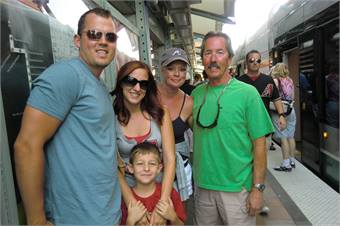
Shown from left: Kyle Wagg, Tonya Pagaro with son Jayden, Ruth Wagg and Vince Wagg.
Residents and visitors alike are impressed with the system and the ease of travel. Braves’ fans, Vince and Ruth Wagg and their son Kyle, from Anchorage, Alaska, were visiting Kyle’s girlfriend, Tanya Pagero and her son Jayden, who live in Gilbert, Ariz. Their initial outing on Metro was for game two of the four-game series between the D-backs and the Braves. On Sunday, they boarded the train again to see a second game.
“We lived along the light rail line in Seattle and went to the Mariners’ games at SAFECO Field,” said Vince Wagg. “Riding METRO has been a good experience and it’s easy.” According to Kyle and Tanya, they like how convenient it is to get to the station and that they avoid the cost of driving to downtown and parking.
“It’s been a good experience, even though it’s crowded after the game,” said Kyle. “We plan to ride Metro to other sporting events, go to Mill Avenue in Tempe, and see the sites. It’s a lot less hassle.”
Game day passengers board at stations all along the 20-mile system traveling from the east and west areas of the 20-mile system to the Metro stop downtown located nearest the ballpark. There are thousands of game day passengers who cross the downtown station platform nearest the ballpark to attend D-backs and Phoenix Suns games, as well as concerts and a variety of other downtown events.
“When transit becomes more desirable than driving to a local sporting venue or social event, we know we’ve accomplished our objectives,” said Steve Banta, Valley Metro CEO.
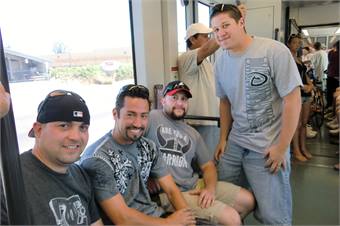
Shown from left: Tony Rand, Gregory Solano, Anthony Martinez and Nicholas Garcia.
Taking the train to the game was easier and more convenient than driving, claimed Tony Rand from Queen Creek, Ariz. He and three of his friends boarded Metro at Sycamore station after making the drive from San Tan Valley in the southeast area of metropolitan Phoenix.
“It’s the guys’ day out today,” said Tony. “We are going to enjoy the game and take it easy as we ride to and from downtown in the air conditioning.” Claiming to be Braves and Angels fans, the group of four in their mid-twenties weren’t too concerned about the outcome of the game, just their first stop after getting off the train. They were headed to a neighborhood sports bar to grab a cold beer.
Despite it being a day of record-setting heat in April at 105 degrees, the light rail cars were cool and comfortable as the train stopped to pick up additional passengers at the stations heading west towards downtown. Upon de-boarding the trains, passengers were met at the station by local city ambassadors that helped riders navigate their way safely to Chase Field.
Great Bike Chase riders arrive for events at ballpark on Earth Day.
While some riders traveled by trains to get to the game, others took to the streets on bicycles as they joined in Valley Metro’s Great Bike Chase as a way to celebrate Earth Day.
The annual event, themed “One Less Car,” encouraged local residents to try bicycling to a D-backs game as a way to reduce traffic congestion and improve air quality. Free bike valet parking was available to all riders, as well as a bike safety rodeo and stations offering free t-shirts, face painting, safety information and ice cold water.
More than 300 riders pledged to ride to Chase Field and many stayed to watch the game and cycle their way home afterward. A portion of the Great Bike Chase ticket sales helps to support additional bicycle racks at downtown Phoenix businesses, and in a separate initiative, the city is encouraging the mode by adding more bicycle lanes to downtown city streets.
In the metro Phoenix area, where the car has traditionally been considered the first option for travel, alternatives are being accepted and utilized. Seeking out new ways to explore the region, locals and visitors alike are now finding that on transit as well as other alternative modes…half the fun is getting there.
More Rail

Stadler, CapMetro Sign Long-Term Rail Fleet Support Agreement
Beginning in 2027, Stadler will provide on-site technical expertise, spare parts support, training, and obsolescence management to help extend the reliability and longevity of CapMetro’s GTW fleet.
Read More →
Biz Briefs: Alstom Lands Canadian Contract, LYT to Supply California TSP, and More
In METRO's latest installment, we take a look at recent news from Complete Coach Works, Beep, FlixBus, and more partnerships making headlines across the transportation sector.
Read More →
CATS Gold Line Marks 5 Years of Service, 2.8M Passenger Trips
With a six-mile expansion planned, the Charlotte streetcar is positioned to connect more neighborhoods and major transit hubs across the region.
Read More →
Why Simulating Pedestrian Movement Has Become Essential for Modern Rail Stations
Pedestrian microsimulation is helping rail planners identify bottlenecks, test station designs, and prepare complex transit hubs for growing passenger volumes.
Read More →
Amtrak Begins Major Construction at New York’s Sunnyside Yard
The new maintenance facility will support Amtrak’s Airo trainsets while improving maintenance efficiency and turnaround times in New York.
Read More →
Chicago Leaders Unveil Plans for O’Hare Airport Express Train
The privately developed project would offer a 15-minute trip between downtown and O’Hare’s Terminal 2, with trains operating every 15 minutes on a dedicated track. The service would use battery-electric trains and three existing freight rail rights-of-way.
Read More →
OCTA Maps Out 30-Year Strategy to Protect Coastal Rail Corridor
The draft feasibility report identifies strategies to protect the coastal rail line for decades as the agency continues near-term stabilization and sand placement efforts.
Read More →
The Business Voice Behind Public Transportation
As chair of APTA’s Business Members Board of Governors, Ray Melleady explains how more than 850 business members are partnering with transit agencies to advance funding, innovation, and industry-wide collaboration.
Read More →
FRA Announces $5.3B in Rail Investments, Including $2B for Amtrak
Funding will support grade-crossing improvements, infrastructure upgrades, and new Amtrak equipment in 23 states.
Read More →
Finding the ‘Happy Medium’: Optimizing Maintenance Without Sacrificing Reliability
The key to maintenance optimization isn’t doing less work—it’s doing the right work at the right time on the right assets.
Read More →