



Calif.'s MST Wraps its First Five-Year Plan with the Monterey Jazz Festival
In celebration of the festival's recent 60th Anniversary, MST revamped the exhibits to showcase a new generation of performers from the most recent festivals.
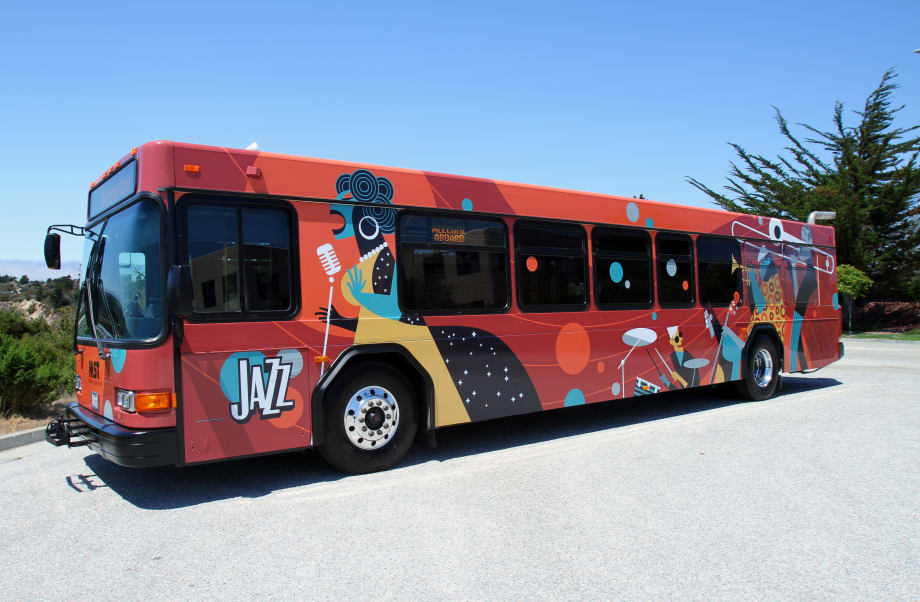
As a partner, MJF also granted permission for Phil Wellman, Wellman Advertising & Design, Carmel, Calif., to extend the distinctive branding to the JAZZ buses and shelters to echo the vibrancy of the Festival.
Photo: Craig Lovell
In 2007, Monterey-Salinas Transit (MST) had qualified for a Very Small Starts grant from the Federal Transit Administration (FTA) and was moving forward on the final planning and design of the Fremont-Lighthouse Bus Rapid Transit (BRT) Line. With its scheduled debut five years away, the new system would serve Monterey, Seaside, and Sand City and link all major visitor and shopping destinations.
Had the name remained Bay Rapid Transit as originally proposed, riders would appreciate the speedier service through the Monterey Valley all the same — but no way would it inspire and reflect of the spirit and cultural significance of these vibrant Northern California communities.
As creative people always say, the most inspiring idea springs up as an elegant solution grown from the least suspecting AHA! moment.
Case in point: on a September afternoon early in the planning, MST executives, GM/CEO Carl Sedoryk, and Assistant GM Hunter Havarth, were in the audience for the Monterey Jazz Festival, nursing their favorite beverages as they waited for the music and marveling at the always compelling graphic design that has marked this event for more than 60 years. Without saying much, they looked at one another and wondered, “Why not just call our system JAZZ?”
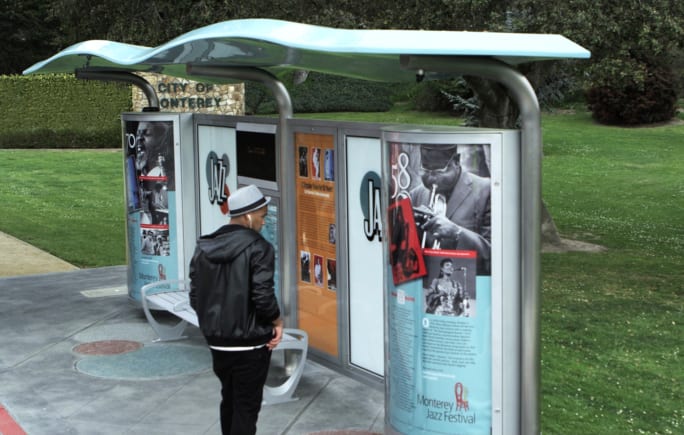
Their joint-mission was to connect the two organizations through mutual branding and shared graphics on the seven new JAZZ BRT buses and 24 stops along the 9.5-mile route.
Photo:Craig Lovell
MST's JAZZ BRT
With a mutual nod of agreement, their long-time BRT project had just gained a soul and its partner for life. The legendary Monterey Jazz Festival (MJF), the longest continuously running event of its kind, would provide the inspiration truly great works require.
While MST has always worked closely with MJF over the years to accommodate its transportation needs, the suggestion to partner with the festival and deepen their relationship was especially inviting for both organizations.
“Our new thinking was to have no fear in reaching out to those in our community who might enjoy and benefit greatly from an association with our transit project,” says Havarth. “This was our one big chance to go beyond public transportation and communicate precisely what our community has to offer.”
Their joint-mission was to connect the two organizations through mutual branding and shared graphics on the seven new JAZZ BRT buses and 24 stops along the 9.5-mile route.
MJF opened its archives of historic artwork, photographs, and classic recordings, which MST assembled as a linear presentation of museum quality on specially-designed kiosks at each of the JAZZ bus shelters that traced the history and lasting significance of the Monterey Jazz Festival.
As a partner, MJF also granted permission for Phil Wellman, Wellman Advertising & Design, Carmel, Calif., to extend the distinctive branding to the JAZZ buses and shelters to echo the vibrancy of the Festival.
“This partnership and the MST Jazz Bus line is the project of a lifetime,” he says. “I worked very closely with MST to develop the concept of bus shelters as a linear museum. As a graphic designer, my biggest thrill was working with Pablo Lobato, the brilliant illustrator from Argentina, to create the highly-energized imagery on the JAZZ buses.”
The initial presentations focused on the first 30 years through images that remembered legendary jazz musicians, including Miles Davis, Ella Fitzgerald, Dizzy Gillespie, Dave Brubeck, and Herbie Hancock; as well as singers and musicians normally not associated with jazz, but who had performed at the festival — artists such Janis Joplin, Jefferson Airplane, and Richie Havens.

In celebration of the festival’s recent 60th Anniversary, MST revamped the exhibits to showcase a new generation of performers from the most recent festivals. Pictured performing is Monsieur Perine.
Photo:Craig Lovell
60 Years of Jazz
In celebration of the festival’s recent 60th Anniversary, MST revamped the exhibits to showcase a new generation of performers from the most recent festivals, which featured Diana Krall, Terence Blanchard, Joshua Redman, and Esperanza Spalding.
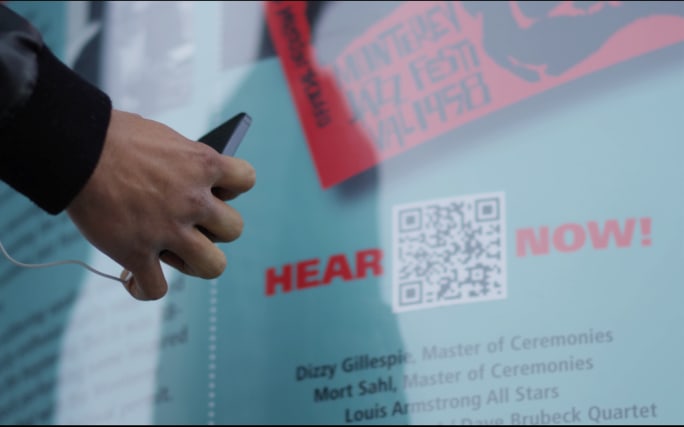
“The JAZZ buses and shelters have become settings for riders to learn about jazz and listen to classic performances available through their smartphones using any QR Code reader,” says Sedoryk. “We will continue to depict the festival’s most current aspects by showcasing contemporary artists, such as Trombone Shorty and pertinent up-and-coming jazz artists.”
Nonetheless, in the early going, incorporating the immensely-popular Monterey Jazz Festival into a community transit experience was an unusual concept for many.
”Because this was far beyond the normal scope, we had to go out and sell it,” he says. “We spent many days and long evenings stumping for JAZZ BRT at community meetings and local events, such as farmers markets and street fairs.”
As the communities caught on and bought in, the work began and JAZZ BRT buses rolled in 2013.
Monterey Jazz Festival Executive Director, Colleen Bailey, says in the first five years, MJF’s unique partnership with MST has brought additional value to the city of Monterey and heightened awareness of the Festival.
“The JAZZ buses are a constant visual reminder of Monterey’s most iconic event,” she says. “The system surrounds local residents and visitors with our rich history and cultural vitality.”
Sedoryk says the public’s Aha! Moment came once riders realized all they could experience and enjoy while simply waiting for their bus; noting the communities of the Monterey Peninsula have come to embrace JAZZ BRT with enthusiasm and respect.
During the Festival, JAZZ riders drop off at the front entrance of the County Fairgrounds, and with their ticket, attend their favorite performances and come and go and as they please on the JAZZ buses.
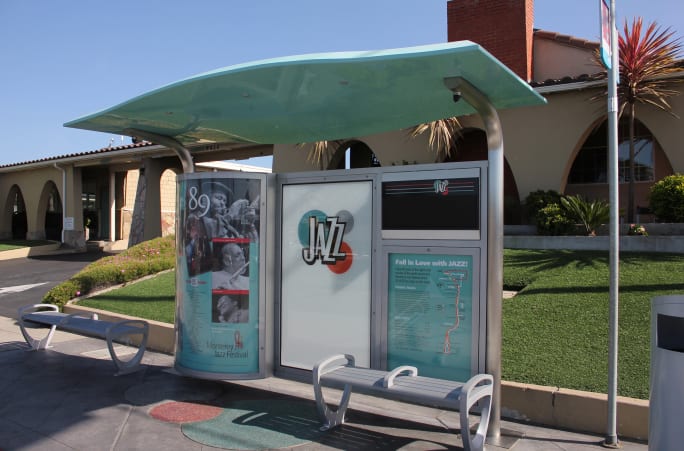
The initial presentations focused on the first 30 years through images that remembered legendary jazz musicians, as well as singers and musicians normally not associated with jazz, but who had performed at the festival.
Photo:Craig Lovell
The vision of Frank Lichtanski
The original concept of BRT through the Monterey region belongs to the late Frank Lichtanski, former MST administrator and early BRT proponent. He often traveled on his own money to investigate systems operating in other countries, and hosted conferences throughout Monterey and Salinas to educate policy makers on the value and benefit BRT could bring.
Upon Lichtanski’s death in 2005, Sedoryk took up the cause and began sowing the seeds to grow his predecessor’s ideas.
His first step was to simply extend the existing MST 24 line. Interested vintners and growers eagerly provided funds to create a more vibrant image of public transit that would serve the wineries, restaurants, and shops throughout this region. The new minibus service that ensued was known as The Grapevine Express. MST quickly discovered that this more frequent route service with snappier branding was quadrupling previous ridership numbers.
“It then occurred to us The Grapevine Express was functioning much like BRT — though on a much smaller scale,” says Sedoryk. “These new analytics spurred us to raise the level of local transit between more cities for our residents, employees, and tourists.”
To meet the required FTA thresholds for the BRT system that would eventually become JAZZ, the agency simply scaled-back and incorporated only the most essential BRT components it saw as the best fit in the communities it would serve.
For example, JAZZ buses operate in conventional traffic lanes and jump queues converted from on-street parking spaces; avoiding the tremendous capital investment of larger projects.
During the Festival, JAZZ riders drop off at the front entrance of the County Fairgrounds, and with their ticket, attend their favorite performances and come and go and as they please on the JAZZ buses.
Photo:Craig Lovell
Thumbs Up for the First 5 Years, The Second 5-Year Plan
Assessing the first five-year plan, MST reports JAZZ ridership continues to thrive.
“Our riders were using this service in a lesser capacity before JAZZ BRT,” says Sedoryk. “We have just upgraded their experience to include traffic signal prioritization and jump-lane technology, which has significantly improved on-time performance. Automobile traffic is running smoother as well with the signal prioritization technology now synchronized through the three cities.”
With much of the funding in place from the local sales tax measure passed in 2016, MST is currently in the environmental planning phase for a second BRT line to extend the JAZZ BRT corridor another 6.5 miles from the Sand City station, the northern most JAZZ terminus, to the city of Marina.
MST says with access to an abandoned rail line, this next phase will function as a fixed BRT guideway along the Pacific Coast Highway One.
“With half of the funding in place through the local sales tax measure, we are seeking state and federal grants to begin construction,” says Sedoryk. “If all goes to plan, our next project will go live within five years.”
MST also reports it has worked out descriptive branding as equally compelling as JAZZ for the new service immediately adjacent to the Pacific Ocean — SURF.
More Bus

New York MTA Plans Largest Bus Fleet Upgrade in More Than a Decade
The agency is seeking manufacturers for 650 new CNG buses to replace aging vehicles, improve reliability, and advance its broader fleet modernization strategy.
Read More →
Building a Flexible Path to Transit Electrification
John Hroncich discusses BAE Systems’ modular and scalable approach, lessons learned from decades of real-world operations, and how agencies can identify electrification strategies that fit their fleets.
Read More →
Bus Tech Talk: Keeping Transit Technicians Ahead of the Technology Curve
LA Metro’s Obed Mejia discusses technician training, evolving maintenance technology, fleet replacement, and strategies for getting the most out of today’s transit fleets.
Read More →
Biz Briefs: RIPTA Unveils New Frontrunners, Clevland RTA Adds New Siemens, and More
In METRO's latest installment, we take a look at recent news from Siemens, Prevost, Dodge, and more partnerships making headlines across the transportation sector.
Read More →
People Movement: Holly Arnold Joins Transdev and More
In this edition, we also cover recent appointments and announcements at Pace, CamTran, MCI, and more, showcasing the individuals helping to shape the future of transportation.
Read More →
The High Cost of Transit Buses: Industry Leaders Look to Procurement Reform
Transit leaders and policymakers examine how standardized bus designs, streamlined procurement, and predictable funding could help agencies stretch budgets and deliver better service.
Read More →
The Business Voice Behind Public Transportation
As chair of APTA’s Business Members Board of Governors, Ray Melleady explains how more than 850 business members are partnering with transit agencies to advance funding, innovation, and industry-wide collaboration.
Read More →
From Surviving to Thriving: Building Stronger Transportation Organizations
Bus Business Consultants founder Brian Dickson shares lessons on leadership, organizational health, and creating options for long-term success in a changing transportation industry.
Read More →
Finding the ‘Happy Medium’: Optimizing Maintenance Without Sacrificing Reliability
The key to maintenance optimization isn’t doing less work—it’s doing the right work at the right time on the right assets.
Read More →
LA Metro, City of West Hollywood, and Partners Advance Smarter Bus Lane Enforcement
The award-winning partnership combines AI-powered detection with human oversight to improve bus reliability, accessibility, and enforcement efficiency.
Read More →