



Caltrain Marks A New Era in Rail Transportation
Caltrain’s Electrification Project represents a transformative leap forward for transit in California’s Bay Area.
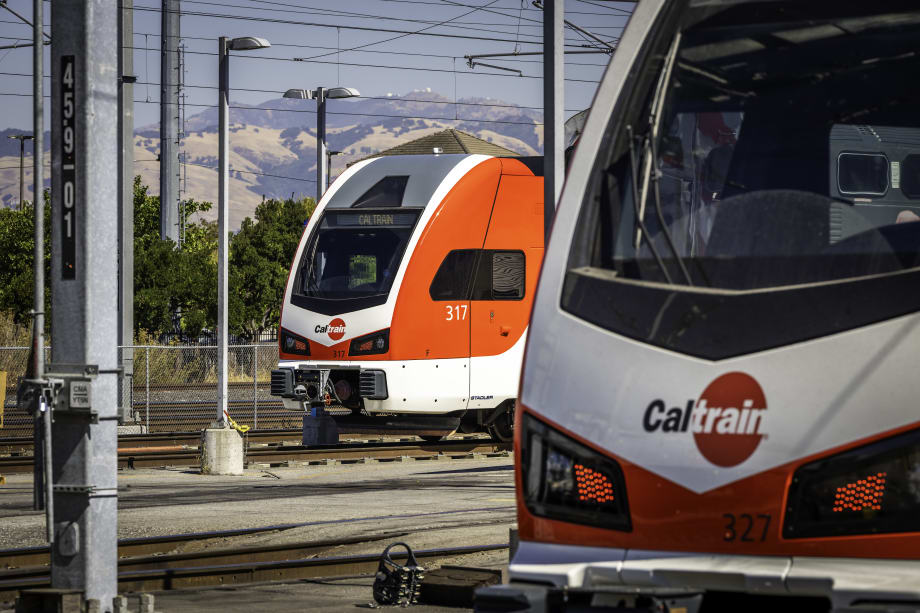
Caltrain debuted its cutting-edge electric fleet at a soft launch event in August. Full electrified service on the 51-mile corridor began September 21.
Photo: Core Visual, Courtesy of HNTB
Caltrain’s initiative to transition the rail corridor between San Francisco and San Jose from diesel to electric service marks a pivotal moment.
After 20 years of planning and eight years of construction, the transformational Peninsula Corridor Caltrain Electrification Project moves the San Francisco Peninsula toward modernized, faster, and sustainable public transportation.
Caltrain debuted its cutting-edge electric fleet at a soft launch event in August. Full electrified service on the 51-mile corridor began September 21.
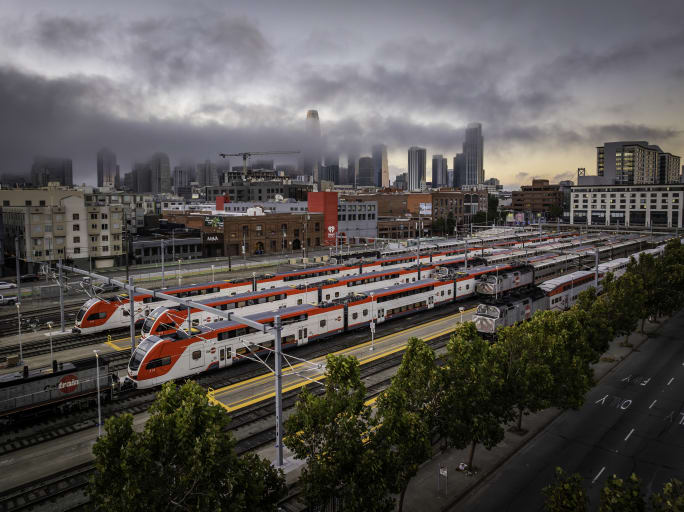
The electric trains are more energy efficient, and because they are powered by renewable energy, their carbon footprint is significantly lower than the diesel locomotives.
Photo: Core Visual, Courtesy of HNTB
Greener Rail for the Bay Area
Caltrain is introducing a new era on the corridor with electrification, which improves Caltrain system performance and curtails long-term environmental impacts by reducing noise, improving regional air quality, and lowering greenhouse gas emissions.
The electric trains are more energy efficient, and because they are powered by renewable energy, their carbon footprint is significantly lower than the diesel locomotives.
Annual emissions will be reduced by a projected 250,000 metric tons of carbon dioxide per year, the equivalent of taking 55,000 cars off the road.
“This project represents a leading-edge change that has gained attention locally, nationally and even internationally,” says Pranaya Shrestha, sr. program manager for HNTB, which served as owner’s representative for the project. “A unique aspect of this corridor is that it’s a complete partnership. Caltrain garnered not only public support, but also support from the governor’s office and federal elected officials.”
Valley Transportation Authority (VTA) in San Jose, the San Francisco Municipal Transportation Agency (MUNI), and the California High-Speed Rail Authority are among Caltrain’s project partners.
The Federal Transit Administration and the state’s Transit and Intercity Rail Capital Program provided key funding for the project.
HNTB’s responsibility in the project included providing program management, driving the project toward success.
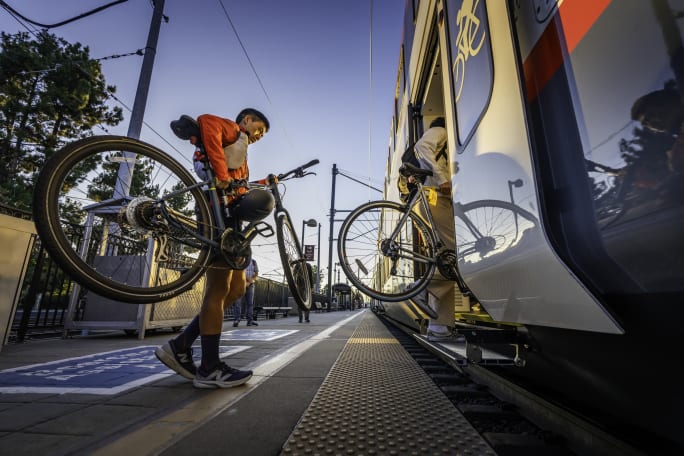
The train cars are equipped with roomier seats, free Wi-Fi, electrical outlets under every fixed seat, and expanded storage capacity, including bicycle storage.
Photo: Core Visual, Courtesy of HNTB
Built for Passenger Safety, Capacity, and Comfort
Throughout construction for the last eight years and consistent with Caltrain’s goals, the project team minimized inconvenience to corridor passengers by keeping existing service in place and scheduling construction when it had as little impact on riders as possible, including during overnight hours and weekends.
Construction included locating underground utilities, testing soil conditions, upgrading and inspecting signal and communication equipment, and pruning and removing trees.
The project team installed foundations and 2,569 pre-engineered poles and strung more than 2.8 million feet of wire to support the overhead contact systems (OCS) that powers Caltrain’s fleet of 19 new, high-performing electric trains.
Additionally, 10 traction power facilities — electric power stations used to provide, distribute, and regulate electricity to the OCS and electric trains — were installed on the corridor.
With little impact to the system, the power upgrades will accommodate California High-Speed Rail trains when they are ready, allowing riders to step off a Caltrain vehicle and onto high-speed rail to travel further south.
As part of its signal system upgrade, Caltrain implemented wireless grade crossing technology that will improve warning time consistency.
When wireless crossing is enabled, Caltrain’s positive train control-equipped electric locomotives send messages to a controller to facilitate constant warning times at the crossing based on the train’s GPS position and speed.
The electrification of the line also delivers more frequent service for passengers, including during weekends.
Caltrain’s seven-car electric trainsets maintain operating speeds up to 79 miles per hour, zipping between San Francisco and San Jose in less than an hour.
Service offerings have increased by 20%, with trains arriving every 15 to 20 minutes during rush hours at most stations and every 30 minutes during weekends, midday, and evenings.
Faster and more frequent service means the trains provide an additional capacity for riders, about the same number of passengers as one U.S. 101 lane can carry between San Francisco and San Jose.
The train cars are equipped with roomier seats, free Wi-Fi, electrical outlets under every fixed seat, and expanded storage capacity, including bicycle storage.
Each train includes an ADA-compliant restroom. CCTVs installed in the train cars enhance safety, and the electric trains provide a quieter, more comfortable rider experience.
“This historic electrification project also requires a new approach to Caltrain’s operations and maintenance,” says Shrestha. “HNTB partnered with the Caltrain team throughout the life of the project to navigate punch lists, manuals, operation maintenance, training, and record drawings. Caltrain is fully prepared to maintain the system well beyond the design life.”
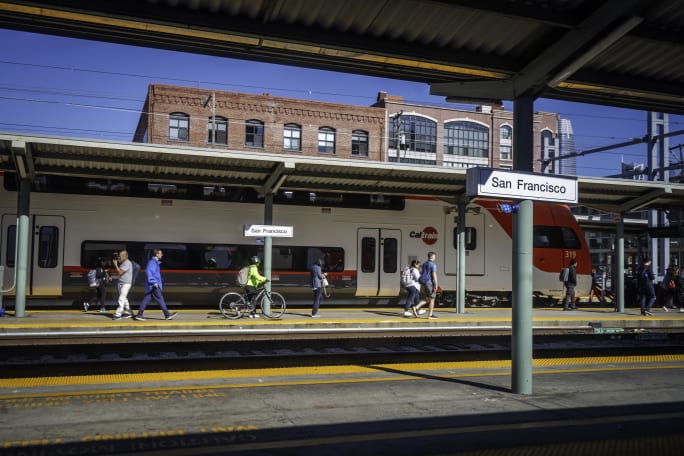
Caltrain’s seven-car electric trainsets maintain operating speeds up to 79 miles per hour, zipping between San Francisco and San Jose in less than an hour.
Photo: Core Visual, Courtesy of HNTB
Long-Term Benefits In and Beyond the Region
Within the Bay Area, Caltrain’s new electrified corridor will serve as a key component of the region's interconnected transportation network.
The VTA and Amtrak will connect with Caltrain at San Jose Diridon Station, while Bay Area Rapid Transit provides a direct link to San Francisco International Airport via Millbrae Station.
California High-Speed Rail will eventually integrate with Caltrain, providing riders with improved access to destinations beyond the Bay Area.
“We are celebrating the completion of this project along with a transformative leap forward for our community and every rider who will benefit from these advancements,” says Michelle Bouchard, Caltrain executive director. “We are immensely grateful for our partners who have helped us deliver this project to ensure we can provide our community with safer, more efficient and sustainable transportation options.”
The electrification of Caltrain’s San Francisco-San Jose corridor is set to offer the region’s communities a more sustainable and efficient transportation solution, reshaping how the Bay Area moves for decades to come.
Shrestha expects the project, completed on the oldest continuously operating railroad in the West, to also serve as a model for rail transit modernization throughout the country.
“It’s important to note that this historic, 160-year-old corridor, now electrified, will be used by our grandchildren and their grandchildren,” he says. “Just as our country moved from steam to diesel, electric corridors are the next big step. In the years ahead, we’ll see diesel that is being used throughout the country now begin to move toward electrification. Caltrain is leading that effort.”
About the Author: Suze Parker is a public relations consultant and writer who writes about transportation infrastructure.
More Rail

New York MTA Advances Final Contract for Second Avenue Subway Expansion
Contract Four is the largest in the Second Avenue Subway Phase 2 project and includes construction of station infrastructure, tracks, and signals for the subway expansion, MTA officials said. Work on Contract Four will begin in 2027.
Read More →
San Diego MTS Breaks Monthly Trolley Ridership Record
Agency officials said July’s ridership indicates MTS’s continued recovery from the pandemic.
Read More →
Report Examines NJ TRANSIT Reliability, Funding Challenges
The Garden State Initiative analysis examines the roles of Amtrak infrastructure, fleet management, and agency operations while recommending a more performance-based approach to improving reliability.
Read More →
Stadler, CapMetro Sign Long-Term Rail Fleet Support Agreement
Beginning in 2027, Stadler will provide on-site technical expertise, spare parts support, training, and obsolescence management to help extend the reliability and longevity of CapMetro’s GTW fleet.
Read More →
Biz Briefs: Alstom Lands Canadian Contract, LYT to Supply California TSP, and More
In METRO's latest installment, we take a look at recent news from Complete Coach Works, Beep, FlixBus, and more partnerships making headlines across the transportation sector.
Read More →
CATS Gold Line Marks 5 Years of Service, 2.8M Passenger Trips
With a six-mile expansion planned, the Charlotte streetcar is positioned to connect more neighborhoods and major transit hubs across the region.
Read More →
Why Simulating Pedestrian Movement Has Become Essential for Modern Rail Stations
Pedestrian microsimulation is helping rail planners identify bottlenecks, test station designs, and prepare complex transit hubs for growing passenger volumes.
Read More →
Amtrak Begins Major Construction at New York’s Sunnyside Yard
The new maintenance facility will support Amtrak’s Airo trainsets while improving maintenance efficiency and turnaround times in New York.
Read More →
Chicago Leaders Unveil Plans for O’Hare Airport Express Train
The privately developed project would offer a 15-minute trip between downtown and O’Hare’s Terminal 2, with trains operating every 15 minutes on a dedicated track. The service would use battery-electric trains and three existing freight rail rights-of-way.
Read More →
OCTA Maps Out 30-Year Strategy to Protect Coastal Rail Corridor
The draft feasibility report identifies strategies to protect the coastal rail line for decades as the agency continues near-term stabilization and sand placement efforts.
Read More →