



A Favorable Outlook for Chicago’s Intercity Rail Traffic, But Seat Shortages Loom
A new study, Growth Spurt: The Outlook for Chicago’s Intercity Rail Traffic through 2030, highlights an upswing in travel on state-supported Amtrak trains serving the Windy City, exemplified by many sold-out trains during Labor Day weekend.
Amtrak hopes to double Midwest train ridership by 2040, an effort being facilitated by the USDOT’s Corridor ID program, which jump-starts planning for state-led rail expansion.
Photo: METRO
- A study predicts an increase in usage of state-supported Amtrak trains in Chicago by 2030.
- The rise in train travel is confirmed by the numerous sold-out trains over the Labor Day weekend.
- Despite growth, the study warns of potential seat shortages on these popular routes.
*Summarized by AI
A new study, Growth Spurt: The Outlook for Chicago’s Intercity Rail Traffic through 2030, highlights an upswing in travel on state-supported Amtrak trains serving the Windy City, exemplified by many sold-out trains during Labor Day weekend.
Driven by strong demand for regional travel, ongoing improvements to Chicago Union Station, and the introduction of a new Twin Cities train, the report shows that the Chicago Hub is outperforming other regions with clusters of state-supported routes serving major metropolitan areas.
However, the study cautions that worsening capacity shortages could soon dampen growth.
During the first nine months of Amtrak’s fiscal year, which ended in June 2025, ridership on Amtrak trains to Chicago, operated with state finance support, including routes to Detroit, St. Louis, and the Twin Cities, rose by 8% compared to the same nine-month period the previous year.
This outpaces the North Carolina and Virginia networks (NC-VA), which together grew by 7.5%, and California and New York–Vermont (NY–VT), which grew by 3.6% and 0.2%, respectively.
Traffic in California and New York-Vermont faced extenuating factors that interrupted service, which are expected to be only temporary.
Five states — Illinois, Indiana, Michigan, Minnesota, and Wisconsin — that provide significant operating assistance for Amtrak trains to Chicago, coordinate their work through the Midwest Interstate Rail Passenger Commission.
“We’re impressed that all seven Chicago Hub routes had passenger gains of 2.7% or more since October, noted Joseph Schwieterman, a DePaul University professor who is the study’s author, who added that “the increase is comfortably above Illinois’s 1.1% real GDP growth” in 2024.
The Windy City’s Recovery
The DePaul study attributes recent gains to the Borealis (a second Chicago–Saint Paul, MN train), the gradual rollout of 110-mile-per-hour service on the St. Louis line, and the Windy City’s appeal as a business and leisure destination. New Venture passenger coaches purchased by states, manufactured by Siemens, and upgraded stations are helping meet demand.
“We expect ridership to exceed 2019 levels by late 2026 consistently,” said Schwieterman.
The Chicago Hub's ridership recovery still lags that of NC–VA and NY–VT, which have risen to 163% and 115.2% of their 2019 levels, respectively, partly due to their more extensive service expansion over the past seven years.
However, the study predicts that Chicago Hub ridership will increase by another 10% over the next 24 months, despite its capacity shortages and a national domestic travel slowdown that has prompted some airlines to cut flights. It expects Chicago’s growth to be fueled by a new twice-daily Metra-operated service to Rockford, Illinois, projected to start in 2026.
An additional Chicago–Milwaukee round-trip, facilitated by ongoing trackwork in Wisconsin, is expected to launch in 2026 or 2027.
Sustaining brisk traffic growth between 2028 and 2030 will be a “heavier lift,” Schwieterman cautioned, due to the need for additional coaches and the likely absence of substantial new service additions during this period.
Load factors (the percentage of seats filled) in the Chicago Hub are now higher than in other regions and far above the national average. DePaul's review of the Labor Day holiday found that many trains were sold out days in advance.
“We were surprised to find more than 50 trains sold out well before the Thursday–Monday holiday period,” said DePaul’s Samantha Rouzan. Rouzan added that many St. Louis–Chicago trains haven't had seats for days.
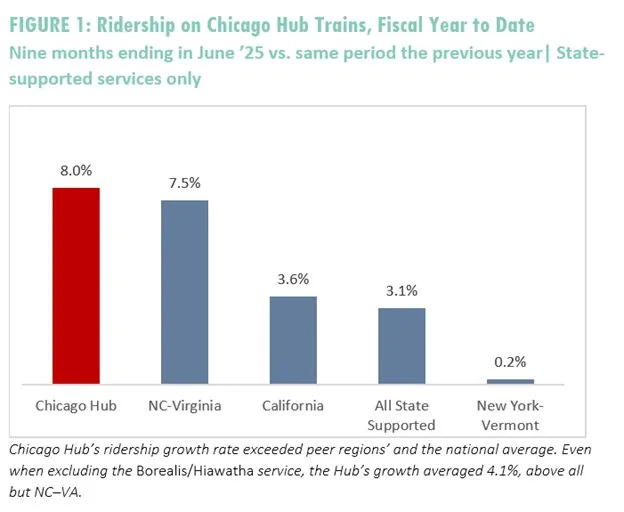
The study predicts that Chicago Hub ridership will increase by another 10% over the next 24 months, despite its capacity shortages and a national domestic travel slowdown that has prompted some airlines to cut flights.
Photo: DePaul University
Continued Focus on Midwest Growth
Amtrak hopes to double Midwest train ridership by 2040, an effort being facilitated by the USDOT’s Corridor ID program, which jump-starts planning for state-led rail expansion. Many of the payoffs from the ID program for travelers will likely be realized well after 2030.
Focusing on the short term, Schwieterman called for state governments to “prioritize capacity expansion on existing trains, including adding coaches on a relatively ambitious timetable.”
Wisconsin’s trains are expected to have increased seat capacity once the state receives nine new Venture cars, reportedly scheduled to arrive in 2026. The study urges other states to follow suit, placing orders and joining the queue for new deliveries.
Older equipment could also be found. Suppose Amtrak’s Horizon cars, which have been sidelined due to corrosion, are brought back into service, or decades-old Amfleet cars from other regions are freed up. In that case, Schwieterman believes that states should “push to have a significant number of them allocated to the Chicago Hub.”
Another priority is developing intercity bus services to supplement Amtrak trains, a strategy that Oregon, Washington, and Vermont have implemented, even listing buses alongside trains on Amtrak.com.
The study recommends filling schedule gaps on routes from Chicago to Champaign, Illinois, and to Indianapolis and Grand Rapids, Michigan.
“First and foremost, state agencies should prioritize activities that alleviate the shortage of seats,” said Schwieterman.
Although technical factors may prevent new routes, such as proposed service expansion to Columbus, Ohio; Green Bay, Wisconsin; the Quad Cities, Illinois; and central Iowa, from being launched until well after 2030, he calls for avoiding stretching out the implementation timelines any further than they are.
“The recent traffic growth shows that the demand for rail passenger travel in the Chicago Hub is robust,” said Schwieterman.
The report, “Growth Spurt: The Outlook for Chicago’s Intercity Rail Traffic through 2030,” from DePaul University’s Chaddick Institute for Metropolitan Development, is available here.
Quick Answers
The study indicates an upswing in travel on state-supported Amtrak trains serving Chicago, with many trains selling out during peak times like Labor Day weekend.
*Summarized by AI
More Rail

OCTA Declares Emergency to Protect Rail Corridor From Coastal Erosion
The California agency is accelerating shoreline protection and plans to place approximately 690,000 cubic yards of sand along the San Clemente coast to protect a key passenger and freight rail link.
Read More →
More Than a Summer Job: Building the Next Generation of Transit Talent
The Delaware River Port Authority and PATCO have transformed their internship program into a hands-on professional development experience that introduces students to the breadth of transportation careers — and creates a pipeline for future employees.
Read More →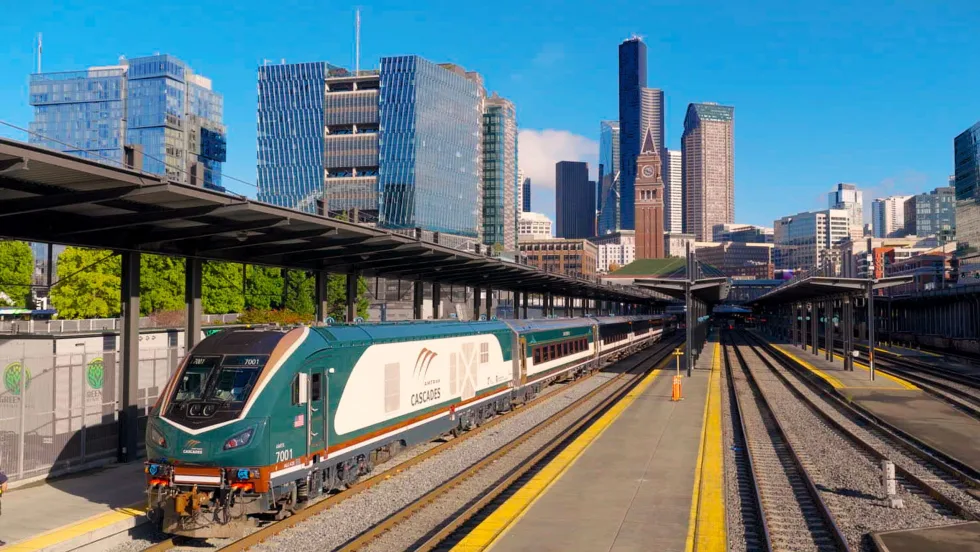
Airo Trains Make Their Amtrak Cascades Debut in the Pacific Northwest
Effective immediately, two cutting-edge Airo trainsets will join the Amtrak Cascades route, operating four daily trips between Vancouver, B.C., Seattle, Portland, and Eugene, Oregon, marking the first introduction of Airo trains into passenger service anywhere in the country.
Read More →
Florida's Brightline Announces Financial Restructuring
Brightline Florida says train operations will continue as normal as certain parent entities enter Chapter 11 and financial stakeholders provide $490 million in new long-term capital.
Read More →
ENC Lands MATA Contract and More in Biz Briefs
In this edition of Biz Briefs, we spotlight the latest developments shaping the future of mobility.
Read More →
Strada360’s Steve Lassey on Turning Transit Data Into Better Decisions
From breaking down data silos to preparing for AI, Strada360 CEO Steve Lassey discusses how transit agencies can use technology to improve operations, customer information, and long-term decision-making.
Read More →
SEPTA Details Accelerate Vision for Transit System
The plan outlines investments in trolley modernization, new Metro and Regional Rail vehicles, accessible stations, and more frequent bus and rail service.
Read More →
FTA Ends Direct Oversight of MBTA Safety Actions
The federal agency closed its remaining special directive to the Massachusetts Department of Public Utilities following a safety review that began in 2022.
Read More →
Amtrak, CN Reach Agreements to Strengthen Passenger Rail Service, Safety
The agreement resolves a more than decade-long proceeding before the Surface Transportation Board concerning the terms and conditions for Amtrak services, such as the City of New Orleans, Illini/Saluki, and Wolverine.
Read More →
New York MTA Advances Final Contract for Second Avenue Subway Expansion
Contract Four is the largest in the Second Avenue Subway Phase 2 project and includes construction of station infrastructure, tracks, and signals for the subway expansion, MTA officials said. Work on Contract Four will begin in 2027.
Read More →