



California has a high-speed rail project
California’s state legislature authorized the first sale of $4.6 billion of the $9 billion voter-approved 2008 Proposition 1A High-Speed Rail (HSR) bonds. That matches and commits the state’s $3.4 billion federal HSR stimulus grant.
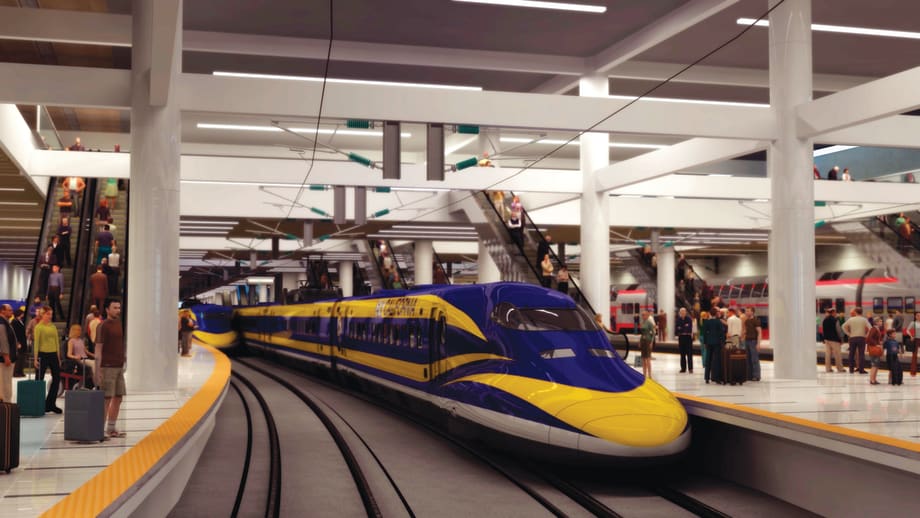
California’s state legislature authorized the first sale of $4.6 billion of the $9 billion voter-approved 2008 Proposition 1A High-Speed Rail (HSR) bonds. That matches and commits the state’s $3.4 billion federal HSR stimulus grant.
Indeed, 32 states are receiving federal HSR funding, 11 of which have Republican governors. California’s last four governors supported HSR; two Republicans and two Democrats. This non-partisan project has begun, so let’s step back and apply some logic.
Early cost projections
Certainly the California project suffered from a sequence of business plans that give the impression of increased costs. Most of those apparent increases result from two understandable phenomena.
First, the early cost projections were based on current-year (1998 or early 2000) fund values. The new projections are based on year-of-construction or 2029 fund values. That adds nearly 30 years of compounded cost-of-living fund value increases, about one-third of the total cost, but is more conservative and credible.
The second phenomenon was that early cost projections were based on average costs-per-mile not considering potential significant elevated or underground sections. Later, detailed planning with each community revealed that many desired elevated or depressed tracks, multiple times more expensive. So, the project costs increased to meet the communities’ desires, as should be the case with a world-class state’s transportation system. The result is the current $68 billion estimate for a 520-mile system from Anaheim via Los Angeles’ Union Station, the Central Valley, San Jose, and to San Francisco’s new TransBay Terminal. That cost-per-mile compares favorably with the other HSR projects around the world and quite favorably with the 427-mile, $151 billion proposed HSR Acela upgrade from Boston to New York; Philadelphia; and Washington, D.C.
Why not spend the HSR funds on education, health care and other threatened state programs? The HSR funds can be spent only on HSR. The $3.4 billion in federal stimulus funds, if not committed by the end of the year, will be returned and distributed to the other 12 designated national HSR corridors. The $9 billion in state Proposition 1A bonds were voter-approved only for HSR; use it for HSR, or lose it. Yet the investment of those billions right now converts the unemployed into local, state and federal taxpayers and rekindles the flagging local economy in the most economically devastated portion of California. President Roosevelt would be proud.
But the U.S. can’t afford it!
New England needs the Acela Corridor upgrade, as does California need HSR. How can every other industrialized country in the world, and many emerging countries, afford HSR, but the world’s richest country cannot? Over 30 HSR systems currently operate worldwide, most with a profit after operating and maintenance costs, with many more in planning or construction. Only the U.S. does not. And, not coincidentally, according to Tom Brokaw in the June issue of Discovery, the U.S. pays more than $5 billion per week to import foreign oil. And, according to the National Geographic, with only 4% of the world’s population, the U.S. creates nearly 30% of the world’s greenhouse gases. [PAGEBREAK]It’s a railroad to nowhere!
The business plan commits more than $1 billion to upgrading the current commuter rail systems for eventual HSR use in the state’s most populous area between San Francisco and San Jose and between Los Angeles and Anaheim. The added $6 billion HSR starter project in the Central Valley between Bakersfield and Fresno is about 120 miles long between two rapidly growing cities in an area with near 30% construction industry unemployment. The new business plan, which former critics declare to be credible, describes an economically viable system built over the next 19 years in operating sections as funding becomes available, just like President Eisenhower’s interstate highway system. The first section is in the middle, as with Ike’s first highways in Nebraska and Kansas, from Fresno (nearing a million people in the metro area) to Bakersfield (nearly 300,000 in the metro area), two not-so-small and growing population centers. The system’s maintenance base will be in that section, which also includes a 220-mile-per-hour track section for rolling stock testing. That is the only place in the state with those pivotal requirements.
California’s population of 38 million is projected to double by mid-century, with much of that growth in the Central Valley. Compliments go to President Obama, Gov. Jerry Brown, and the farsighted California legislature for having the courage, during these most difficult times, to sustainably meet the transportation needs of that unavoidable population explosion. It’s time now for the naysayers to help our leaders drive some spikes…or get off the tracks.
Rod Diridon, Sr. is the executive director, Mineta Transportation Institute and the Chair Emeritus, California High-Speed Rail Authority Board.
More Rail

New York MTA Advances Final Contract for Second Avenue Subway Expansion
Contract Four is the largest in the Second Avenue Subway Phase 2 project and includes construction of station infrastructure, tracks, and signals for the subway expansion, MTA officials said. Work on Contract Four will begin in 2027.
Read More →
San Diego MTS Breaks Monthly Trolley Ridership Record
Agency officials said July’s ridership indicates MTS’s continued recovery from the pandemic.
Read More →
Report Examines NJ TRANSIT Reliability, Funding Challenges
The Garden State Initiative analysis examines the roles of Amtrak infrastructure, fleet management, and agency operations while recommending a more performance-based approach to improving reliability.
Read More →
Stadler, CapMetro Sign Long-Term Rail Fleet Support Agreement
Beginning in 2027, Stadler will provide on-site technical expertise, spare parts support, training, and obsolescence management to help extend the reliability and longevity of CapMetro’s GTW fleet.
Read More →
Biz Briefs: Alstom Lands Canadian Contract, LYT to Supply California TSP, and More
In METRO's latest installment, we take a look at recent news from Complete Coach Works, Beep, FlixBus, and more partnerships making headlines across the transportation sector.
Read More →
CATS Gold Line Marks 5 Years of Service, 2.8M Passenger Trips
With a six-mile expansion planned, the Charlotte streetcar is positioned to connect more neighborhoods and major transit hubs across the region.
Read More →
Why Simulating Pedestrian Movement Has Become Essential for Modern Rail Stations
Pedestrian microsimulation is helping rail planners identify bottlenecks, test station designs, and prepare complex transit hubs for growing passenger volumes.
Read More →
Amtrak Begins Major Construction at New York’s Sunnyside Yard
The new maintenance facility will support Amtrak’s Airo trainsets while improving maintenance efficiency and turnaround times in New York.
Read More →
Chicago Leaders Unveil Plans for O’Hare Airport Express Train
The privately developed project would offer a 15-minute trip between downtown and O’Hare’s Terminal 2, with trains operating every 15 minutes on a dedicated track. The service would use battery-electric trains and three existing freight rail rights-of-way.
Read More →
OCTA Maps Out 30-Year Strategy to Protect Coastal Rail Corridor
The draft feasibility report identifies strategies to protect the coastal rail line for decades as the agency continues near-term stabilization and sand placement efforts.
Read More →