



“We are running into the same [challenges] as any other transit agency right now, which is the need to stabilize our workforce."
IndyGo's Evans discusses present, future of mobility
Inez Evans was selected as IndyGo’s president and CEO in the summer of 2019, replacing Michael Terry, who led the agency for more than 11 years.
by Alex Roman, Managing Editor
April 13, 2020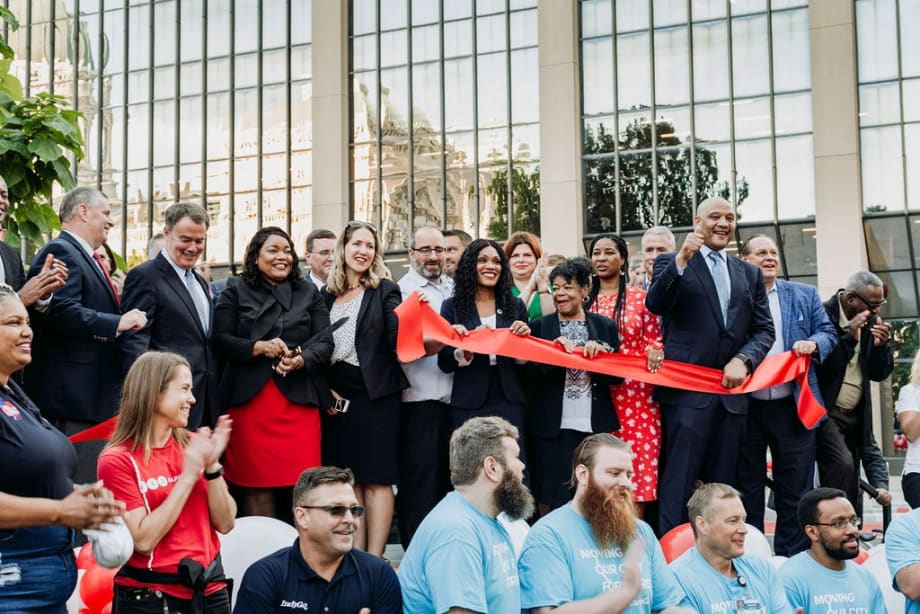
Just a couple weeks after taking the job at IndyGo, Evans cut the ribbon on the agency's new Red Line BRT service.
IndyGo
4 min to read
Just a couple weeks after taking the job at IndyGo, Evans cut the ribbon on the agency's new Red Line BRT service. IndyGo
Inez Evans was selected as IndyGo’s president and CEO in the summer of 2019, replacing Michael Terry, who led the agency for more than 11 years. Evans began her transit career as a customer service call center representative in the early 1990s and most recently served as a COO for Calif.’s Santa Clara Valley Transportation Authority.
METRO Managing Editor Alex Roman spoke to Evans about her short- and long-term goals for the agency, as well as how her team is working to overcome some of the challenges IndyGo is facing.
What were some of the short-term goals you had when you began your tenure at IndyGo?
My initial short-term goal was to make sure the Red Line [BRT service] opened September 1st. To be honest, I got here August 19, so with the opening so close, it was really all about conducting meetings with staff and going through our checklist to make sure everything was ready to go so we could cut that ribbon and put our best foot forward.
Since then, it’s been about getting with each of my department heads to drill down and learn what their needs and desires are and what their goals are to meet our strategic plan, vision, and mission statements. We also wanted to make sure they have all the tools necessary to be able to accomplish those goals, while also identifying any gaps they may have. When an organization is growing by 30% or so, sometimes they have not considered some of the background or back-end support staff that’s needed, such as data analysts and things of that nature. So, we have been going through and breaking all those things down, while preparing for the Purple and Blue Lines to open next down the road. I measure my time here in dog years. It’s been six months, but it feels like four years already.
What are some of the agency’s biggest challenges and how are you looking to solve them?
We are running into the same [challenges] as any other transit agency right now, which is the need to stabilize our workforce. We have many individuals that can retire here at IndyGo, so we are looking at those growth challenges. We are also transitioning over to brand new technology going from diesel vehicles to electric, so we are looking to start our own high-voltage apprenticeship program and building a new training facility. It is in the works, but I’ve made some modifications to it because it didn’t include maintenance, initially.

Inez Evans
IndyGo
We are also looking at our facilities and our infrastructure as a whole. We have been in this building for several years, and while we have no plans to abandon it by any means, we are growing. The facility we currently have is beautiful, but it’s built for bus storage not for bus operations. Because of that, it is looking like we may have a need for two facilities, which is something that wasn’t anticipated. We are working with our city leaders to identify if they have some land that’s banked. If so, we will continue working to set up an intermodal agreement so that we can get through the process and have a shovel-ready project that we are able to present to the FTA for possible funding.
And then of course, we are still working continuously toward the building of the next two BRT lines. We are working with our community and leaders, and honestly, it’s a heavy lift for this team. The community voted for it, but when you start digging up their streets, they are like, ‘Hey, what are you doing?’ So I am working with my team to be out there to have those discussions with the community. Our plan is to have a building in the areas where there is heavy construction, which is something we didn’t do with the last project.
I want to have a field office that can serve as one consistent place where people can stop by and get real-time information, ask questions, and stay up to date as we continue making progress on those projects.
We are also lucky to have some great partnerships with all our city and civic leaders, who are supportive of what we are doing to really change the landscape of Indianapolis. To see the construction that’s going on along our lines just gives you a lens into how those leaders and the communities we serve are embracing the importance of transportation and what it can do to transform their neighborhoods, and our city as a whole.
In addition to the BRT lines, where else do you see IndyGo growing in the long-term?
I forsee us focusing more on regionalism. Within our community, there are several major employment centers located outside of our service area, and there is a such a demand for individuals here, within Indianapolis, who want to work in those areas. So we are beginning to start to have those conversations with those employment centers to see how we can work together, perhaps through public-private partnerships, to provide some type of service. That is very long term, but it’s a needed goal for this organization and for this community.
Subscribe to Our Newsletter
More Management

METRO Opens Submissions for 2026 Motorcoach Awards
Nominations are now being accepted for METRO Magazine’s Operator of the Year and Innovative Operator of the Year awards.
Read More →
New York MTA Advances Final Contract for Second Avenue Subway Expansion
Contract Four is the largest in the Second Avenue Subway Phase 2 project and includes construction of station infrastructure, tracks, and signals for the subway expansion, MTA officials said. Work on Contract Four will begin in 2027.
Read More →
Transit Agencies Highlight Safety Gains at National Summit
Leaders from 15 major transit systems shared crime-reduction results and safety initiatives while discussing the role of continued federal support.
Read More →

NITA Names New Leadership, Expands Reduced-Fare Program at First Board Meeting
The new regional transit authority appointed its first board chair and interim executive director while extending reduced fares across CTA, Metra, and Pace for eligible riders.
Read More →
Beyond the Checklist: A Structured Approach to Transit Maintenance
Reliability-Centered Maintenance helps transit agencies move beyond routine checklists to focus limited resources on the assets and failures that have the greatest impact on safety, reliability, and service.
Read More →
APTA 2026 Nominating Committee Selects Leadership Slate, Names Chair and Vice Chair Nominees
Leadership changes will help shape the association’s priorities and its representation of the transportation industry during the 2026–2027 term.
Read More →
DART Launches Major Security, Fare Enforcement Initiative
The 90-day demonstration will deploy coordinated security teams at five light rail stations while testing controlled access and gathering data to guide future investments.
Read More →
Sponsored•September 9, 2026
Advancing Fare Collection Through Technology and Innovation
Learn about delivering 1300 gates at 91 stations while managing fare evasion. Explore the large scale deployment, solution customization and real-world results that affect the region. Prepare for deployment in your region now.
Read More →
Game Day in Motion: Moving Millions During the 2026 World Cup
Between packed transit stations and team motorcoaches, see how agencies and operators across North America tackled the transportation demands of the 2026 FIFA World Cup.
Read More →
Surface Transportation Extension Averts Shutdown, Leaves Transit Funding Gap
The stopgap keeps federal transportation programs moving, but missing advance funding could complicate the transit and rail projects agencies are planning next.
Read More →