



NYC Transit Uses New Tech, Tests Real-Time Train Arrival
Countdown clocks take the guesswork out of waiting for a train, offering a reduction in stress levels for harried New Yorkers.
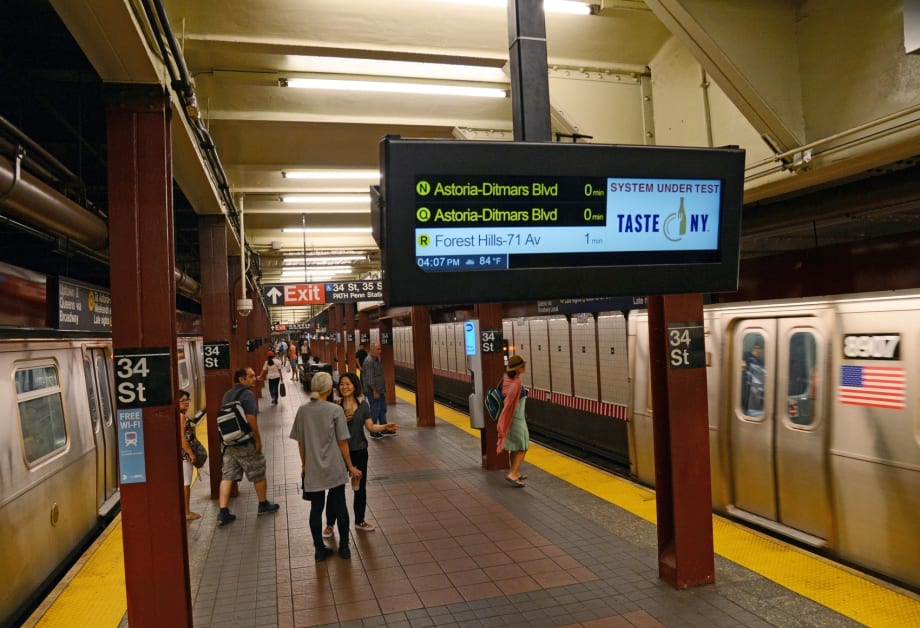
All photos: Marc A. Hermann, MTA NYCT
All photos: Marc A. Hermann, MTA NYCT
The first portion of New York City’s subway system opened in 1904, and since then, riders have developed a number of subway-centric behaviors aimed at making their trips easier. One of the most time honored is the craning of the neck as riders gaze into the tunnel or along a stretch of elevated track to determine if they can see the next train approaching.
Over the past few years, however, MTA New York City Transit (NYC Transit) customers using the numbered lines (except 7) and the L have benefitted from the installation of countdown clocks that alert them to which trains are coming and how many minutes away they are. Countdown clocks were first introduced along the L in conjunction with the installation of the Communications-Based Train Control (CBTC) moving block signaling system. Second-generation clocks, facilitated by Automatic Train Supervision (ATS), were installed along the 1 through 6 lines.
Countdown clocks take the guesswork out of waiting for a train, offering a reduction in stress levels for harried New Yorkers. The clocks are arguably the most welcome innovation to the New York City subway since the arrival of dependable and effective subway car air conditioning. Instead of leaning over the platform, all they have to do is look up and the arrivals of the next trains are displayed in real-time.
With stations along the numbered lines (A Division) nearly all covered, that unfortunately still left about two-thirds of the system in the dark, so to speak. Given the size of the B Division and the technical complexity of the implementation, customers using the A, B, C, D, E, F, G, J/Z, M, N, Q and R Lines were looking at 2020 before they could begin relaxing those neck muscles.
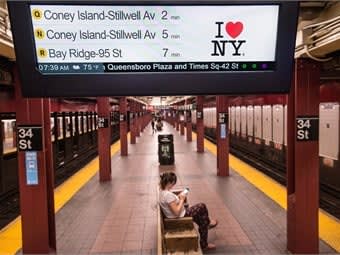
Instead of leaning over the platform, all riders have to do is look up and the arrivals of the next trains are displayed in real time.
Then, prompted by New York State Gov. Andrew M. Cuomo, innovation combined with the arrival of a new technology to create a solution. That solution involves the use of beacon technology. In description, the system being piloted is relatively simple: Installed on platforms are Bluetooth receivers that communicate with beacons placed on the first and last cars of a subway train. As the train enters a station, the system uses its arrival and departure times to estimate the time at which the train will reach the next stop. That information is them transmitted via Wi-Fi to the LCD screens.
“Governor Cuomo challenged the MTA to develop an aggressive approach to putting countdown clocks on the lettered lines, and our technology team’s response has been phenomenal,” commented MTA Chairman & CEO Thomas F. Prendergast. “In very short order, they developed an easy-to-deploy, cost-effective system that we think will play a central role in bringing this essential service to more and more of our customers.”
Implementation, testing
The MTA has begun a 90-day test of countdown clocks in eight stations along the N, Q, and R lines in Manhattan. The clocks, which have been an enormous success along the 1 through 6 lines, are being tested along the Broadway Line at 23rd Street; 28th Street; 34th Street-Herald Square; 42nd Street; 49th Street; 57th Street-7th Avenue; 5th Avenue/59th street; and Lexington Avenue/59th Street.
Two countdown clocks with enhanced LCD screens have been installed on each subway platform. The LCD screens, which look much like computer screens, have the added capability of displaying public service announcements and other content, a step forward from the digital display LCD screens currently in use.
New York City Transit President Ronnie Hakim noted that countdown clocks are the type of customer-friendly amenity that is helping bring the 113-year-old subway system into the 21st century. “The largest part of our system was planned and built long before this technology was a gleam in the eye of the most imaginative science-fiction writer but we are taking on the challenge of making it accessible and commonplace for our customers,” she says.
The MTA has begun a 90-day test of countdown clocks in eight stations along the N, Q and R lines in Manhattan.
The new clocks rely on technology that is straightforward, cost effective and does not require large infrastructure. The system uses the existing wireless network in the stations and cloud computing, and involves four Bluetooth receivers placed in each station, two at each end of the platform. These receivers communicate with four Bluetooth devices that have been installed in the first and last two in the front and two in the rear of each train.
During the 90-day test of the clocks, the MTA will work to identify and correct any issues with the new system. The goal is to evaluate the accuracy of location data, performance of Transit Wireless infrastructure, performance of the LCD displays, physical and network security of Bluetooth devices, security of data being transmitted, and internal access and use of data being generated.
“It is highlighted by the fact that technology is really catching up with and making possible many of the things we want to make available to our customers,” says Sidney Gellineau, the MTA’s chief information officer and leader of the project team.
The next step
In anticipation of the successful completion of the test, the MTA is developing a rollout plan for countdown clocks across the lettered lines. There are 152 stations on the numbered lines with real time train arrival information. Clocks will be installed on the 7 line as part of the ongoing CBTC project. Countdown clocks currently serve 176 stations, including the 24 stations along the L, and plans call for the installation of the clocks in all 269 lettered-line stations.
Charles Seaton is transit director, marketing, for MTA NYC.
More Rail

New York MTA Advances Final Contract for Second Avenue Subway Expansion
Contract Four is the largest in the Second Avenue Subway Phase 2 project and includes construction of station infrastructure, tracks, and signals for the subway expansion, MTA officials said. Work on Contract Four will begin in 2027.
Read More →
San Diego MTS Breaks Monthly Trolley Ridership Record
Agency officials said July’s ridership indicates MTS’s continued recovery from the pandemic.
Read More →
Report Examines NJ TRANSIT Reliability, Funding Challenges
The Garden State Initiative analysis examines the roles of Amtrak infrastructure, fleet management, and agency operations while recommending a more performance-based approach to improving reliability.
Read More →
Stadler, CapMetro Sign Long-Term Rail Fleet Support Agreement
Beginning in 2027, Stadler will provide on-site technical expertise, spare parts support, training, and obsolescence management to help extend the reliability and longevity of CapMetro’s GTW fleet.
Read More →
Biz Briefs: Alstom Lands Canadian Contract, LYT to Supply California TSP, and More
In METRO's latest installment, we take a look at recent news from Complete Coach Works, Beep, FlixBus, and more partnerships making headlines across the transportation sector.
Read More →
CATS Gold Line Marks 5 Years of Service, 2.8M Passenger Trips
With a six-mile expansion planned, the Charlotte streetcar is positioned to connect more neighborhoods and major transit hubs across the region.
Read More →
Why Simulating Pedestrian Movement Has Become Essential for Modern Rail Stations
Pedestrian microsimulation is helping rail planners identify bottlenecks, test station designs, and prepare complex transit hubs for growing passenger volumes.
Read More →
Amtrak Begins Major Construction at New York’s Sunnyside Yard
The new maintenance facility will support Amtrak’s Airo trainsets while improving maintenance efficiency and turnaround times in New York.
Read More →
Chicago Leaders Unveil Plans for O’Hare Airport Express Train
The privately developed project would offer a 15-minute trip between downtown and O’Hare’s Terminal 2, with trains operating every 15 minutes on a dedicated track. The service would use battery-electric trains and three existing freight rail rights-of-way.
Read More →
OCTA Maps Out 30-Year Strategy to Protect Coastal Rail Corridor
The draft feasibility report identifies strategies to protect the coastal rail line for decades as the agency continues near-term stabilization and sand placement efforts.
Read More →