



Publisher's Perspective: A good year for new service openings, but not funding certainty
The New Year that just began should be a good one for the launching of new rail and bus rapid transit lines and extensions to existing networks, with the project schedules we’ll look at below.
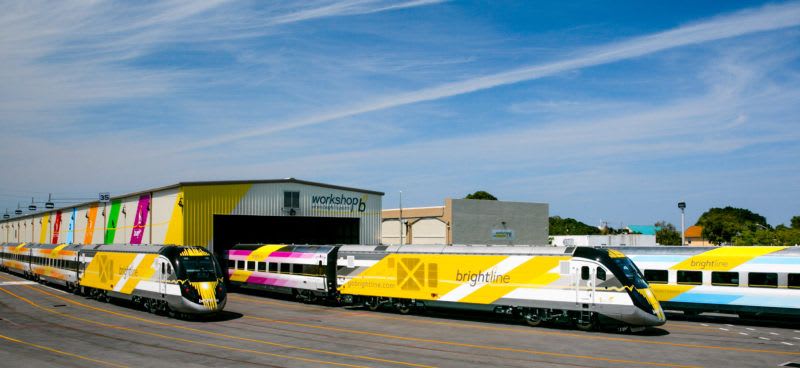
Brightline
Brightline
The New Year that just began should be a good one for the launching of new rail and bus rapid transit lines and extensions to existing networks, with the project schedules we’ll look at below. Given the uncertain state of future funding at the federal level and in more than a few states, however, 2019 may be the end of the trend.
Project investment totals $13 billion
According to Transport Politic, public transportation planner Yonah Freemark’s popular blog, no fewer than 29 major capital projects are expected to open their doors in North American countries this year — totaling 340 route-miles of new service. The investment totals $13.2 billion, comprising projects in the U.S., Mexico, and Canada. An additional 366 route-miles comprising budgets exceeding $75 billion are scheduled to be under construction throughout the course of the year, with their openings planned for dates beyond 2018.
One heavy rail extension is set to begin revenue service (the San Francisco Bay Area Rapid Transit’s extension to San Jose), while five new light rail lines will open in 2018 (two in Mexico, including Guadalajara and Monterrey; two in Canada, including Kitchener-Waterloo and Ottawa in Ontario; and a fifth in Charlotte, N.C.). Four new streetcar lines are set to begin service (El Paso, Texas; Milwaukee, and Oklahoma City), along with five new commuter rail lines (San Francisco; Denver; Fort Worth, Texas; Hartford, Conn.; and Mexico City), as well as an extension of SunRail in Orlando, Fla. Finally, no fewer than 11 bus rapid transit lines are set to open this year, along with three major multimodal station projects (in San Francisco; Raleigh, N.C.; and Miami) are expected to open during the year.
These events exclude the opening of Brightline, the nation’s first high-speed rail service in many decades. This project is also the nation’s first privately owned and operated regularly scheduled intercity passenger rail service in 35 years.
Will the good times last?
Prospects for the projects slated for revenue service beginning beyond this year, however, will depend on whether many of them can resolve some significant policy and funding challenges. While the new federal administration and Congress have acted last year to cut significant environmental and other regulatory reviews, it has not come with any additional funding certainty. At press time, the Trump Administration released additional details regarding its policy principles for its long-promised major infrastructure investment initiative, what details emerged came with no significant revenues and policies that left much of the bill to be paid by states and localities, many of which are already cash-strapped and over-leveraged.
Our industry must take this as an opening to continue engagement — for at this point, that is all that it is.
More Management

METRO Opens Submissions for 2026 Motorcoach Awards
Nominations are now being accepted for METRO Magazine’s Operator of the Year and Innovative Operator of the Year awards.
Read More →
New York MTA Advances Final Contract for Second Avenue Subway Expansion
Contract Four is the largest in the Second Avenue Subway Phase 2 project and includes construction of station infrastructure, tracks, and signals for the subway expansion, MTA officials said. Work on Contract Four will begin in 2027.
Read More →
Transit Agencies Highlight Safety Gains at National Summit
Leaders from 15 major transit systems shared crime-reduction results and safety initiatives while discussing the role of continued federal support.
Read More →

NITA Names New Leadership, Expands Reduced-Fare Program at First Board Meeting
The new regional transit authority appointed its first board chair and interim executive director while extending reduced fares across CTA, Metra, and Pace for eligible riders.
Read More →
Beyond the Checklist: A Structured Approach to Transit Maintenance
Reliability-Centered Maintenance helps transit agencies move beyond routine checklists to focus limited resources on the assets and failures that have the greatest impact on safety, reliability, and service.
Read More →
APTA 2026 Nominating Committee Selects Leadership Slate, Names Chair and Vice Chair Nominees
Leadership changes will help shape the association’s priorities and its representation of the transportation industry during the 2026–2027 term.
Read More →
DART Launches Major Security, Fare Enforcement Initiative
The 90-day demonstration will deploy coordinated security teams at five light rail stations while testing controlled access and gathering data to guide future investments.
Read More →
Advancing Fare Collection Through Technology and Innovation
Learn about delivering 1300 gates at 91 stations while managing fare evasion. Explore the large scale deployment, solution customization and real-world results that affect the region. Prepare for deployment in your region now.
Read More →
Game Day in Motion: Moving Millions During the 2026 World Cup
Between packed transit stations and team motorcoaches, see how agencies and operators across North America tackled the transportation demands of the 2026 FIFA World Cup.
Read More →
Surface Transportation Extension Averts Shutdown, Leaves Transit Funding Gap
The stopgap keeps federal transportation programs moving, but missing advance funding could complicate the transit and rail projects agencies are planning next.
Read More →