




RELATED: How transit agencies can prepare for a driverless world
A transit employer’s duty to bargain over automation: Introduction
Three types of labor laws govern transit employment: NLRA, the RLA or state-specific public sector collective-bargaining statutes.
December 3, 2019
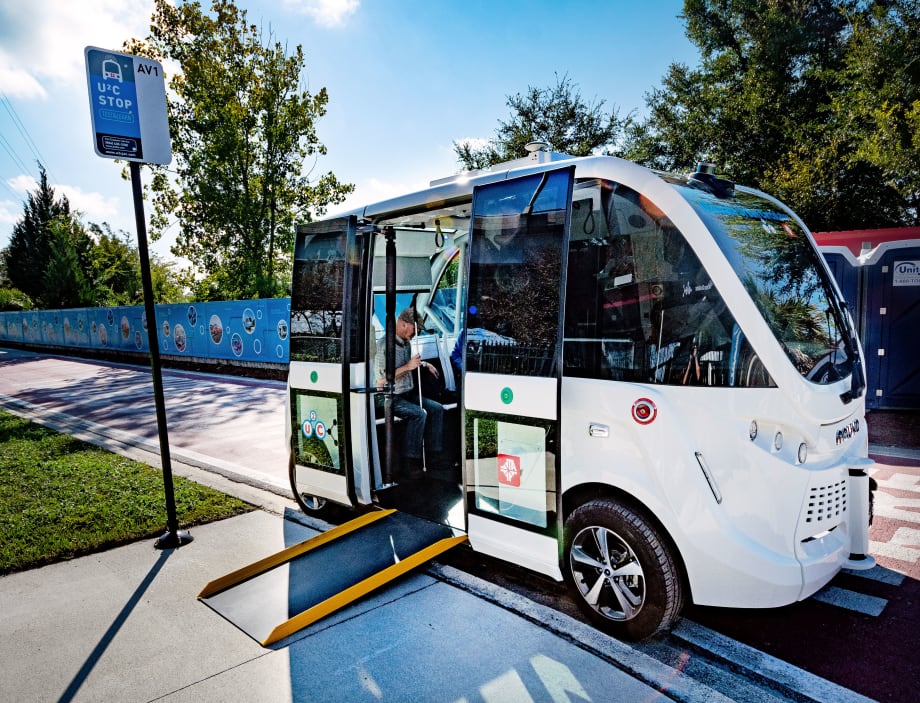
Fla.’s Jacksonville Transportation Authority is testing the first ADA accessible NAVYA autonomous vehicle prototype in the U.S. at its Ultimate Urban Circulator Test and Learn Track.
JTA
4 min to read
Fla.’s Jacksonville Transportation Authority is testing the first ADA accessible NAVYA autonomous vehicle prototype in the U.S. at its Ultimate Urban Circulator Test and Learn Track.
JTA
This is the second post in a five-part weekly series reviewing the legal landscape for transit employers considering automation. (Click here for first article.)
When a transit authority considers automation, a duty to bargain with labor over the decision to automate and a duty to bargain over the effects of the decision may arise. The source of the duty may be one of three types of labor laws that govern the transit employment relationship: the National Labor Relations Act (NLRA), the Railway Labor Act (RLA) or state-specific public sector collective bargaining statutes. This post will discuss the duty to bargain generally.
Coverage
First, a bit of background about the three statutory sources of the duty to bargain. The NLRA applies to private sector employers that engage in a minimal level of interstate commerce. Trucking, busing and shipping companies that transport passengers or goods and have a gross annual volume of at least $50,000 are covered. Other transit systems are covered if they have a gross annual volume of at least $250,000. The law does not apply to the federal government, state governments or their political subdivisions, or any person subject to the Railway Labor Act.
The RLA applies to “carriers”: railroads, airlines and any company directly or indirectly owned or controlled by, or under common ownership with a railroad or airline that performs a service in connection with transportation. A rail carrier is “a person providing common carrier railroad transportation for compensation.” The RLA covers both “direct” rail and air carriers and enterprises “owned or controlled by or under common control with” a direct rail or air carrier. Direct rail carriers include freight railroads, Amtrak, other entities that provide intercity rail passenger service, and commuter rail passenger operators. A railroad owned by a state or other governmental authority that provides freight transportation service has been found to be a carrier for purposes of the RLA.
Public employers, who are specifically excluded from coverage under the NLRA and RLA, may have a duty to bargain if the states in which they operate have applicable labor laws that address the duty. (A survey of the various state law requirements is beyond the scope of this blog.)
The Collective Bargaining Agreement
Regardless of which statutory scheme governs the relationship, an employer must first determine whether its collective bargaining agreement with a union addresses the implementation of automation, robotics or artificial intelligence. If it does, the employer must next determine whether it has agreed to bargain over the decision to automate or if its agreement reserves such decisions to management. These matters might be addressed in work preservation, subcontracting or management rights clauses.
If the collective bargaining agreement is silent on the issue of automation, the employer may be required to bargain with the union regarding the decision to automate and/or its effects under the applicable statute. Whether the parties must engage in bargaining over the decision, the effects or both will depend upon the workplace action planned by the employer.
The Duty to Bargain Under the NLRA
The NLRA requires employers and unions to meet and confer in good faith with respect to wages, hours, and other terms and conditions of employment. Applying this mandate, the National Labor Relations Board and the courts have developed three categories of bargaining subjects: mandatory, permissive and illegal. Mandatory subjects include rates of pay, wages and hours of employment, and other terms and conditions of employment. Even if the decision to automate is a permissive subject of bargaining, bargaining may be required over the effects of that decision on terms and conditions of employment. After giving notice to the union of a planned workplace action, an employer should give the union an opportunity to request effects bargaining prior to implementation.
The Duty to Bargain Under the RLA
Similarly, under the RLA, carriers and unions must bargain over “rates of pay, rules and working conditions.” Some courts have held that the concepts of mandatory and permissive subjects of bargaining under the NLRA apply under the RLA. However, there is little case law under the RLA on what constitutes a permissive subject of bargaining. The U.S. Supreme Court and lower courts have held that even if there is no duty to bargain over a decision, there is a duty to bargain over the effects of the decision on employees. To the extent that there is an obligation under the RLA to maintain the status quo during effects bargaining, the obligation does not bar the employer from proceeding with the transaction because a bar would transform effects bargaining into decision bargaining.
For a more in-depth analysis and overview of the labor law issues discussed in this series, please refer to our white paper, Labor Law Issues in Deciding to Automate Mass Transit Operations.
Alvero Hasani is an Associate with Fisher Phillips.
Subscribe to Our Newsletter
More Blog Posts
Building a Winning FTA Grant Proposal: Why Propane Autogas is the Pragmatic Choice for Fleet Resilience
With $610 million available through the FY 2026 Buses and Bus Facilities Competitive Program and the Low or No Emission Grant Program, agencies must build a compelling case before the September 21 deadline that balances environmental compliance with operational feasibility.
Read More →
Velo-city Conference 2026: Latest Trends in Cycling as Part of Urban Mobility
The global cycling conference highlighted how cities are integrating bicycles into multimodal transportation networks, expanding cycle tourism and reshaping urban mobility.
Read More →
Kindness Isn’t Soft...It’s Strategic.
Mike Bismeyer — often known as “The Kindness Guy” — has spent more than 17 years in public transit and mobility, serving in industry leadership roles, speaking across North America, and advocating for stronger workplace cultures. But his message doesn’t come from theory. It comes from lived experience.
Read More →
Inside ITF 2026: Transport Reacts to A Challenging World
Transport leaders from around the world gathered in Leipzig, Germany, for the 2026 International Transport Forum to discuss resilience, climate impacts, supply chains and the future of sustainable mobility.
Read More →
Every Ride Tells a Story — But You’re Not Just Selling the Ride
You’re selling the moment, the meaning, and the emotion behind it.
Read More →
How Digital Signage is Reshaping the Traveler Experience at Transportation Hubs
What was once a landscape of static signs has evolved into a responsive, immersive environment powered by real-time visual communication.
Read More →
Latest Trends in Urban Mobility from Polis Conference 2025
Polis comprises cities and regions, as well as corporate partners, from across Europe, promoting the development and implementation of sustainable mobility. This year’s event had over a thousand attendees across various policy forums and an exhibition.
Read More →
Why Transit Leaders Require Better Tools for Operational Clarity In Today’s Tech-Fragmented Environment
Across North America and beyond, transit agency officials are contending with a perfect storm of operational headaches and strategic challenges that hamper daily service and long-term progress.
Read More →
The Powerless Brokers: Why California Can’t Build Transit
It is no secret that transit in the U.S. is slow and expensive to build.
Read More →
Why Transport Sustainability Should Focus on People Instead of Cars
Simply incentivizing electrification is not enough to make a meaningful impact; we must shift our focus toward prioritizing public transportation and infrastructure.
Read More →