




RELATED: How Transit Agencies are Alleviating Paratransit Demand
ADA sensitivity training makes drivers MCTS' 'most valuable asset'
Storylines about Milwaukee County Transit System bus operators are always consistent, involving a driver going above and beyond their job description in order to help someone in need.
November 1, 2018
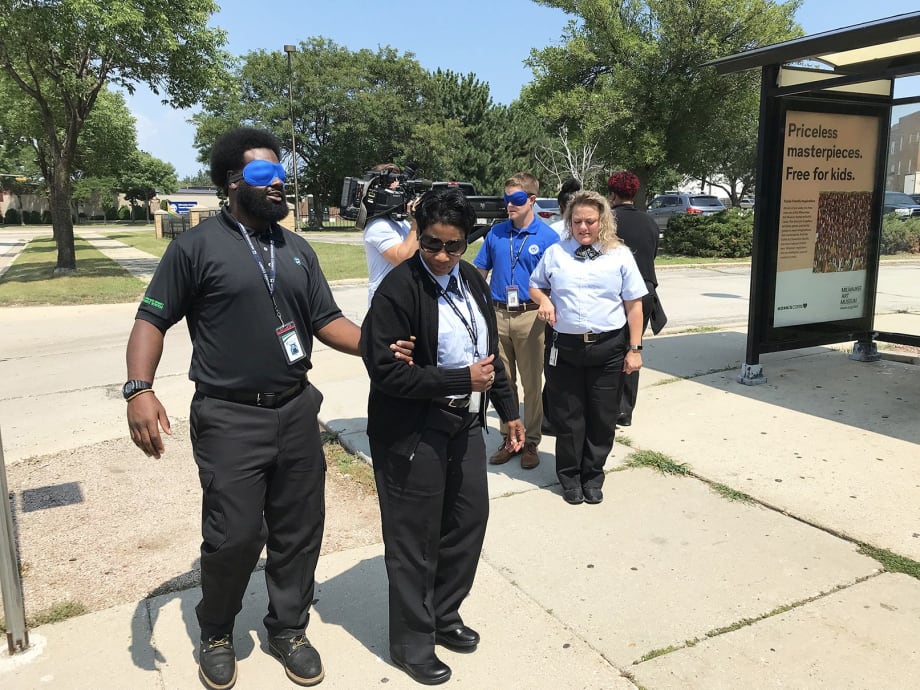
A portion of Milwaukee County Transit System's ADA Sensitivity Training includes a sight-guided exercise. Photo: MCTS
3 min to read
A portion of Milwaukee County Transit System's ADA Sensitivity Training includes a sight-guided exercise. Photo: MCTS
Milwaukee County Transit System (MCTS) bus operators are receiving positive attention from around the world. The storylines are always consistent, involving a driver going above and beyond their job description in order to help someone in need.
Whether they’re assisting a passenger in a wheelchair who is stuck in a pothole or helping a rider who is visually-impaired get across a busy street, our bus operators are eager to lend a helping hand.
Their big and small acts of kindness while on the job are nothing new. But the 10 high-definition cameras mounted on each bus in our fleet are. Our Marketing Department, as part of an innovative campaign called “MCTS Excellence”, has been able to use this surveillance video to tell positive stories highlighting drivers’ good deeds.
These stories of MCTS Excellence are frequently picked up by local, state, national and international media outlets. The videos and social media posts have been viewed and shared hundreds of millions of times.
Many of our drivers credit their headline-grabbing actions to the extensive training they received from MCTS before hitting the road for the first time.
In 2012, MCTS acknowledged that an increasing number of seniors and people with disabilities, especially those using wheelchairs and scooters, were using fixed-route buses.
The New Freedom Team, which is funded by an FTA Mobility Management grant, worked with the MCTS Training Division to develop enhanced ADA Sensitivity Training for all new bus operators.
The training sessions, which were expanded from 45-minute sessions to a full day, include:
Discussions on hidden disabilities and common stereotypes
Training videos, produced by the New Freedom Team, that show students the best ways to assist individuals with disabilities while using the bus
Proper securement procedures for passengers who use mobility devices
Real-life passengers who have disabilities conduct Q&A with students
Students operate a scooter and power wheelchair onto several different styles of buses and practice securing them
Students wear goggles simulating different visual impairments during a sighted-guide exercise
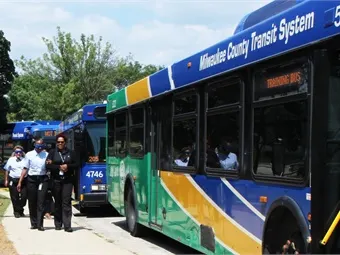
Photo: MCTS
The portion of the ADA Sensitivity Training that seems to leave the biggest impression with students is the sighted-guide exercise. In it, one student wears a blindfold while another practices leading and describing a path of travel from the indoor classroom to a bus stop down the block. After they complete a full lap back and forth, the students switch roles.
A TV news crew that attended a recent training session recorded video of a student wiping away tears after completing the sighted-guide exercise. The student explained that it was very emotional for her to experience what passengers with visual impairments go through every day.
There is always a positive vibe at the end of the ADA Sensitivity Training. That enthusiasm then carries over to each new driver’s first days out in regular service.
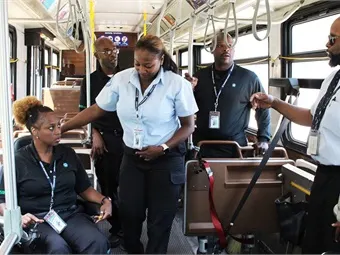
Photo: MCTS
Due to positive operator feedback and MCTS’ continued emphasis on safety and customer service, the ADA Sensitivity Training is going to be expanded once again. It will soon include a day-and-a-half worth of activities and instruction. This will allow the students even more time to practice learning the skills that they will need to help passengers in the community.
Thanks to all of the positive exposure and attention from around the globe, the general public is starting to realize what we’ve known all along: MCTS operators are our most valuable asset. Their skills, dedication, compassion and kindness make them much more than “just” a bus driver; they’re often a rider’s best friend.
Chris Fox is the Mobility Coordinator for the Milwaukee County Transit System.
Subscribe to Our Newsletter
More Blog Posts

Five Years Later: What’s Changed at Greyhound
Five years after Flix acquired it, Greyhound reflects on fleet modernization, operational improvements, employee empowerment, and a renewed focus on customer experience.
Read More →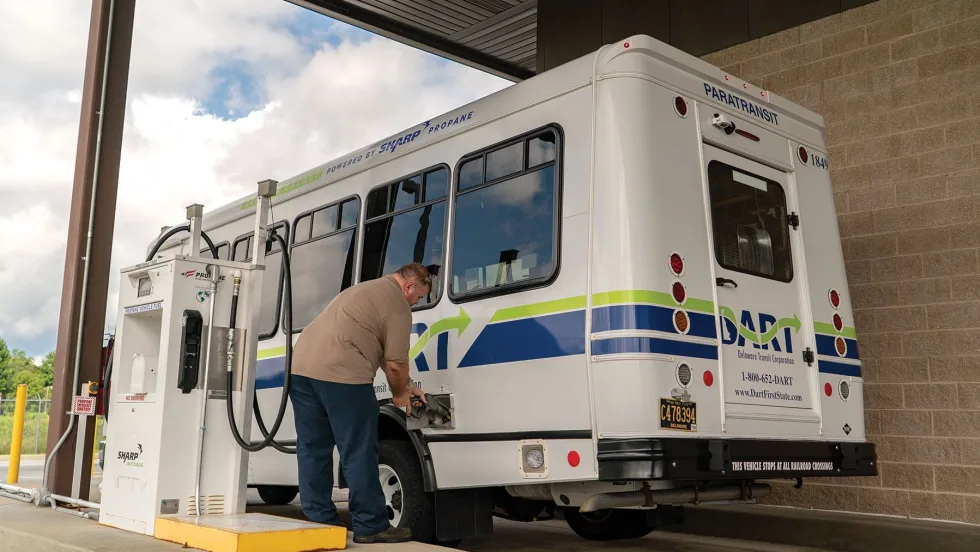
Building a Winning FTA Grant Proposal: Why Propane Autogas is the Pragmatic Choice for Fleet Resilience
With $610 million available through the FY 2026 Buses and Bus Facilities Competitive Program and the Low or No Emission Grant Program, agencies must build a compelling case before the September 21 deadline that balances environmental compliance with operational feasibility.
Read More →
Velo-city Conference 2026: Latest Trends in Cycling as Part of Urban Mobility
The global cycling conference highlighted how cities are integrating bicycles into multimodal transportation networks, expanding cycle tourism and reshaping urban mobility.
Read More →
Kindness Isn’t Soft...It’s Strategic.
Mike Bismeyer — often known as “The Kindness Guy” — has spent more than 17 years in public transit and mobility, serving in industry leadership roles, speaking across North America, and advocating for stronger workplace cultures. But his message doesn’t come from theory. It comes from lived experience.
Read More →
Inside ITF 2026: Transport Reacts to A Challenging World
Transport leaders from around the world gathered in Leipzig, Germany, for the 2026 International Transport Forum to discuss resilience, climate impacts, supply chains and the future of sustainable mobility.
Read More →
Every Ride Tells a Story — But You’re Not Just Selling the Ride
You’re selling the moment, the meaning, and the emotion behind it.
Read More →
How Digital Signage is Reshaping the Traveler Experience at Transportation Hubs
What was once a landscape of static signs has evolved into a responsive, immersive environment powered by real-time visual communication.
Read More →
Latest Trends in Urban Mobility from Polis Conference 2025
Polis comprises cities and regions, as well as corporate partners, from across Europe, promoting the development and implementation of sustainable mobility. This year’s event had over a thousand attendees across various policy forums and an exhibition.
Read More →
Why Transit Leaders Require Better Tools for Operational Clarity In Today’s Tech-Fragmented Environment
Across North America and beyond, transit agency officials are contending with a perfect storm of operational headaches and strategic challenges that hamper daily service and long-term progress.
Read More →
The Powerless Brokers: Why California Can’t Build Transit
It is no secret that transit in the U.S. is slow and expensive to build.
Read More →