



'AIM-ing' High for Succession Planning in the Transportation Industry
How do you replace the institutional knowledge and subject expertise of a 40-year employee? You do it through succession planning, which is especially necessary in the transportation industry where senior level managers often have well over 25 years’ experience.

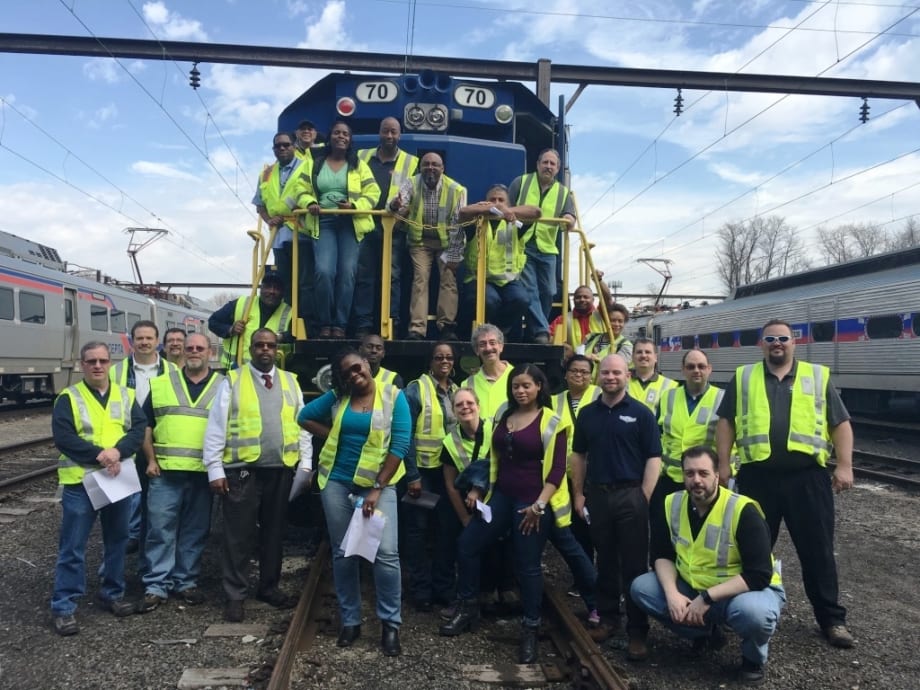
SEPTA's AIM/AD class out in the field. As part of their coursework, they visit various SEPTA sites to learn about every aspect of the Authority as well as shadow other SEPTA managers and directors. Photo: SEPTA
SEPTA's AIM/AD class out in the field. As part of their coursework, they visit various SEPTA sites to learn about every aspect of the Authority as well as shadow other SEPTA managers and directors. Photo: SEPTA
How do you replace the institutional knowledge and subject expertise of a 40-year employee? You do it through succession planning, which is especially necessary in the transportation industry where senior-level managers often have well over 25 years of experience.
In 2012, the Southeastern Pennsylvania Transportation Authority (SEPTA) launched its Advancing Internal Management for Assistant Directors (AIM AD) program to develop a pool of potential candidates for future critical leadership positions to ensure a smooth transition in the event of planned or unplanned turnover in key roles throughout the Authority.
“We identified 12 high-priority jobs that would need to be filled immediately, should someone retire or resign,” said SEPTA GM Jeffrey Knueppel. “We wanted to make sure potential internal candidates had the leadership skills and experience to move into one of those positions if and when needed.”
To participate in the program, employees had to meet minimum requirements and complete an application process, including submitting resumes, letters of recommendation and career statements. Candidates also needed to be qualified to fill the key vacancies at the time of the application process or within five years.
“We had 30 participants in the first class, which lasted one year,” said Knueppel. “No one was guaranteed a promotion following completion of the AIM AD program. Their goal was to expand and enrich their capacity as leaders. These skills would be applicable for a variety of positions at SEPTA.”

SEPTA
With the success of the AIM AD program, the agency evaluated its preparation of candidates for assistant director positions in transportation, maintenance and construction. “Many organizations prepare top-level management, but not the first-level managers that supervise hourly employees in the field,” said Josh Gottlieb, director, administration and finance, SEPTA Surface Transportation, and a co-developer of the authority’s AIM AD program. “I think SEPTA is unique in making this type of commitment to preparing our staff to moving into supervisory roles.”
Jennifer Barrett, SEPTA senior training facilitator, and Gottlieb worked to develop a program that would be practical for employees preparing to take a “step up” in their careers; a program that would broaden their institutional knowledge through interaction with the agency's leadership and introduction to a variety of jobs across the Authority. “The ultimate goal of the program was to expand the pool of supervisors who are ready to move into assistant director positions in our Operations and Engineering, Maintenance and Construction divisions,” said Barrett. “We would do this using a core curriculum — a body of knowledge required for success as assistant directors; mentoring, cross training and job shadowing.”

SEPTA
To identify a pool of program candidates, Barrett and Gottlieb used departmental evaluations and Profile XT, an assessment tool that measures how well an individual fits specific jobs within an organization. Categories measured include thinking style, behavioral traits and occupational interests. The online program, which costs $150 per assement, was administered at SEPTA’s Testing Center and took approximately 60 minutes to complete, with 145 candidates participating. This was the first time the agency used Profile XT. There are plans to use the assessment again with the next AIM AD program.
Out of almost 100 applicants, 27 people are now enrolled in the year-long program, which began in November 2015.
“The participants have excelled in the program,” said Barrett. “The group members ask thought-provoking questions when we have guest speakers in the classroom and have shown great interest when out in the field. They realize that SEPTA is providing them with a unique opportunity to help further their careers and they are taking advantage of what the program has to offer them.”

SEPTA
Of the 27 class members, six have already been promoted to assistant directors (but are still finishing the AIM AD program) and three are in pools to be promoted. “We are especially proud of the program’s success rate thus far, when we just reached its halfway point,” said Gottlieb.
The program participants are appreciative of the opportunity provided by the AIM AD program. Stan Goff, maintenance manager at SEPTA’s Regional (commuter) Rail Frazer shop, said “Those of us that are first-level managers usually have our hands full with our immediate tasks and what is going on in front of us. We don't know what other groups in our own mode are doing much less what is going on in the other modes. Going to class with such a diverse group from all over SEPTA exposes you to a whole array of other people's daily tasks and experiences.”
“We have had the opportunity to meet with SEPTA’s leadership to get an idea of the ‘Big Picture.’ Now we have an opportunity to spread that information to the people that we manage. AIM AD has taught me the value of networking and working together as one cohesive team,” added Eric Barnes, SEPTA assistant director, Surface Transportation.
“My favorite component of the program is the leader behavior analysis sessions,” said Shakirah K. Smith, a member of SEPTA’s Suburban Operations group. “These sessions have given me the confidence to pursue my goals without a doubt. Now, I have concrete evidence and support to pursue what I always thought I was suited to be, a leader.”
Keith Seward, a 26-year employee, was recently promoted to assistant director, station operations. “As a participant in the program, you are assigned a mentor and a coach who inspire and help bring out all of your talents,” he said. “I believe the program has armed me with all of the right tools to be an effective manager and was very instrumental in my promotion.”
Heather Redfern is the Public Information Manager for the Southeastern Pennsylvania Transportation Authority.
More Blog Posts
Building a Winning FTA Grant Proposal: Why Propane Autogas is the Pragmatic Choice for Fleet Resilience
With $610 million available through the FY 2026 Buses and Bus Facilities Competitive Program and the Low or No Emission Grant Program, agencies must build a compelling case before the September 21 deadline that balances environmental compliance with operational feasibility.
Read More →
Velo-city Conference 2026: Latest Trends in Cycling as Part of Urban Mobility
The global cycling conference highlighted how cities are integrating bicycles into multimodal transportation networks, expanding cycle tourism and reshaping urban mobility.
Read More →
Kindness Isn’t Soft...It’s Strategic.
Mike Bismeyer — often known as “The Kindness Guy” — has spent more than 17 years in public transit and mobility, serving in industry leadership roles, speaking across North America, and advocating for stronger workplace cultures. But his message doesn’t come from theory. It comes from lived experience.
Read More →
Inside ITF 2026: Transport Reacts to A Challenging World
Transport leaders from around the world gathered in Leipzig, Germany, for the 2026 International Transport Forum to discuss resilience, climate impacts, supply chains and the future of sustainable mobility.
Read More →
Every Ride Tells a Story — But You’re Not Just Selling the Ride
You’re selling the moment, the meaning, and the emotion behind it.
Read More →
How Digital Signage is Reshaping the Traveler Experience at Transportation Hubs
What was once a landscape of static signs has evolved into a responsive, immersive environment powered by real-time visual communication.
Read More →
Latest Trends in Urban Mobility from Polis Conference 2025
Polis comprises cities and regions, as well as corporate partners, from across Europe, promoting the development and implementation of sustainable mobility. This year’s event had over a thousand attendees across various policy forums and an exhibition.
Read More →
Why Transit Leaders Require Better Tools for Operational Clarity In Today’s Tech-Fragmented Environment
Across North America and beyond, transit agency officials are contending with a perfect storm of operational headaches and strategic challenges that hamper daily service and long-term progress.
Read More →
The Powerless Brokers: Why California Can’t Build Transit
It is no secret that transit in the U.S. is slow and expensive to build.
Read More →
Why Transport Sustainability Should Focus on People Instead of Cars
Simply incentivizing electrification is not enough to make a meaningful impact; we must shift our focus toward prioritizing public transportation and infrastructure.
Read More →