



Connected Vehicles: An important step forward for the transit community
NHTSA estimates that a connected vehicle network could potentially address 80% of all unimpaired crash scenarios, a safety leap exceeding even seat belts and airbags. The Research and Innovative Technology Administration and FTA are working with transit agencies and stakeholders to advance connected vehicle applications that will help improve safety, mobility and convenience for transit riders.
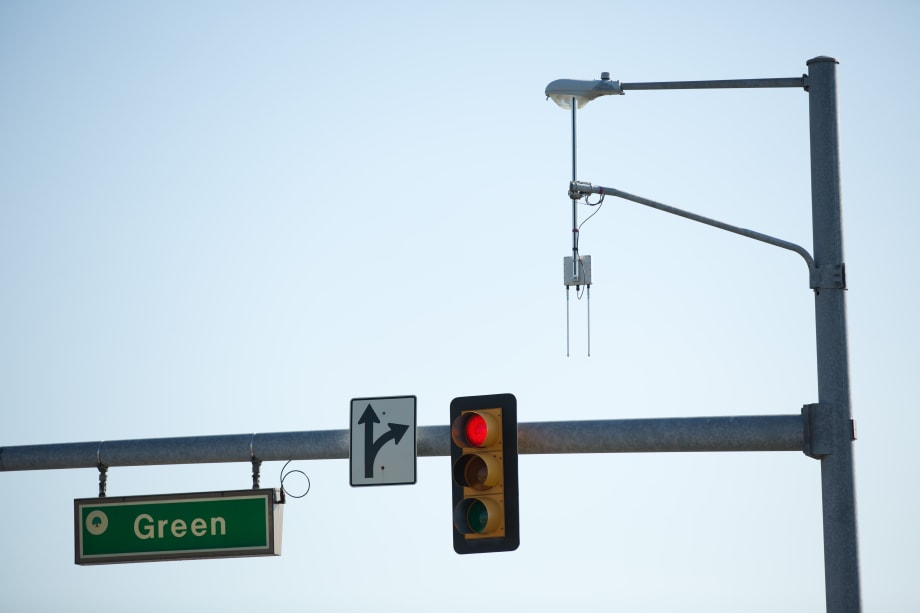
Signal equipment used in the University of Michigan Transportation Research Institute connected vehicle test.

Later this year the U.S. Department of Transportation will make an important decision about the future of connected vehicles, widely seen as the next major breakthrough in vehicle and pedestrian safety.
You may have heard of connected vehicles. This innovative technology enables real-time communication between vehicles and with the roadway infrastructure and mobile devices to help prevent crashes while providing new mobility benefits.
Excitement has been growing as automakers, tech companies and transportation officials work together to create a secure, interoperable wireless communications system that has the potential to save thousands of lives each year and modernize the driving experience.
While vehicle safety efforts have historically focused on reducing the impact of crashes after they happen, connected vehicles will warn drivers about dangerous situations in real time so they can avoid crashes in the first place.
The National Highway Traffic Safety Administration (NHTSA) estimates that a connected vehicle network could potentially address 80% of all unimpaired crash scenarios, a safety leap exceeding even seat belts and airbags. Just last month the National Transportation Safety Board (NTSB) made a formal recommendation to NHTSA that the technology be installed on all newly manufactured vehicles.
Right now in Ann Arbor, Mich., nearly 3,000 cars, buses, trucks and motorcycles are driving around equipped with connected vehicle technology in a final real-world test before U.S. DOT makes its highly-anticipated decision later this year on whether and how the technology should be implemented. A similar decision for heavy-duty vehicles will be made by the end of 2014.
While much of the focus has been on the future of automobiles, the extremely important impact of connected vehicles on public transportation is often lost in the excitement.
The U.S. DOT’s Research and Innovative Technology Administration (RITA) and Federal Transit Administration (FTA) are working with transit agencies and stakeholders to advance connected vehicle applications that will help improve safety, mobility and convenience for transit riders.
Among these is an application that will warn a bus driver turning into an intersection if a pedestrian is in a crosswalk. Another application will warn drivers about vehicles making illegal right turns in front of transit buses as the driver pulls away from a bus stop. I am comfortable guessing that almost all transit drivers have experienced one or both of these scenarios.
Many existing technologies will also be greatly enhanced as a result of connected vehicle technology. A few examples include transit-preferential traffic signals that stay green longer when a bus is approaching, real-time bus and train arrival and departure information, dynamic ridesharing applications that require real-time location information and demand-responsive transit services that match low-income and elderly travelers with human service transportation providers.
We are living in an increasingly interconnected world, and our transportation system is playing catch-up. Thankfully, connected vehicles and smarter infrastructure are fast-approaching solutions that will change the way we live, work and travel.
To learn more about ITS America and Connected Vehicles, visit us online at www.itsa.org or visit the U.S. DOT’s ITS Joint Program Office online at http://www.its.dot.gov.
In case you missed it...
Read our METRO blog, "A campus-centered service unifies the community"
More Blog Posts

Velo-city Conference 2026: Latest Trends in Cycling as Part of Urban Mobility
The global cycling conference highlighted how cities are integrating bicycles into multimodal transportation networks, expanding cycle tourism and reshaping urban mobility.
Read More →
Kindness Isn’t Soft...It’s Strategic.
Mike Bismeyer — often known as “The Kindness Guy” — has spent more than 17 years in public transit and mobility, serving in industry leadership roles, speaking across North America, and advocating for stronger workplace cultures. But his message doesn’t come from theory. It comes from lived experience.
Read More →
Inside ITF 2026: Transport Reacts to A Challenging World
Transport leaders from around the world gathered in Leipzig, Germany, for the 2026 International Transport Forum to discuss resilience, climate impacts, supply chains and the future of sustainable mobility.
Read More →
Every Ride Tells a Story — But You’re Not Just Selling the Ride
You’re selling the moment, the meaning, and the emotion behind it.
Read More →
How Digital Signage is Reshaping the Traveler Experience at Transportation Hubs
What was once a landscape of static signs has evolved into a responsive, immersive environment powered by real-time visual communication.
Read More →
Latest Trends in Urban Mobility from Polis Conference 2025
Polis comprises cities and regions, as well as corporate partners, from across Europe, promoting the development and implementation of sustainable mobility. This year’s event had over a thousand attendees across various policy forums and an exhibition.
Read More →
Why Transit Leaders Require Better Tools for Operational Clarity In Today’s Tech-Fragmented Environment
Across North America and beyond, transit agency officials are contending with a perfect storm of operational headaches and strategic challenges that hamper daily service and long-term progress.
Read More →
The Powerless Brokers: Why California Can’t Build Transit
It is no secret that transit in the U.S. is slow and expensive to build.
Read More →
Why Transport Sustainability Should Focus on People Instead of Cars
Simply incentivizing electrification is not enough to make a meaningful impact; we must shift our focus toward prioritizing public transportation and infrastructure.
Read More →
Transit ROI & System Efficiencies Will Drive 'Big, Beautiful' Transit Funding
For many years, the narrative surrounding public transit improvements has been heavily weighted toward environmental gains and carbon reduction. While these are undeniably crucial long-term benefits, the immediate focus of this new funding environment is firmly on demonstrable system efficiencies and a clear return on investment.
Read More →