




During my morning bus commute...most of my co-passengers are not taking public transit by choice.
Ending the ‘No Car, No Job; No Job, No Car’ Paradox in Northeast Ohio
During my morning bus commute...most of my co-passengers are not taking public transit by choice.
November 18, 2019
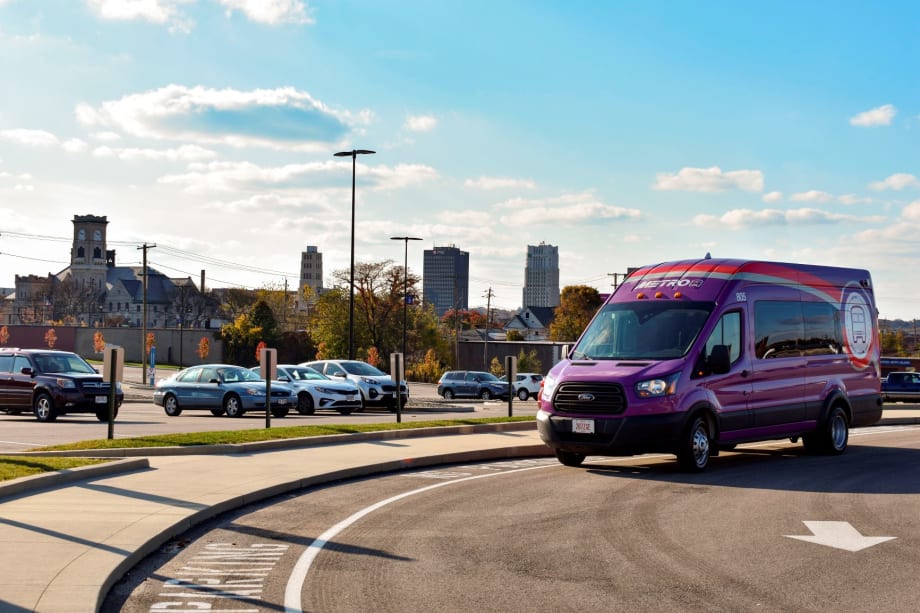
Akron METRO won $75,000 from the Paradox Prize to test its FlexRide program, a door-to-door, on-demand service connecting workers to job hubs in northern Summit County.
Photo: Akron METRO
6 min to read
Northeast Ohio is a region built for the car, evidenced by cross-cutting freeways and huge parking lots that dominate the landscape. For the past year, I have lived carless in this car-centric community, using public transportation, ride-hailing services and my bike to get around.
During my morning bus commute, I have come to know many other carless residents — workers who wake up before daybreak to travel two hours to get to jobs on time, mothers who drop off their children at daycare in one part of the city before taking another bus to get to work on the opposite end, and those traveling by bus because their driver’s license was suspended for any number of offenses (in many cases, some that have nothing to do with driving). Most of my co-passengers are not taking public transit by choice.
They face challenging commutes, if they can get to a job at all, because of decades of development patterns that have isolated entire neighborhoods. Without a car, it’s like living on an island without bridges or boats and everything you need is across the water.
This reality is the result of decades of outward migration by businesses and residents, without an increase in jobs or population to substantiate the spread. A 2016 report from the Brookings Institution found that, out of 96 metro areas, the Cleveland MSA saw the largest drop in the number of jobs near where people lived. Roughly 1 in 4 jobs disappeared for the average resident. Not surprisingly, vehicle miles traveled (VMT) has increased by 21 percent over the last two decades.
Northeast Ohio’s history of no-growth sprawl is challenging and harmful for:
Transit systems, which are expected to do more with less (the Greater Cleveland Regional Transit Authority, for example, is expected to serve all of Cuyahoga County on a tight budget, compromising many of these levels of service);
Municipalities, which are overburdened fiscally by having to support new infrastructure while maintaining the old;
Businesses, which struggle to fill open positions;
The environment, which suffers as air quality declines due to long, car-based commutes; and, most importantly,
People, who spend more time and money commuting, if they can get to a job in the first place.
Essentially, the options for residents are: a commute by public transit that can be as long as three hours every day, an expensive commute by car that can consume more than an hour’s worth of wages, or a significantly smaller set of employment opportunities closer to home. Too many residents, especially persons of color and those living in low-income areas with low rates of car ownership, find themselves stuck in an intractable scenario: no car, no job; no job, no car.
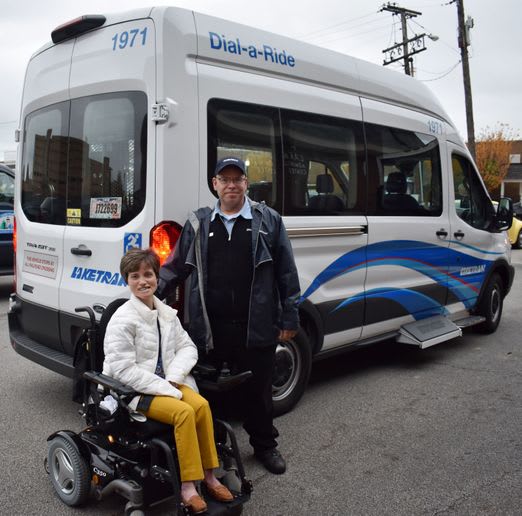
Laketran rider Kim Stenger with driver Ken Bowers getting a ride to work.
Photo: Laketran
The Fund for Our Economic Future, an alliance of Northeast Ohio funders working to achieve economic growth with equitable access to opportunity, has been focused for more than a decade on improving the spatial aspects of the region’s growth, calling for efforts that bring jobs to people and people to jobs. In June, the Fund joined with several other partners to launch The Paradox Prize.
This innovation challenge is open to anyone—nonprofits, employers, mobility providers, individuals, public institutions—and seeks ideas that will improve the mobility of Northeast Ohioans stranded economically by their geography.
The Paradox Prize will grant up to $1 million in funding and technical assistance to support up to 15 pilots over the next three years. We structured this as a public competition in the hopes that it builds awareness around transportation challenges in the region, while testing innovative mobility options that look beyond car ownership and work on a foundation of transit.
We pulled together a regional Advisory and Selection Committee comprising of experts in transit, workforce development, philanthropy, and business to review and select ideas. More than 80 proposals were received in the first two rounds. Proposed solutions included different forms of ridesharing, shuttle services, transit agencies testing new routes, MaaS applications, community or co-op based transportation, commuter benefits, and multimodal solutions.
So far, five winners have been named:
Manufacturing Works, a manufacturing coalition for small and medium businesses, working with the Cleveland Clergy Coalition and the American Association of Clergy and Employers, won $100,000 to connect church-based hubs in two low-income neighborhoods in Cleveland to outlying job hubs in the county with limited to no public transportation access, using church vans that typically sit idle throughout the week.
Akron METRO RTA, collaborating with workforce development organization ConxusNEO, won $75,000 to test its FlexRide program, a door-to-door, on-demand service connecting workers to job hubs in northern Summit County that promises to save employers thousands of dollars in reduced turnover and lost down-time, while opening up new job possibilities.
SHARE, a mobility solutions startup, will receive $16,000 to work with the staffing agency Express Employment Professionals to provide ride-sharing services for job seekers from East Cleveland, Euclid and Glenville to the Mentor/Painesville job hub in neighboring Lake County.
Community Action Wayne/Medina’s $100,000 award will build on an existing service and support new technology to create an affordable, flexible, on-demand, vanpooling option to give people access to employment opportunities in a rural area with no public transit.
Laketran, Lake County's public transit operator, will receive $75,000 to test a new on-demand van service from underserved areas to high-paying manufacturing jobs in Lake County, working closely with employers, Lincoln Electric and Component Repair Technologies, the Lake County Board of Commissioners and the Lake County Ohio Port & Economic Development Authority.
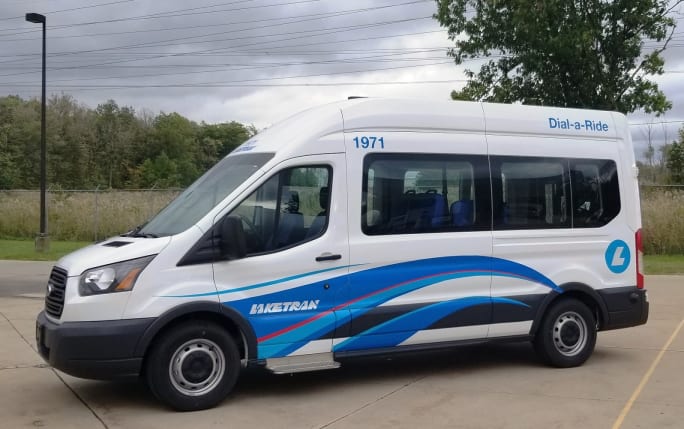
Laketran, Lake County's public transit operator, will receive $75,000 to test a new on-demand van service from underserved areas to high-paying manufacturing jobs.
Photo: Laketran
In total, these pilots will serve up to 200 workers.
As we take a step back and analyze the submissions we’ve received and the pilots funded so far, we are seeing some important lessons emerge. Namely, the need for mobility solutions is greater than we realized; our region (and state) would benefit from an environment that encourages experimentation; and there is more we can be doing as a community to help businesses see the importance of transportation.
With these early lessons in mind, we hope future rounds of The Paradox Prize yield more ideas that:
Increase public transit ridership or improve the rider experience
Come from communities experiencing the challenge
Are supported by the private sector and have the potential to serve a larger scale of employees
Incorporate electric mobility
Integrate multiple modes of transit
The Paradox Prize is welcoming submissions for Round 3 until January 15, 2020. Ultimately, we hope to catalyze not just a range of mobility solutions for our community, but conversations that can bridge the mobility divide in our region and raise the profile of this important issue.
About the Author: Dominic Mathew is an urban and regional planner, mobility innovations for the Cleveland-based nonprofit Fund for Our Economic Future.
Subscribe to Our Newsletter
More Blog Posts
Building a Winning FTA Grant Proposal: Why Propane Autogas is the Pragmatic Choice for Fleet Resilience
With $610 million available through the FY 2026 Buses and Bus Facilities Competitive Program and the Low or No Emission Grant Program, agencies must build a compelling case before the September 21 deadline that balances environmental compliance with operational feasibility.
Read More →
Velo-city Conference 2026: Latest Trends in Cycling as Part of Urban Mobility
The global cycling conference highlighted how cities are integrating bicycles into multimodal transportation networks, expanding cycle tourism and reshaping urban mobility.
Read More →
Kindness Isn’t Soft...It’s Strategic.
Mike Bismeyer — often known as “The Kindness Guy” — has spent more than 17 years in public transit and mobility, serving in industry leadership roles, speaking across North America, and advocating for stronger workplace cultures. But his message doesn’t come from theory. It comes from lived experience.
Read More →
Inside ITF 2026: Transport Reacts to A Challenging World
Transport leaders from around the world gathered in Leipzig, Germany, for the 2026 International Transport Forum to discuss resilience, climate impacts, supply chains and the future of sustainable mobility.
Read More →
Every Ride Tells a Story — But You’re Not Just Selling the Ride
You’re selling the moment, the meaning, and the emotion behind it.
Read More →
How Digital Signage is Reshaping the Traveler Experience at Transportation Hubs
What was once a landscape of static signs has evolved into a responsive, immersive environment powered by real-time visual communication.
Read More →
Latest Trends in Urban Mobility from Polis Conference 2025
Polis comprises cities and regions, as well as corporate partners, from across Europe, promoting the development and implementation of sustainable mobility. This year’s event had over a thousand attendees across various policy forums and an exhibition.
Read More →
Why Transit Leaders Require Better Tools for Operational Clarity In Today’s Tech-Fragmented Environment
Across North America and beyond, transit agency officials are contending with a perfect storm of operational headaches and strategic challenges that hamper daily service and long-term progress.
Read More →
The Powerless Brokers: Why California Can’t Build Transit
It is no secret that transit in the U.S. is slow and expensive to build.
Read More →
Why Transport Sustainability Should Focus on People Instead of Cars
Simply incentivizing electrification is not enough to make a meaningful impact; we must shift our focus toward prioritizing public transportation and infrastructure.
Read More →