



Flying Taxis Could Transform Our Cities If We Set the Right Rules
Might Urban Aerial Mobility be the key to reducing congestion, removing people and packages off roads?

Photo: Embraer/Uber Elevate
(Article originally published on World Economic Forum.)
Urban Aerial Mobility – the movement of goods and people through the skies – has long been a focus for city builders, policymakers, engineers and urban designers trying to understand how unlocking the elusive third dimension of transportation could positively transform people’s lives.
Might Urban Aerial Mobility be the key to reducing congestion, removing people and packages off roads?
Might it enable more people to access well-paid jobs, or will it induce urban sprawl?
How might the addition of flying vehicles such as taxis and drones affect noise, the environment, even our cityscapes and city views?
And could it be accessible to all, regardless of income or neighborhood?
These questions sit at the center of policymaking decisions as new technologies with the potential to transform the organization of urban life emerge – and as it becomes more difficult to address the growth of cities and congestion with traditional infrastructure investments.
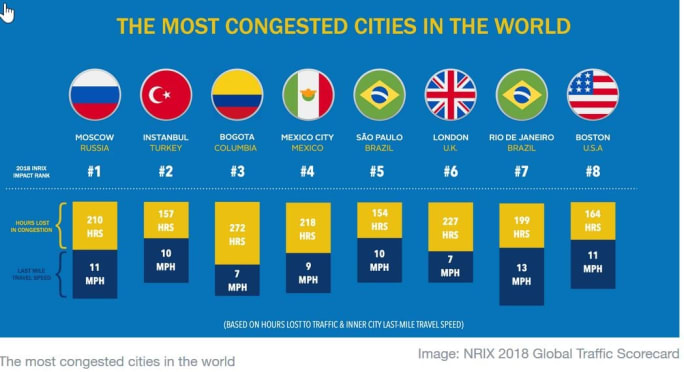
Around the world, gridlock is draining economies and human potential. Congestion cost drivers in the United States more than $87 billion in 2018, according to the INRIX Global Traffic Scorecard, an average of $1,348 per driver. Emerging economies are the most affected, with Russia, Turkey, Colombia, Mexico and Brazil ranked the top five most-gridlocked nations. Increasingly, policymakers are grappling with the use of the third dimension as an important part of a multi-modal network to reverse gridlock even as more people and jobs locate in metropolitan areas.
Urban flight is not new. VIPs have been using helicopters in cities for decades, leading to a stigma that low-altitude aviation is only accessible to the rich and famous – and with a high cost to our carbon footprint and emissions.
In the past two years, however, developments by the private sector have been challenging that assumption. We see new air operators, new models of service and a new focus on electric vertical take-off and landing (EVTOL) and autonomous flight, which could make 80% of helicopter accident causes obsolete. Safer transport and cleaner mobility are vital to the successful growth of cities. In recent models comparing distances, passenger load and energy consumption, an EVTOL aircraft outperformed even an electric car for distances further than 62 miles.
By supplementing existing transportation networks and providing accessible service by air, Urban Aerial Mobility could be a core component of future urban mobility. However, affordability requires scale. Uber Elevate set a goal to reduce the cost of aerial taxi ridesharing to $0.44 per passenger mile (compared to $0.464 per mile to drive your own car) but it’s unclear whether this can be achieved, given current understanding of both the challenges and opportunities of operating more vehicles in the sky.
Making urban flight a reality
The future of aerial mobility will of course rely on advances in technology that are just beginning to take shape today.
Vehicles must meet a certifiable safety threshold from regulators. Given Moore’s Law and the steep slope of technology adoption curves, so many in the aviation community believe it’s time for policymakers and companies to collaborate and ensure tech developments and deployments and government processes mature along the same timeline.
For example, Uber, which wants to become the platform to connect air taxi services, has set a timeline to operate their first commercial urban air taxis by 2023. Volocopter, a German-based UAM company, recently unveiled the world’s first air taxi vertiport in Singapore for completely autonomous flight testing. Airbus, a global leading aviation manufacturer, has invested extensively in multiple UAM projects, including Vahana (a one-passenger EVTOL platform), Voom (on-demand helicopter booking platform) and City Airbus (a four-passenger EVTOL platform). The company sees the increasing congestion and trend of urbanization as a catalyst for sustainable transportation in urban environments.
Regardless of the maturity of technology, it will take more than just technologists and urban planners to make Urban Aerial Mobility a meaningful and impactful part of cities’ future transportation networks.
As Jonathan Hartman, Disruptive Technologies Lead for Lockheed Martin’s Sikorsky Innovations’ group explains, “We need to be talking about this in a more systematic way. This includes reaching out beyond aerospace and to others we don’t normally interact with. I don’t know the last time an elevator company talked to a helicopter company, but that’s exactly what we’re doing.”
Sikorsky is developing enabling technologies to help make urban mobility a reality, including electric propulsion, autonomy and fleet management. But as Hartman will tell you, “Sikorsky fundamentally believes that the environment that these vehicles will operate in will be just as important as the vehicle itself.”
For Urban Aerial Mobility to become a reality, we’ll need to bring together policymakers at all levels, to talk about decision points that haven’t ever been considered, and to assess the impact on a scale and timeframe unique to the Fourth Industrial Revolution.
Startups in Los Angeles are investing heavily in urban aviation to create new modes of efficient and safe transportation in one of the most congested cities in the world. Skyryse, for example, is focused on developing community-friendly air transportation infused with cutting-edge technology. Mark Groden, CEO of Skyryse, explains, “Our goal is to democratize the air, and there’s no better place to start than in Los Angeles, the heart of aerospace innovation. As an industry co-chair of the Urban Aerial Mobility Working Group, we look forward to sharing our vision for our transportation future.”
Local Policy Opportunities
The City of Los Angeles, a long-time leader both in aerospace and in transportation technology, is creating an aerial mobility network integrated with its other transportation systems and investments. Led by the Mayor’s Office, the City is working with the World Economic Forum to develop an international cohort of cities. Although every city context is different, connecting city leaders in a global forum will illuminate early barriers, opportunities and lessons learned, which can be shared across communities.
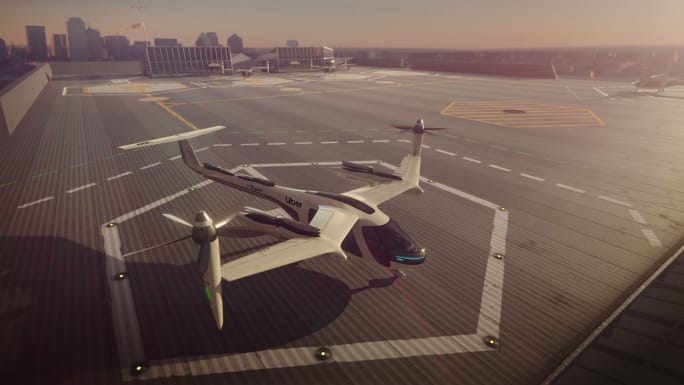
Photo: Uber Elevate
“In L.A., we’re not ‘future-phobic’; we’re future-guiding. We believe that Urban Aerial Mobility can be a meaningful part of our transportation network, but only if we work hand-in-hand with communities, companies, and cities across the world to ensure that outcomes are safe, secure, sustainable, and equitable,” says Julia Thayne, Associate Director of Mobility Innovation for L.A. Mayor Eric Garcetti’s Office.
L.A. Mayor Eric Garcetti’s Office, the World Economic Forum and CoMotion LA will collaborate over the next year to examine the challenges and opportunities of urban aerial mobility and to develop principles for governing new technologies in aviation.
Both policymakers and businesses must think about the needs and desired outcomes for next-generation mobility – especially before it is ready for implementation at-scale. And the L.A. Mayor’s Office and the World Economic Forum will be focusing on the big questions – around equity and pricing, workforce and operational licensing, digital management of the 3D right-of-way and the intragovernmental UTM, fleet management, cybersecurity and privacy, vehicle design and propulsion, land use and zoning, infrastructure and standardization, regulation of operations, permitting and tax revenues, and, of course, environmental considerations, chief among them noise and visual pollution require planning and careful consideration.
Urban Aerial Mobility can only become a meaningful component of urban transportation through careful municipal engagement, planning and industry support. By working together, creating an international effort for harmonization and connectivity – which is non-existent today – we can avoid the pitfalls that have prevented other forms of mobility from having a positive global impact.
About the Author: Harrison Wolf is Project Lead, Aerospace and Drones, for the World Economic Forum.
More Blog Posts
Building a Winning FTA Grant Proposal: Why Propane Autogas is the Pragmatic Choice for Fleet Resilience
With $610 million available through the FY 2026 Buses and Bus Facilities Competitive Program and the Low or No Emission Grant Program, agencies must build a compelling case before the September 21 deadline that balances environmental compliance with operational feasibility.
Read More →
Velo-city Conference 2026: Latest Trends in Cycling as Part of Urban Mobility
The global cycling conference highlighted how cities are integrating bicycles into multimodal transportation networks, expanding cycle tourism and reshaping urban mobility.
Read More →
Kindness Isn’t Soft...It’s Strategic.
Mike Bismeyer — often known as “The Kindness Guy” — has spent more than 17 years in public transit and mobility, serving in industry leadership roles, speaking across North America, and advocating for stronger workplace cultures. But his message doesn’t come from theory. It comes from lived experience.
Read More →
Inside ITF 2026: Transport Reacts to A Challenging World
Transport leaders from around the world gathered in Leipzig, Germany, for the 2026 International Transport Forum to discuss resilience, climate impacts, supply chains and the future of sustainable mobility.
Read More →
Every Ride Tells a Story — But You’re Not Just Selling the Ride
You’re selling the moment, the meaning, and the emotion behind it.
Read More →
How Digital Signage is Reshaping the Traveler Experience at Transportation Hubs
What was once a landscape of static signs has evolved into a responsive, immersive environment powered by real-time visual communication.
Read More →
Latest Trends in Urban Mobility from Polis Conference 2025
Polis comprises cities and regions, as well as corporate partners, from across Europe, promoting the development and implementation of sustainable mobility. This year’s event had over a thousand attendees across various policy forums and an exhibition.
Read More →
Why Transit Leaders Require Better Tools for Operational Clarity In Today’s Tech-Fragmented Environment
Across North America and beyond, transit agency officials are contending with a perfect storm of operational headaches and strategic challenges that hamper daily service and long-term progress.
Read More →
The Powerless Brokers: Why California Can’t Build Transit
It is no secret that transit in the U.S. is slow and expensive to build.
Read More →
Why Transport Sustainability Should Focus on People Instead of Cars
Simply incentivizing electrification is not enough to make a meaningful impact; we must shift our focus toward prioritizing public transportation and infrastructure.
Read More →