Helsinki Case Study Confirms Infrastructure Influences Behavior
The Helsinki E-Scooter Safety Tech Case Study has been published, and the results are in, confirming that a deficient bicycle lane network is causing users to ride on sidewalks.
Scott Shepard・Head of Policy & Government Affairs, Drover.Ai
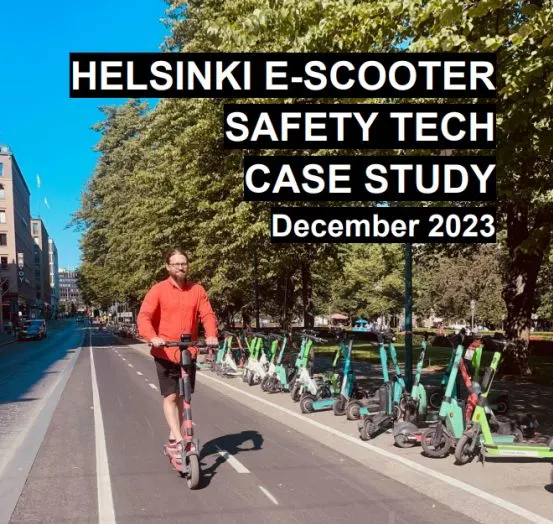
The study revealed that riding on sidewalks is most common in areas where there are often shared lanes for cyclists and pedestrians, or where it is difficult to discern the continuation of bicycle lanes.
Photo: Cover of Study via Cities First Newsletter
3 min to read
The Helsinki E-Scooter Safety Tech Case Study has been published, and the results are in, confirming that a deficient bicycle lane network is causing users to ride on sidewalks.
The Helsingin kaupunki — Helsingfors stad — City of Helsinki, Forum Virium Helsinki, Drover AI, Voi Technology, VTT, and Vianova collaborated on the 12-week research project that monitored the use of e-scooters and utilizing AI and computer vision.
Ad Loading...
The study revealed that riding on sidewalks is most common in areas where there are often shared lanes for cyclists and pedestrians, or where it is difficult to discern the continuation of bicycle lanes.
How The Real-World Case Operated
Voi used the PathPilot application developed by Drover AI to monitor scooter usage in Helsinki for 12 weeks, observing how e-scooters are ridden and the challenges users encounter during their journeys.
In Helsinki, e-scooters are mostly ridden on sidewalks in the areas around the Railway Station, Töölö, and Hietalahti.
"The monitoring study confirmed the assumption that e-scooter riders primarily want to use bicycle paths and lanes. For example, in the Esplanadi area, where investments have been made in bicycle lanes, there was the least riding on sidewalks," said Hannu Oskala, Voi's director, public affairs. "Riding on sidewalks is particularly common in areas where the continuity of bicycle lanes is unclear. In many environments built with a focus on car traffic, such as Hietalahti and Jätkäsaari, e-scooter riders may find themselves among pedestrians as they avoid car traffic.”
During the pilot, an audio sound was also tested to notify e-scooter users if they were riding on the sidewalk.
Ad Loading...
In Helsinki, e-scooters are mostly ridden on sidewalks in the areas around the Railway Station, Töölö, and Hietalahti.
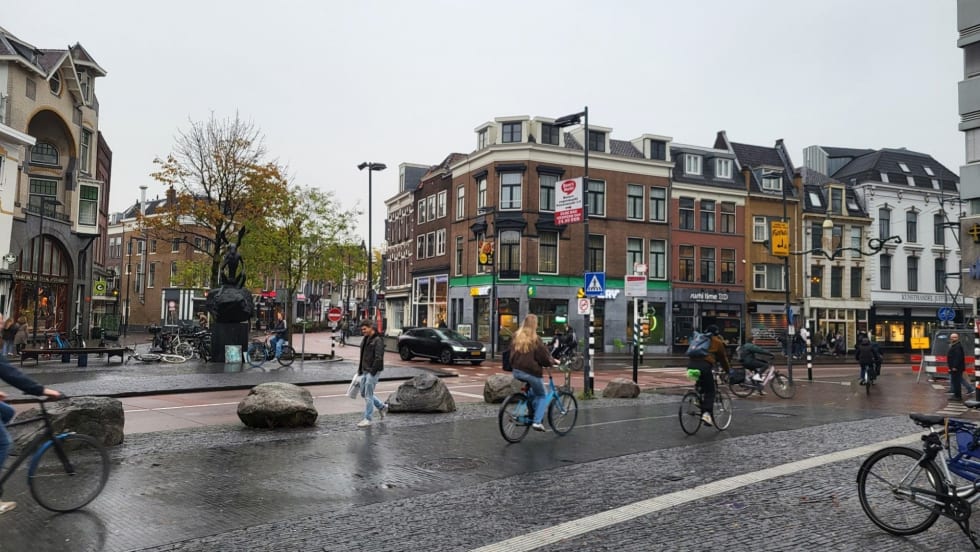
Photo: Pexels/Art Merikotka
What the Pilot Found
“The pilot confirmed the use of an audio alert can reduce sidewalk riding by approximately 15%. Real-time AI for traffic monitoring is a rapidly evolving and increasingly common tool for cities as well," said Scott Shepard, Drover AI’s head, policy & government affairs.
According to Shepard, “Drover AI's solution is a valuable tool for cities, as in addition to riding behavior, the pilot provided AI-based visual and locational information on the need for road maintenance and parking enforcement, and granular infrastructure insights from Path Pilot can help regulators better manage pedestrian and cycle paths.”
"From the images collected by the scooters, we obtained accurate information about, among other things, potholes on sidewalks, which can be a safety risk for road users. Additionally, several situations were observed where, for example, a parked car blocked access to the bicycle lane," Juho Kostiainen from the City of Helsinki said.
Voi intends to use the data obtained from the study for the placement of e-scooters as well. The pilot was carried out in collaboration with the City of Helsinki (Business Helsinki, Mobility Lab), Forum Virium Helsinki, Voi Technology Finland Ab, Vianova, VTT, and Drover AI.
With $610 million available through the FY 2026 Buses and Bus Facilities Competitive Program and the Low or No Emission Grant Program, agencies must build a compelling case before the September 21 deadline that balances environmental compliance with operational feasibility.
The global cycling conference highlighted how cities are integrating bicycles into multimodal transportation networks, expanding cycle tourism and reshaping urban mobility.
Mike Bismeyer — often known as “The Kindness Guy” — has spent more than 17 years in public transit and mobility, serving in industry leadership roles, speaking across North America, and advocating for stronger workplace cultures. But his message doesn’t come from theory. It comes from lived experience.
Transport leaders from around the world gathered in Leipzig, Germany, for the 2026 International Transport Forum to discuss resilience, climate impacts, supply chains and the future of sustainable mobility.
Polis comprises cities and regions, as well as corporate partners, from across Europe, promoting the development and implementation of sustainable mobility. This year’s event had over a thousand attendees across various policy forums and an exhibition.
Across North America and beyond, transit agency officials are contending with a perfect storm of operational headaches and strategic challenges that hamper daily service and long-term progress.
Simply incentivizing electrification is not enough to make a meaningful impact; we must shift our focus toward prioritizing public transportation and infrastructure.