




RELATED: Building Multimodal Models, Tech Integration Key 4 Contractors
How and How Not To Contract For Better Transit Service
After enjoying a long period of ridership growth and expansions of rail and bus networks, American transit has found itself in a mess. Transit ridership fell in all but two cities in 2016, local budgets are stagnant, and riders are demanding higher quality services. While there are some domestic examples of how agencies are innovating, agencies must begin looking beyond the border.
December 5, 2017

A view from Slussen, an area in central Stockholm. Photo: Wikimedia Commons/Arild Vågen
4 min to read

A view from Slussen, an area in central Stockholm. Photo: Wikimedia Commons/Arild Vågen
After enjoying a long period of ridership growth and expansions of rail and bus networks, American transit has found itself in a mess. Transit ridership fell in all but two cities in 2016, local budgets are stagnant, and riders are demanding higher quality services. While there are some domestic examples of how agencies are innovating, agencies must begin looking beyond the border.
Similar to the U.S., Europe, and Australia typically use public authorities to plan, manage, and pay for transit services in urban areas. A key difference is that few of them actually operate and maintain the trains and buses in-house. Private companies operate nearly all agency services through a competitive process. The agencies hold them accountable by leveraging financial bonuses and penalties for exceeding or failing to meet agency standards.

A new report conducted by Transit Center and Eno Center for Transportation analyzes how contracting can be done successfully, and what agencies should avoid. Photo: TransitCenter
In partnership with TransitCenter, Eno investigated the use of contractors in the transit industry in "A Bid for Better Transit: Improving Service with Contracted Operations." The report details six case studies in Europe and North America that examine when and how agencies engage with private contractors, how contracting can be done successfully, and what agencies should avoid.
The report found three lessons that agencies should keep in mind when contracting their service:
1. Government cannot contract out the public interest. Government is uniquely positioned to prioritize high-quality, affordable, equitable, sustainable, and safe transit access to its citizens. It’s no secret that transit is publicly subsidized around the world to meet these goals. But private companies must strive for profitability — a fundamentally different operating model. Keeping these distinct goals in mind, private contracting should be designed to expand, rather than constrain, government’s ability to advance the public interest. For example, European labor protections at the national level provide foundational ground rules for contracting and offer a strategic opportunity to facilitate more transformational change. Public goals for increasing ridership, improving service quality, assisting environmental sustainability, and enabling equity can be codified into a contract, making the profit motive meet the public sector goals.
2. Clear contracts can align contractors’ profit motive with agency goals. Public agencies that contract service must clearly articulate their goals and set specific performance standards for private contractors. London contracts each of its bus routes on a five-year term, and sets a target for reliability, using what it calls “excess wait time.” Contractors that exceed the target receive bonus payments. Thanks to these measureable goals and the financial incentives behind them, reliability of the bus network has improved dramatically over the past 15 years. In Stockholm, the public agency gives contractors broad flexibility to design routes and frequencies that maximize ridership. If contractors can exceed ridership goals, they receive bonuses. Since ridership became the primary financial incentive, it has grown by more than 20%.
3. Symbiotic agency-contractor relationships can improve operations and foster innovation. Agencies in Oslo regularly engage their contractors on strategic issues, not just operations, and these contractors bring valuable knowledge from the other cities. Stockholm presents one of the clearest cases of staffing changes intended to complement, rather than duplicate, contractor skills. Allowing contractors to focus on operations can enable agencies to focus more on policy and planning to benefit their riders, while contractors serve as the agency’s “eyes and ears” in daily operations.
As agencies in the U.S. search for options to improve their struggling services, contracting should be considered as an option. However, it cannot be exclusively a means to cut costs or undermine the workforce. Countless case studies show that when cost reduction is the goal, riders suffer. But when an agency focuses on service and broad public goals, competitive forces can bring new innovations to the table where agencies lack technological or financial capacity. For example, subsidized Uber-like service in certain areas rather than traditional buses. Or a new fleet of cleaner buses that also provide better information to customers.
Contracting out transit service is hard work requiring specialized skills, but agencies that internalize and heed this report’s recommendations will gain powerful management strategies — and transit riders will be the key beneficiaries.
Paul Lewis is VP, Policy and Finance, at the Eno Center for Transportation. He has led policy projects related to federal policy, transportation planning, and transportation governance.
Subscribe to Our Newsletter
More Blog Posts
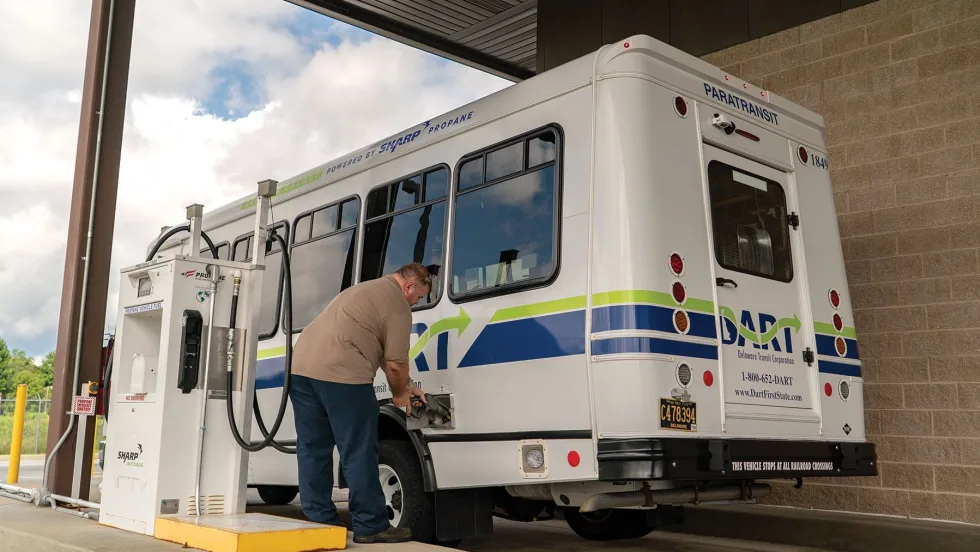
Building a Winning FTA Grant Proposal: Why Propane Autogas is the Pragmatic Choice for Fleet Resilience
With $610 million available through the FY 2026 Buses and Bus Facilities Competitive Program and the Low or No Emission Grant Program, agencies must build a compelling case before the September 21 deadline that balances environmental compliance with operational feasibility.
Read More →
Velo-city Conference 2026: Latest Trends in Cycling as Part of Urban Mobility
The global cycling conference highlighted how cities are integrating bicycles into multimodal transportation networks, expanding cycle tourism and reshaping urban mobility.
Read More →
Kindness Isn’t Soft...It’s Strategic.
Mike Bismeyer — often known as “The Kindness Guy” — has spent more than 17 years in public transit and mobility, serving in industry leadership roles, speaking across North America, and advocating for stronger workplace cultures. But his message doesn’t come from theory. It comes from lived experience.
Read More →
Inside ITF 2026: Transport Reacts to A Challenging World
Transport leaders from around the world gathered in Leipzig, Germany, for the 2026 International Transport Forum to discuss resilience, climate impacts, supply chains and the future of sustainable mobility.
Read More →
Every Ride Tells a Story — But You’re Not Just Selling the Ride
You’re selling the moment, the meaning, and the emotion behind it.
Read More →
How Digital Signage is Reshaping the Traveler Experience at Transportation Hubs
What was once a landscape of static signs has evolved into a responsive, immersive environment powered by real-time visual communication.
Read More →
Latest Trends in Urban Mobility from Polis Conference 2025
Polis comprises cities and regions, as well as corporate partners, from across Europe, promoting the development and implementation of sustainable mobility. This year’s event had over a thousand attendees across various policy forums and an exhibition.
Read More →
Why Transit Leaders Require Better Tools for Operational Clarity In Today’s Tech-Fragmented Environment
Across North America and beyond, transit agency officials are contending with a perfect storm of operational headaches and strategic challenges that hamper daily service and long-term progress.
Read More →
The Powerless Brokers: Why California Can’t Build Transit
It is no secret that transit in the U.S. is slow and expensive to build.
Read More →
Why Transport Sustainability Should Focus on People Instead of Cars
Simply incentivizing electrification is not enough to make a meaningful impact; we must shift our focus toward prioritizing public transportation and infrastructure.
Read More →