



How are agencies making service changes in the wake of coronavirus?
Today everything is changing and this requires the industry and the tools it uses to be much more agile.


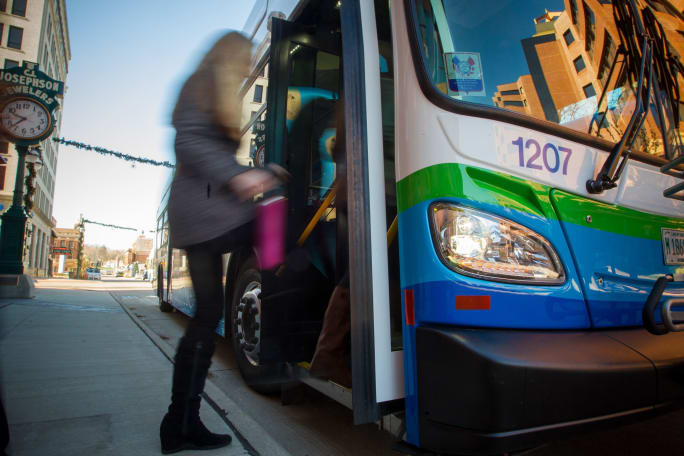
Service cuts need to be planned first so the number of required bus operators can be determined afterwards and allocated to the right service. MetroLINK
These days, browsing through any transit agency site will tell you one basic truth: everything is changing quickly. Two weeks ago, agencies began posting notices about increased sanitation measures, and a week later there was a deluge of announcements: service changes, more service changes, backdoor boarding, no fares, and more. And when this is over (and I believe coronavirus will be over), these same service changes will need to be reversed gradually, creating more flux.
In ordinary times, transit doesn’t change that often and not so deeply. Usually service changes are minor and made in three to four picks annually, not more than that. Today everything is changing and this requires the industry and the tools it uses to be much more agile. On March 23, we surveyed Optibus webinar participants. Eighty-eight percent reported they have already implemented a reduced service plan. Clearly, we are in times of immense change in services that haven’t changed much before.
Driver shortages
Initially, transit agencies were required to submit contingency plans that answer the question of what happens when 10% or 25% of bus operators aren’t available. However these plans quickly became less relevant as ridership dropped, since a deeper need for service cuts was needed, mainly as a result of demands made by local governments or cities. Additionally, while scheduling optimization can take a reasonable driver shortage constraint into account, this approach won’t work well in case of severe shortages. In this case, service cuts need to be planned first so the number of required bus operators can be determined afterwards and allocated to the right service.
What service cuts do agencies perform?
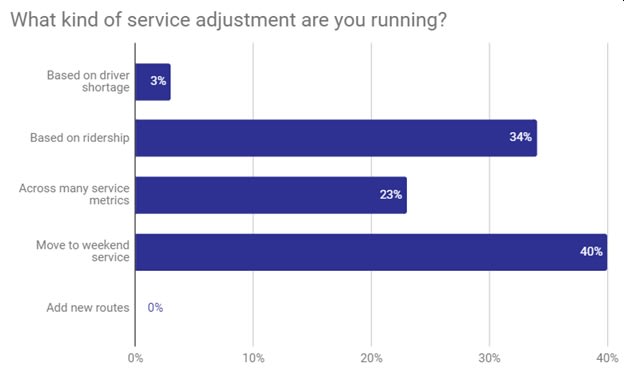
In our March 23 survey, we asked participants which service cuts they had made. Only 3% reported to be adjusting service based on driver shortages. Thirty-four percent reported reducing service based on ridership and 23% reduced service across many metrics (span, coverage, and frequency), while the most — at 40% — reduced service by moving to weekend schedules by taking a Sunday or Saturday schedule and applying it for the entire week.
Moving to a weekend schedule
Moving to a weekend schedule is a simpler solution compared to reducing service across many metrics. However, we do recommend optimizing the roster after the change is made, since in our experience this can reduce the roster count, meaning that less bus operators are needed. Conserving bus operators is important to both protect them and also have many stand-by bus operators in case of quarantines, or a decision to use the buses elsewhere as part of emergency measures.
Service reduction
Another approach, yet one that is totally feasible with modern planning and scheduling platforms, is to plan a reduced service. With older systems that take weeks to produce a new pick, this may be a challenge, but with new systems it is possible to produce a contingency plan relatively quickly.
The process goes as follows:
We define which service metrics will be affected, such as reducing the span of service, eliminating routes or stop, or altering the frequency.
We then quickly generate a schedule to reflect this new service and optimize it. This can be done several times to create multiple scenarios. During this phase important insights can be produced: for instance, changes in timetables can be used to prevent long layovers in case of a reduced service frequency.
An important goal for the optimization process is to reduce the duty count by more than the service reduction — ensuring more bus operators are protected.
A final point is to group the different duties into rosters, with the goal of reducing the roster count.
The day after
This complex adjustment exercise will probably be repeated when all of this is over. Service will be restored gradually, and more changes and optimizations will be required. Is there a silver lining in all of this? Probably yes. The industry will learn how to quickly create planning and scheduling scenarios quickly and effectively and modernize as a result, hopefully providing better service in the future.
Amos Haggiag is the co-founder and CEO of Optibus, a high-tech mobility platform provider that improves mass transit performance. The company is offering help with contingency plans for COVID-19.
More Blog Posts
Building a Winning FTA Grant Proposal: Why Propane Autogas is the Pragmatic Choice for Fleet Resilience
With $610 million available through the FY 2026 Buses and Bus Facilities Competitive Program and the Low or No Emission Grant Program, agencies must build a compelling case before the September 21 deadline that balances environmental compliance with operational feasibility.
Read More →
Velo-city Conference 2026: Latest Trends in Cycling as Part of Urban Mobility
The global cycling conference highlighted how cities are integrating bicycles into multimodal transportation networks, expanding cycle tourism and reshaping urban mobility.
Read More →
Kindness Isn’t Soft...It’s Strategic.
Mike Bismeyer — often known as “The Kindness Guy” — has spent more than 17 years in public transit and mobility, serving in industry leadership roles, speaking across North America, and advocating for stronger workplace cultures. But his message doesn’t come from theory. It comes from lived experience.
Read More →
Inside ITF 2026: Transport Reacts to A Challenging World
Transport leaders from around the world gathered in Leipzig, Germany, for the 2026 International Transport Forum to discuss resilience, climate impacts, supply chains and the future of sustainable mobility.
Read More →
Every Ride Tells a Story — But You’re Not Just Selling the Ride
You’re selling the moment, the meaning, and the emotion behind it.
Read More →
How Digital Signage is Reshaping the Traveler Experience at Transportation Hubs
What was once a landscape of static signs has evolved into a responsive, immersive environment powered by real-time visual communication.
Read More →
Latest Trends in Urban Mobility from Polis Conference 2025
Polis comprises cities and regions, as well as corporate partners, from across Europe, promoting the development and implementation of sustainable mobility. This year’s event had over a thousand attendees across various policy forums and an exhibition.
Read More →
Why Transit Leaders Require Better Tools for Operational Clarity In Today’s Tech-Fragmented Environment
Across North America and beyond, transit agency officials are contending with a perfect storm of operational headaches and strategic challenges that hamper daily service and long-term progress.
Read More →
The Powerless Brokers: Why California Can’t Build Transit
It is no secret that transit in the U.S. is slow and expensive to build.
Read More →
Why Transport Sustainability Should Focus on People Instead of Cars
Simply incentivizing electrification is not enough to make a meaningful impact; we must shift our focus toward prioritizing public transportation and infrastructure.
Read More →