



New Motorcoach Tech Helps Small Operators Compete with Industry Giants
It’s no secret that tech has been slow to come to the group transportation industry. While online options for booking individual travel are about as old as the internet, booking group travel has largely remained onerous.


New tech on the scene means that even the smallest motorcoach operators will be able to easily get bookings from potential customers searching online – without investing tens of thousands of dollars in marketing. Photo: GCS Inc.

New tech on the scene means that even the smallest motorcoach operators will be able to easily get bookings from potential customers searching online – without investing tens of thousands of dollars in marketing. Photo: GCS Inc.
It’s no secret that tech has been slow to come to the group transportation industry. While online options for booking individual travel are about as old as the internet, booking group travel has largely remained onerous: searchers might have to visit dozens of websites, request quotes via phone, and wait a week or more to receive those quotes. This has especially been true for the motorcoach industry, which has lagged behind in technology.
But new tech on the scene means that even the smallest operators will be able to easily get bookings from potential customers searching online – without investing tens of thousands of dollars in marketing.
A Tech Solution for the 94 Percent?
According to the latest available numbers (from the Motorcoach Census of 2015), 93.7% of motorcoach companies have fewer than 25 vehicles. Just 0.7% of the industry is made up of the largest companies (those with 100 vehicles or more).
Put another way: there are 15,596 motorcoaches out there that belong to the smallest operators and 14,217 that belong to the largest.
Given the similar numbers, you’d expect customer rides to be almost evenly split between these groups.
But that’s not the case. In fact, according to the Census, large operators account for about 60% of passenger rides, while small operators handle just 18%.
One likely reason? It costs money to be found online. While small operators often don’t have funds to funnel toward marketing efforts, larger companies do. And that means customers searching for group travel on Google are more likely to find the big players than the small ones.
Online marketing funds are also a major contributor to the phenomenon of larger operators being more frequently sold out on busy weekends despite their greater supply of vehicles.
A session at last year’s Motorcoach Expo offered some insight into this problem, outlining ways small operators can make themselves visible online to compete with enterprise players. But that session drastically understated the cost of appearing in online search.
For example, the session asserted that search engine optimization (SEO), the strategy for showing up in unpaid Google results, is “free.” While it’s true that you can’t buy these results, it ignores the fact that the work of SEO requires the creation of content – and that today, the average salary for a content strategist in Chicago is more than $90,000.
Similarly, while the session characterized search engine marketing (SEM), or bidding to show up in paid Google results, as “inexpensive,” the reality is more complicated. Some of the terms operators would have to bid on (“Chicago bus rental,” for example) come with a cost per click north of $16. The high cost is partly because adding geographic limitations greatly increases the bids, and most vendors are inherently regional players. Those costs become unsustainable fast, especially when you’re bidding against companies with much deeper pockets.
In other words: small operators have little chance of competing with large motorcoach operations on traditional search engines like Google.
A Platform Where Small Operators Can Compete
That’s where Global Charter Services Inc., (GCS) enters the picture.
Earlier this year, GCS was formed when online group-travel booking platform BusBank, known for its customer service, acquired Buster, a fast-growing competitor with a smaller customer base but a more robust online platform. Thanks to the acquisition, group transit providers can now access the demand generated from both sites to get in front of the tens of thousands of customers who use the sites to search for group travel options.
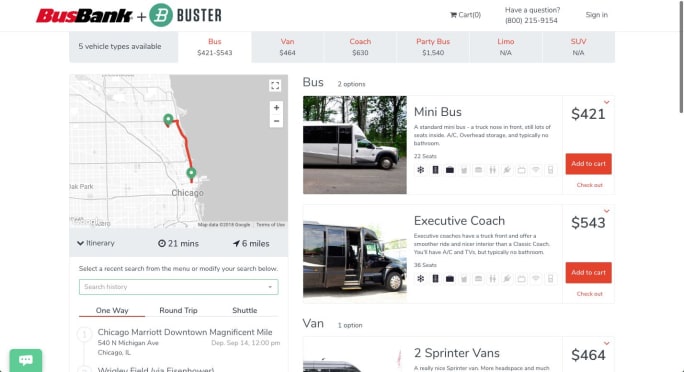
This marks a major transformation for the industry:
Customers around the country now have two choices when they want to find a trusted group travel provider: search directly through the Buster.com platform or get curated quotes from a BusBank representative. All vehicles in the shared system have top marks for inspection and care, and all operators have been vetted for safety through insurance credentials and DOT registration.
For their part, operators can now market efficiently through Buster and BusBank, because the sites can buy ads at scale, nationally.
Further, operators aren’t required to pay any listing fees. After joining either site, they simply enter fleet and pricing details, and the Buster platform uses this data to create a “market price” for trips that come in. When a trip becomes available, only operators with matching inventory in the relevant service area receive an email, which makes it easy for them to claim new business and increase revenue.
Notably, Buster and BusBank never disclose vendors’ fleet or pricing information to customers or competitors. This enables vendors who are eager to grow or who need to fill a revenue gap (say, because of the acquisition of a new vehicle that hasn't been marketed before) to list a lower price without fearing price retaliation or starting a price war.
The results: customers have access to an experience they’re familiar with from booking rental cars or plane tickets. Vendors have a streamlined, cost-effective way to be visible where potential customers are looking online. And group travel companies of all sizes can focus on competing on the quality of their services rather than the size of their marketing budgets.
Harald Kruse is CEO of group transportation booking platform Global Charter Services Inc., the newly combined entity comprising BusBank and Buster.
More Blog Posts

Velo-city Conference 2026: Latest Trends in Cycling as Part of Urban Mobility
The global cycling conference highlighted how cities are integrating bicycles into multimodal transportation networks, expanding cycle tourism and reshaping urban mobility.
Read More →
Kindness Isn’t Soft...It’s Strategic.
Mike Bismeyer — often known as “The Kindness Guy” — has spent more than 17 years in public transit and mobility, serving in industry leadership roles, speaking across North America, and advocating for stronger workplace cultures. But his message doesn’t come from theory. It comes from lived experience.
Read More →
Inside ITF 2026: Transport Reacts to A Challenging World
Transport leaders from around the world gathered in Leipzig, Germany, for the 2026 International Transport Forum to discuss resilience, climate impacts, supply chains and the future of sustainable mobility.
Read More →
Every Ride Tells a Story — But You’re Not Just Selling the Ride
You’re selling the moment, the meaning, and the emotion behind it.
Read More →
How Digital Signage is Reshaping the Traveler Experience at Transportation Hubs
What was once a landscape of static signs has evolved into a responsive, immersive environment powered by real-time visual communication.
Read More →
Latest Trends in Urban Mobility from Polis Conference 2025
Polis comprises cities and regions, as well as corporate partners, from across Europe, promoting the development and implementation of sustainable mobility. This year’s event had over a thousand attendees across various policy forums and an exhibition.
Read More →
Why Transit Leaders Require Better Tools for Operational Clarity In Today’s Tech-Fragmented Environment
Across North America and beyond, transit agency officials are contending with a perfect storm of operational headaches and strategic challenges that hamper daily service and long-term progress.
Read More →
The Powerless Brokers: Why California Can’t Build Transit
It is no secret that transit in the U.S. is slow and expensive to build.
Read More →
Why Transport Sustainability Should Focus on People Instead of Cars
Simply incentivizing electrification is not enough to make a meaningful impact; we must shift our focus toward prioritizing public transportation and infrastructure.
Read More →
Transit ROI & System Efficiencies Will Drive 'Big, Beautiful' Transit Funding
For many years, the narrative surrounding public transit improvements has been heavily weighted toward environmental gains and carbon reduction. While these are undeniably crucial long-term benefits, the immediate focus of this new funding environment is firmly on demonstrable system efficiencies and a clear return on investment.
Read More →