



Social media nurtures productive relationships
Super fans, transit geeks, bus nerds — whatever you want to call them — find Champaign-Urbana Mass Transit District on social media platforms. This pool of repeat socializers is handy for projects such as the transit system’s recent website redesign and recruiting riders to help assess the performance of the CAD/AVL system after an equipment upgrade.
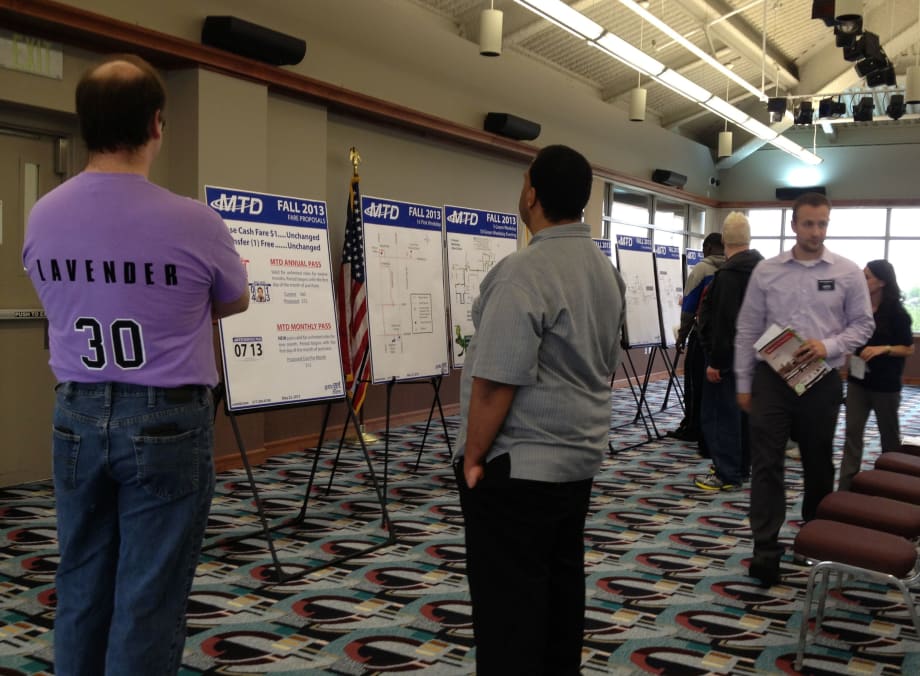
At MTD's last public hearing, a group of super fans showed up, wearing lavender-colored shirts with "30 Lavender" printed on the back. They came to advocate for more service on MTD's lavender route.
School is in session, ridership is on the rise and social media interactions are blossoming.
The Champaign-Urbana Mass Transit District (MTD) provides service to two cities, one village and the University of Illinois (UI). While the population of our district classifies us as a small to mid-level service provider, the addition of the 15th largest university in the country transforms MTD. Last year, we had another record ridership year with more than 12 million rides.
During the UI’s Fall and Spring semesters, demand swells and MTD provides nearly 24/7 service. Our bus service feels the crunch during peak times, but many evening and weekend trips also turn into standing room only as students pour into the community for shopping and recreation.
The return of more than 42,000 students also means increased traffic on our social media sites. In 2010, MTD launched profiles on Facebook and Twitter, as well as media sharing sites YouTube and Flickr. A weekly blog and bi-monthly enewsletter round out our social online presence.
Super fans, transit geeks, bus nerds — whatever you want to call them — find MTD on these platforms. Engagement occurs year-round, but the wired and tech-savvy population of the university increases engagement levels.
As the primary manager of MTD’s social media pages, I am acquainted with user names and avatars. I memorize Twitter handles and recognize faces. Some engagers I only interact with once; others I chat with regularly and have met IRL (in real life).
The one-timers often reach out to MTD because they have a question or want to report a negative experience. We value these users. Complaints are an opportunity to provide customer service, educate and improve our system.
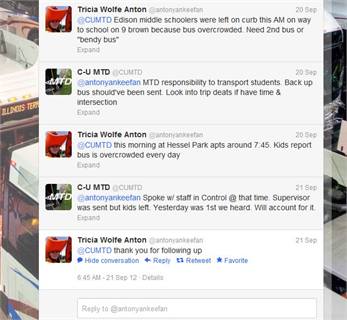
The return of more than 42,000 students to the University of Illinois for the Fall semester means an increased demand in ridership and a significant spike in traffic on its social media sites, including Twitter.
The many-timers are not only transit advocates but tremendous resources. They are extra eyes on the street as they report issues like destination sign errors and corrections to bus stop shelter boards. They also narrate their day-to-day experiences and remind us what makes our service public.
This pool of repeat socializers comes in handy. In 2011, MTD did a complete redesign of our website. We put together focus groups, and thanks to our social media connections, were able to gather a diverse group of regular users from all over the community.
When it came time to renew MTD’s service contract with the UI, we conducted student focus groups. We opened the opportunity to all, but a number of the participants came from social media.
MTD is fortunate to have CAD/AVL (computer aided dispatch/automatic vehicle locator) technology fleet-wide. While we’ve had the system since 2003, updated and new equipment can challenge the integrity of the data. Recently, our planners were testing a new feature and needed trip data as users got it on the street. From their apps, through text messages, and at the stop digital displays, we needed to know how the time displayed compared with the real-life departure of the bus.
I sent direct messages on social media to our most detail-oriented riders asking them if they would participate in "Operation: Ground Truth Investigation." We asked them to fill out a Google form each time they rode the bus. The form detailed the trip, times, information source and actual bus departure.
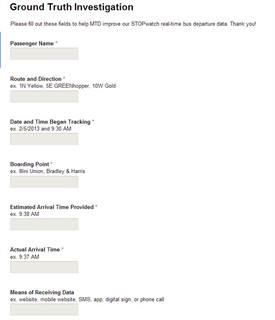
MTD used social media to reach out to its most detail-oriented riders, asking them to participate in an assessment of how its real-time arrival information was displaying compared with the actual bus departures.
We contacted five users and they all agreed to participate. At the end of the two-week collection period, they submitted information on 78 individual trips. The data they submitted proved the added feature was working effectively.
Currently, MTD is updating our strategic plan. To gather external input on the district’s strengths, weaknesses, opportunities and threats we (you guessed it) used our online connections to solicit survey responses.
The frequent online interactions encourage in-person engagement, too. At our last public hearing on proposed service improvements, a small group of super fans showed up. They were all wearing the same lavender colored shirt with the numbers and letters “30 Lavender” screen printed on the back. They came to advocate to MTD’s board of trustees and staff for more service on our Lavender route. While MTD does not currently have the funds to provide the weekday evening and Sunday service the riders want, their attendance sparked great conversation and helps hone our priorities for the future.
At MTD's last public hearing, a group of super fans showed up, wearing lavender-colored shirts with
Through social media, riders and non-riders see that MTD is a transparent organization that is always listening. They are inclined to repay that care through focus group attendance, completing surveys and keeping in touch.
In case you missed it...
Read our METRO blog, "SEPTA offers a different type of school bus"
More Blog Posts
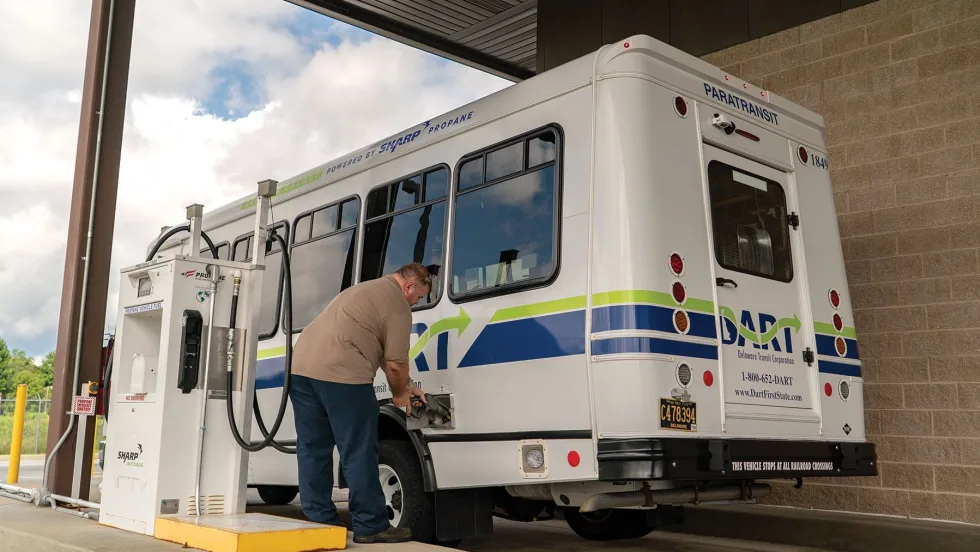
Building a Winning FTA Grant Proposal: Why Propane Autogas is the Pragmatic Choice for Fleet Resilience
With $610 million available through the FY 2026 Buses and Bus Facilities Competitive Program and the Low or No Emission Grant Program, agencies must build a compelling case before the September 21 deadline that balances environmental compliance with operational feasibility.
Read More →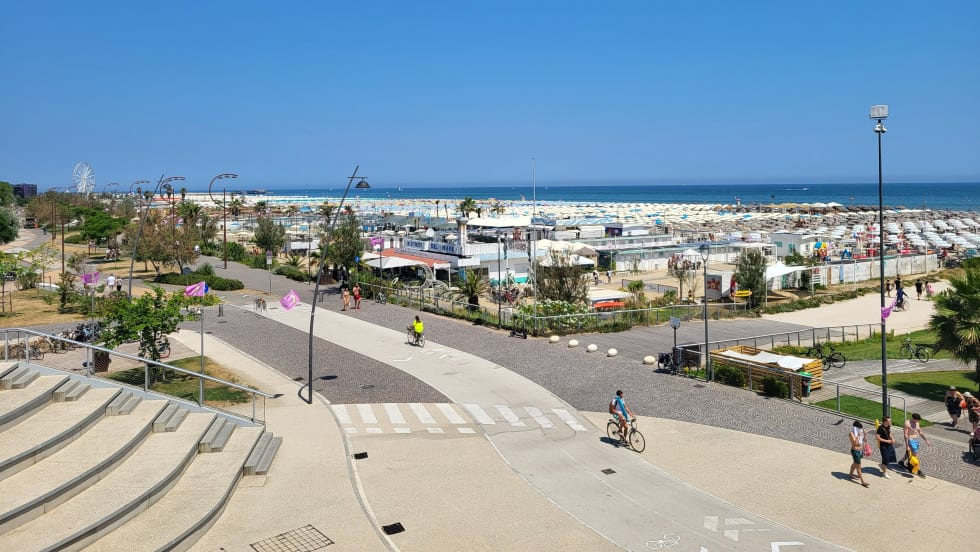
Velo-city Conference 2026: Latest Trends in Cycling as Part of Urban Mobility
The global cycling conference highlighted how cities are integrating bicycles into multimodal transportation networks, expanding cycle tourism and reshaping urban mobility.
Read More →
Kindness Isn’t Soft...It’s Strategic.
Mike Bismeyer — often known as “The Kindness Guy” — has spent more than 17 years in public transit and mobility, serving in industry leadership roles, speaking across North America, and advocating for stronger workplace cultures. But his message doesn’t come from theory. It comes from lived experience.
Read More →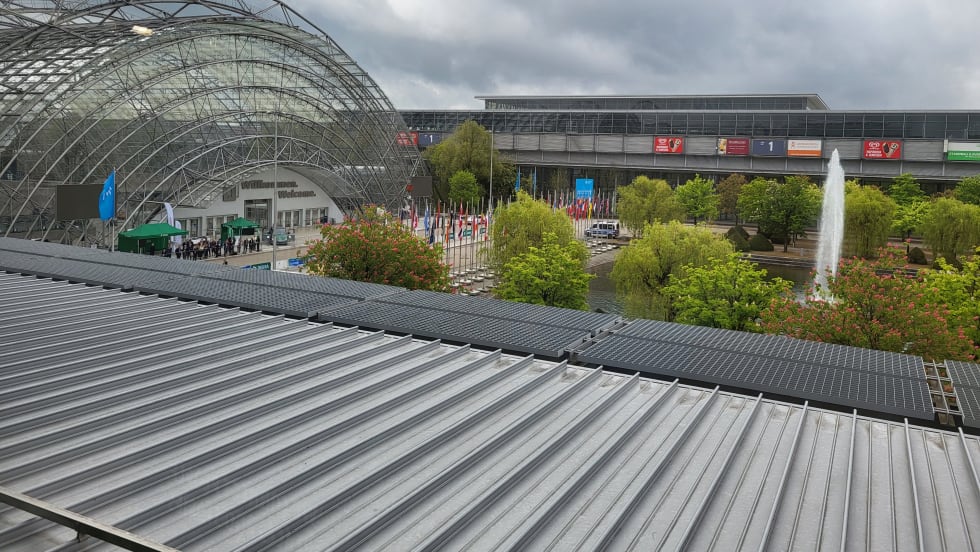
Inside ITF 2026: Transport Reacts to A Challenging World
Transport leaders from around the world gathered in Leipzig, Germany, for the 2026 International Transport Forum to discuss resilience, climate impacts, supply chains and the future of sustainable mobility.
Read More →
Every Ride Tells a Story — But You’re Not Just Selling the Ride
You’re selling the moment, the meaning, and the emotion behind it.
Read More →
How Digital Signage is Reshaping the Traveler Experience at Transportation Hubs
What was once a landscape of static signs has evolved into a responsive, immersive environment powered by real-time visual communication.
Read More →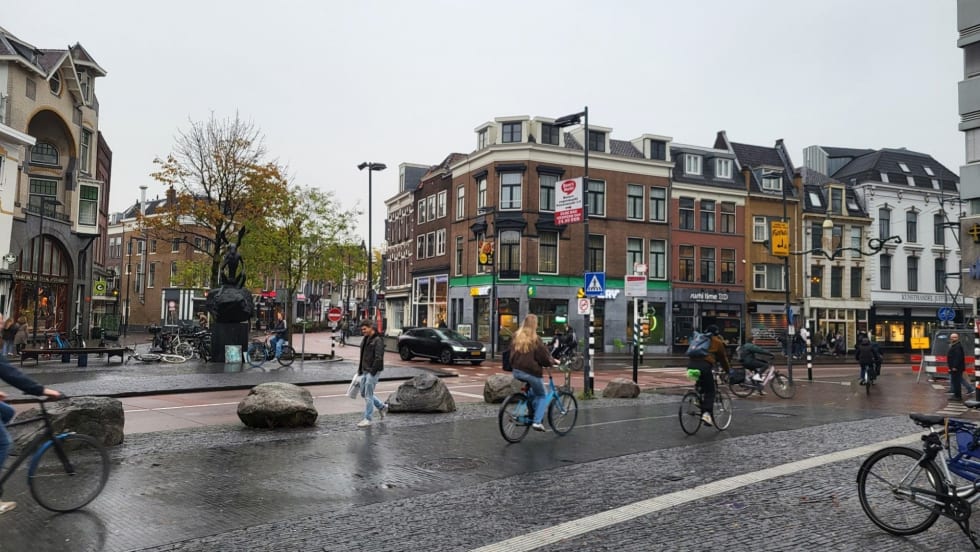
Latest Trends in Urban Mobility from Polis Conference 2025
Polis comprises cities and regions, as well as corporate partners, from across Europe, promoting the development and implementation of sustainable mobility. This year’s event had over a thousand attendees across various policy forums and an exhibition.
Read More →
Why Transit Leaders Require Better Tools for Operational Clarity In Today’s Tech-Fragmented Environment
Across North America and beyond, transit agency officials are contending with a perfect storm of operational headaches and strategic challenges that hamper daily service and long-term progress.
Read More →
The Powerless Brokers: Why California Can’t Build Transit
It is no secret that transit in the U.S. is slow and expensive to build.
Read More →
Why Transport Sustainability Should Focus on People Instead of Cars
Simply incentivizing electrification is not enough to make a meaningful impact; we must shift our focus toward prioritizing public transportation and infrastructure.
Read More →