




RELATED: FAST Act to spur transportation infrastructure improvements
Transportation Funding a Win for All
With more money from the federal level, transit agencies will be able to make crucial infrastructure fixes, replace vehicles and possibly dust off “wish list” improvements projects long-shelved due to lack of capital. The Southeastern Pennsylvania Transportation Authority knows what a difference government support of public transportation can make.
January 20, 2016

One of the projects SEPTA was able to undertake with the ACT 89 funding is the replacement of the Crum Creek Viaduct on its Media/Elwyn Regional (commuter) Rail Line.
Photo: SEPTA
2 min to read
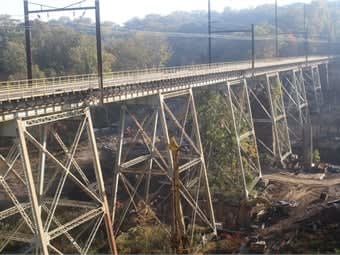
One of the projects SEPTA was able to undertake with the ACT 89 funding is the replacement of the Crum Creek Viaduct on its Media/Elwyn Regional (commuter) Rail Line.
Photo: SEPTA
The Fixing America’s Surface Transportation (FAST) Act, which was passed by Congress on Dec. 3 and signed into law by President Obama on Dec. 4, 2015 will provide essential, long-term federal funding for critical transportation needs — $305 billion over five years.
With more money from the federal level, transit agencies will be able to make crucial infrastructure fixes, replace vehicles and possibly dust off “wish list” improvements projects long-shelved due to lack of capital. The Southeastern Pennsylvania Transportation Authority (SEPTA) knows what a difference government support of public transportation can make.
“Two years ago, we had a $5 billion state-of-good-repair backlog that was estimated to grow to at least $6.5 billion by 2023 without additional capital funding,” said SEPTA GM Jeff Knueppel. “We had been experiencing record ridership, especially on our Regional [commuter] Rail lines, but without money for infrastructure repairs and aging vehicle replacement, the authority would have been forced to implement a drastic Service Realignment Plan that would have greatly downsized the SEPTA rail network over 10 years.”
Fortunately for riders in the five-county Greater Philadelphia Region served by SEPTA, the authority did not have to enact its “Doomsday” plan. In Nov. 2013, the bipartisan Pennsylvania state legislature passed Act 89, providing $2.3 billion for the Commonwealth’s transit systems and highways. SEPTA projected that within five years of Act 89’s passing, the authority’s annual Capital Budget would exceed $600 million — more than double the $300 million annual amount SEPTA had available for improvements in each of four years prior to the legislation.
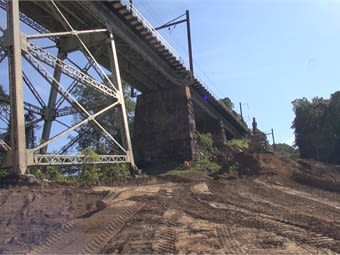
SEPTA is replacing this 925-foot-long, 100-foot-high bridge, which was originally constructed in 1895 and repaired in 1983.Photo: SEPTA
“We were ready to put our new funding to use immediately,” said Knueppel. “We had basic infrastructure projects that would preserve the safety of our system ready to go — all we needed was the capital.”
In December 2013, SEPTA unveiled its aggressive new capital campaign, now known as “Rebuilding the Future.” “Now we’re using funds to make sure the ‘Doomsday’ plan doesn’t come true,” said Knueppel.
“This is an exciting time for our organization, our riders and our region,” Knueppel added. “We are not just replacing infrastructure and vehicles in kind; we are doing our projects with safety, customer experience and capacity enhancements in mind.”
Congress’ passage of the FAST Act will help SEPTA continue its capital improvements programs for the foreseeable future. “We are fortunate to be represented in Congress by members who recognize the important role of public transportation,” said Knueppel. “Investing in infrastructure and new vehicles enhances service for SEPTA’s more than 1.1 million daily riders and is critical to the region’s economic competitiveness.”
Heather Redfern is the Public Information Manager for the Southeastern Pennsylvania Transportation Authority.
Subscribe to Our Newsletter
More Blog Posts
Building a Winning FTA Grant Proposal: Why Propane Autogas is the Pragmatic Choice for Fleet Resilience
With $610 million available through the FY 2026 Buses and Bus Facilities Competitive Program and the Low or No Emission Grant Program, agencies must build a compelling case before the September 21 deadline that balances environmental compliance with operational feasibility.
Read More →
Velo-city Conference 2026: Latest Trends in Cycling as Part of Urban Mobility
The global cycling conference highlighted how cities are integrating bicycles into multimodal transportation networks, expanding cycle tourism and reshaping urban mobility.
Read More →
Kindness Isn’t Soft...It’s Strategic.
Mike Bismeyer — often known as “The Kindness Guy” — has spent more than 17 years in public transit and mobility, serving in industry leadership roles, speaking across North America, and advocating for stronger workplace cultures. But his message doesn’t come from theory. It comes from lived experience.
Read More →
Inside ITF 2026: Transport Reacts to A Challenging World
Transport leaders from around the world gathered in Leipzig, Germany, for the 2026 International Transport Forum to discuss resilience, climate impacts, supply chains and the future of sustainable mobility.
Read More →
Every Ride Tells a Story — But You’re Not Just Selling the Ride
You’re selling the moment, the meaning, and the emotion behind it.
Read More →
How Digital Signage is Reshaping the Traveler Experience at Transportation Hubs
What was once a landscape of static signs has evolved into a responsive, immersive environment powered by real-time visual communication.
Read More →
Latest Trends in Urban Mobility from Polis Conference 2025
Polis comprises cities and regions, as well as corporate partners, from across Europe, promoting the development and implementation of sustainable mobility. This year’s event had over a thousand attendees across various policy forums and an exhibition.
Read More →
Why Transit Leaders Require Better Tools for Operational Clarity In Today’s Tech-Fragmented Environment
Across North America and beyond, transit agency officials are contending with a perfect storm of operational headaches and strategic challenges that hamper daily service and long-term progress.
Read More →
The Powerless Brokers: Why California Can’t Build Transit
It is no secret that transit in the U.S. is slow and expensive to build.
Read More →
Why Transport Sustainability Should Focus on People Instead of Cars
Simply incentivizing electrification is not enough to make a meaningful impact; we must shift our focus toward prioritizing public transportation and infrastructure.
Read More →