



Why freedom of mobility is at the center of dealing with the climate crisis
The single biggest driver of change in transportation in the coming years will undoubtedly be the impending climate catastrophe.

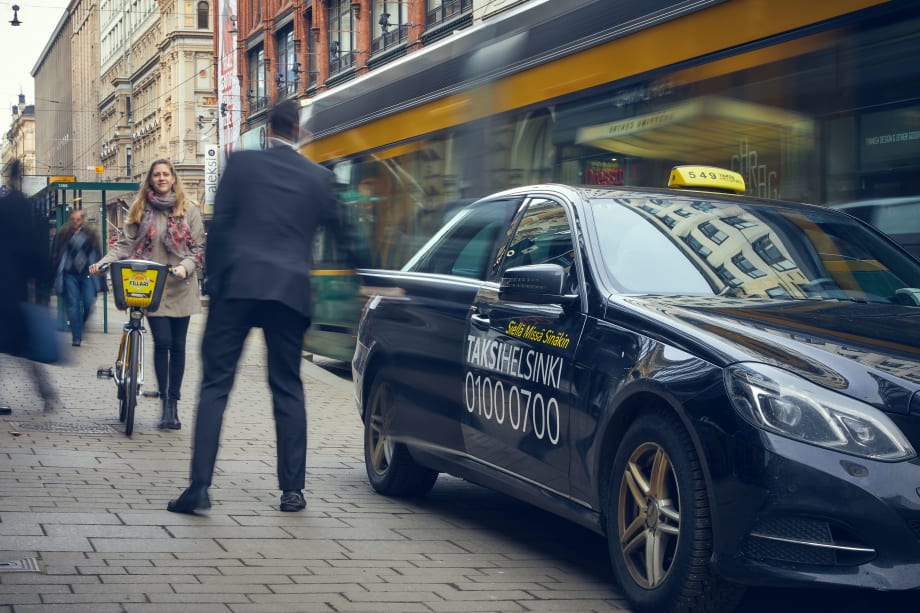
Whim [MaaS Global's mobility app] users are steeped in multimodalism and use both bicycle and taxi to solve the last-mile problem, according to a new study.
MaaS Global/Pasi Salminen
Whim [MaaS Global's mobility app] users are steeped in multimodalism and use both bicycle and taxi to solve the last-mile problem, according to a new study.
MaaS Global/Pasi Salminen
This was original posted on MaaS Global.
The single biggest driver of change in transportation in the coming years will undoubtedly be the impending climate catastrophe. One of the core questions, probably the core question, as this change takes place, is: what will replace the privately owned automobile? Is it virtual reality (VR) and we all stay home? Is it a congested public transportation system enforced by law? Is it multiple fleets of autonomous cars jamming up the streets? Or is it the kind of Mobility as a Service (MaaS) that optimizes low-emission transportation while giving individuals freedom of choice?
Helsinki is the world’s most developed MaaS city. For the first time, we now have real-life annual data on how people use MaaS and how that compares to the overall usage of transportation modes in a particular city from a study called Whimpact: Insights from the World’s First Mobility as a Service Solution we conducted together with consulting engineering firm Ramboll. The key findings are:
Whim [MaaS Global's mobility app] users are steeped in multimodalism and use both bicycle and taxi to solve the last-mile problem.
Growth in MaaS usage has been strongest in the inner-city region.
So, the first numbers are in and it looks like MaaS, when done right, does exactly what we expect it to do: it relies on mass transit (not automobiles), solves the last-mile problem (that automobiles used to solve) and is most popular in dense areas (where automobiles pose the biggest challenge).
It may be fashionable to throw around the idea of electric robot cars taking over and fixing both the CO2 crisis and the urban transportation challenge, but that is not sustainable.
Let’s stop and imagine the moment when autonomous cars will be fit to serve us. The first company drops a fleet of 500 cars into a city. Since there’s no wage cost, the price of a ride is reasonable, close to a bus ticket. People love the service. And as we have seen with private cars, it’s not wisdom that prevails, but freedom. The fleet grows according to demand and not until long, the amount of automobiles on the streets has more than doubled (there’s research on this). Think of any modern city and then, in your mind, double the amount of automobiles on the street. Gridlock. The whole city ceases to function.
Therefore, we do not want people to use autonomous cars instead of public transport; we want folks to use them in addition to public transport. The business case and the positive environmental impact of smart MaaS are based on people using more public transportation than before, not less.
Mobility as a Service, when done right, does exactly what we expect it to do: it relies on mass transit (not automobiles).
MaaS Global
Public transport, walking and biking are the desired substitutes for private automobiles, but not the automatic ones. We choose them if they are the most convenient and pleasant choice available. But we will not choose them if traffic planners and municipal traffic operators are going to force us into using public transport by limiting our options. Many of us will rather sit and swear in traffic jams instead.
This is where things can go amazingly well or awfully wrong...Mobility is the second-biggest sector of economic activity in the world after real estate, and it is entering a hurricane of change. Europe, with its walkable cities and dedication to public transportation, stands to be at the forefront of positive change. But that is not going to happen if every public transport operator in every city tries to go it alone, which is all too often the case.
At MaaS Global, we are frequently asked by European cities to license our software as a white-label solution just for them. We have chosen to not get into these talks because single cities should not see themselves as disruptors and then… well, stall disruption.
Instead of building walled gardens around their service, they can build application programming interfaces (APIs) and make themselves attractive to as many added service providers as possible.
Instead of solving for a city, they can be part of a worldwide solution.
Instead of running out of money and expertise against fierce international competition, they can oversee that whatever happens is for the benefit of their citizens.
Instead of building an entry-level mobile interface to their otherwise compelling services, they can connect to existing world-class applications.
Instead of digging in behind a local monopoly, they can be part of a global solution, for cities and for the planet; the one that makes people ditch their cars because they have found something better. Something that gives them more freedom than before — not less.
Sampo Hietanen is the CEO and founder of Helsinki-based MaaS Global, developer of the Whim app.
More Blog Posts
Building a Winning FTA Grant Proposal: Why Propane Autogas is the Pragmatic Choice for Fleet Resilience
With $610 million available through the FY 2026 Buses and Bus Facilities Competitive Program and the Low or No Emission Grant Program, agencies must build a compelling case before the September 21 deadline that balances environmental compliance with operational feasibility.
Read More →
Velo-city Conference 2026: Latest Trends in Cycling as Part of Urban Mobility
The global cycling conference highlighted how cities are integrating bicycles into multimodal transportation networks, expanding cycle tourism and reshaping urban mobility.
Read More →
Kindness Isn’t Soft...It’s Strategic.
Mike Bismeyer — often known as “The Kindness Guy” — has spent more than 17 years in public transit and mobility, serving in industry leadership roles, speaking across North America, and advocating for stronger workplace cultures. But his message doesn’t come from theory. It comes from lived experience.
Read More →
Inside ITF 2026: Transport Reacts to A Challenging World
Transport leaders from around the world gathered in Leipzig, Germany, for the 2026 International Transport Forum to discuss resilience, climate impacts, supply chains and the future of sustainable mobility.
Read More →
Every Ride Tells a Story — But You’re Not Just Selling the Ride
You’re selling the moment, the meaning, and the emotion behind it.
Read More →
How Digital Signage is Reshaping the Traveler Experience at Transportation Hubs
What was once a landscape of static signs has evolved into a responsive, immersive environment powered by real-time visual communication.
Read More →
Latest Trends in Urban Mobility from Polis Conference 2025
Polis comprises cities and regions, as well as corporate partners, from across Europe, promoting the development and implementation of sustainable mobility. This year’s event had over a thousand attendees across various policy forums and an exhibition.
Read More →
Why Transit Leaders Require Better Tools for Operational Clarity In Today’s Tech-Fragmented Environment
Across North America and beyond, transit agency officials are contending with a perfect storm of operational headaches and strategic challenges that hamper daily service and long-term progress.
Read More →
The Powerless Brokers: Why California Can’t Build Transit
It is no secret that transit in the U.S. is slow and expensive to build.
Read More →
Why Transport Sustainability Should Focus on People Instead of Cars
Simply incentivizing electrification is not enough to make a meaningful impact; we must shift our focus toward prioritizing public transportation and infrastructure.
Read More →