




RELATED: Aiming to travel 'unimpeded' with a visual impairment
Why public transit needs accessibility advocates
It seems that transit has a love-hate relationship with advocates, and many disability community advocates feel the same way about transit.
December 4, 2019

Public transit agencies need to provide accessibility advocates information, training and support to be effective.
6 min to read
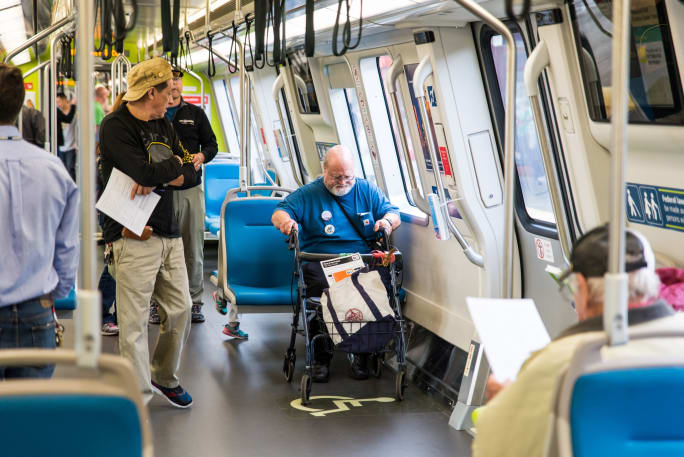
Public transit agencies need to provide accessibility advocates information, training and support for them to be effective. BART
Most of us got our start in the transit industry based on our education and job-related experience. Me? I got in by complaining and stretching the truth on my job application.
In 1991, I was attending San Francisco State and using public transit to get everywhere. Back then, transit accessibility was not as good as it is today and using it as a blind person was continually frustrating. Stops weren’t routinely announced. Priority seats weren’t often available. Detectable warning strips were not on most light rail platforms. And, it seemed that transit didn’t care.
So, when I got the chance to serve on BART’s accessibility advisory group, I took it with glee. This was going to be my chance to tell them everything I had been thinking for all those years during college. Yep, I was going to drop the mic every fourth Tuesday afternoon, and they would have to listen.
This is what I expected, but it’s not what happened.
I was ready to rant, but quickly learned that BART staff actually cared deeply about accessibility. They were listening, and they were taking us seriously. They asked us our opinions about everything — from new station designs, to new ticket machines, to the new paratransit service they were setting up with AC Transit. They even let us play the parts of injured BART passengers during an emergency preparedness drill. In short, they used our input to improve accessibility for everyone.
Soon enough, I was taking the advocacy process seriously, providing meaningful input, and learning to love transit. So much so, that when an entry-level accessibility planning position came available, I applied, and despite my lack of professional industry experience, I was hired. I’ll never know what tall tales my hiring manager must have told BART’s HR Department to get me on payroll, but I’m grateful; that was 25 years ago, and I have never looked back.
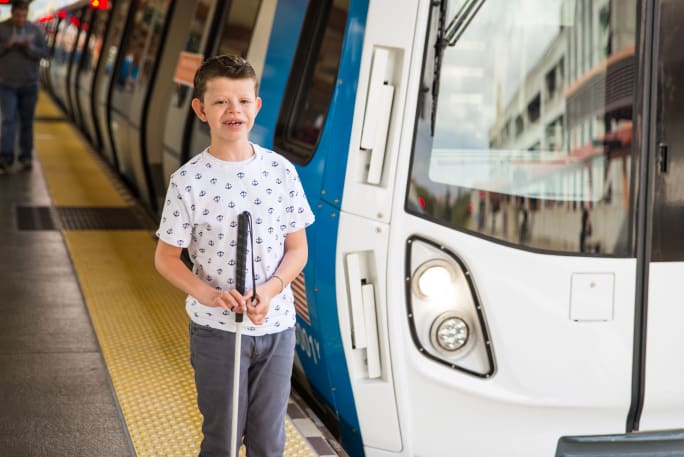
To recruit advocates, partner with local organizations such as consumer groups, senior centers, and college and university disability service centers. BART
But where are we today with passenger advocacy? It seems that transit has a love-hate relationship with advocates, and many disability community advocates feel the same way about transit. And yet, we need each other to be successful. There are a myriad of reasons why; here are just a few:
» Advocates help us fight our battles. Too often, we treat advocates like vocal customers rather than natural allies, who can help garner support for transit projects and priorities, and for the funding transit needs. This is especially true in areas where community leaders are less supportive of public transit spending. And, when funding is constrained, advocates can help develop consensus positions that balance priorities and maximize critical public support.
To be effective, we must treat advocates like partners rather than customers.
We need to provide training on the issues at hand, and on budget and funding constraints, to arm them with information necessary to speak to the concerns we are trying to address. Only then can we transform our most vocal critics into one of our most potent levers in the struggle for funding and public support.
» Advocates educate customers in ways we cannot. An agency where I previously worked had a company based within its service area that hired people with disabilities for entry-level, and part-time jobs. The company’s facility was on the edge of our service area, and we began transporting these customers to and from work. Many of the trips were extremely long, operationally challenging and costly to provide. They were hard on customers who spent hours each day getting to and from jobs that paid them less than their trips cost our agency to provide.
Of course, it would have been inappropriate for me to share my concerns with the community, but one of our local advocates shared her approach for educating customers about the financial and lifestyle implications of the choices they were making.
Instead of focusing on the allowable travel time for very long and costly trips on shared-ride paratransit, she explained how much time and earning potential the customer was losing while sitting on paratransit, and she would explain that the more money spent on long costly trips, the less there would be for other services in the future.
I have listened as other advocates have called upon riders to take responsibility for their choices to live in hard-to-serve rural areas — another message that would be off limits for me to deliver myself. In short, advocates can convey information in ways that we cannot, using logic that will resonate better, and with a level of credibility, authenticity and trust.
» Advocates can bring focus to areas where improvements are needed. Throughout my career, I have met numerous advocates who have spent years helping customers document and report service concerns, including one guy who spends his days helping customers file formal complaints with the FTA’s Office of Civil Rights. None of us like complaints. However, we need to know about legitimate service issues, and it is easier to quantify and correct issues when they are appropriately documented and clearly communicated. Advocates can help by educating customers on what the ADA and other civil rights laws actually require, and they can assist in the documentation and communication of those issues which truly need to be addressed.
Finding vocal customers is easy; finding effective advocates is not. Once you find them, they need information, training and support. Here are some things to keep in mind:
Partner with local organizations to recruit advocates. Consumer groups, independent living centers, rehabilitation organizations, senior centers and college and university disability service centers are good places to start. Many people affiliated with these organizations will already have some knowledge of the ADA as well as a background in advocacy. They may also have networks with other individuals and groups that can be used to increase the reach and effectiveness of the transit agency’s advocacy group when the time comes.
Train and retrain. The key difference between a vocal customer and an advocate is the understanding of what is known as “systems advocacy,” and it’s something most people need to learn. There are many places to turn for advocacy training, including independent living centers, community advocacy groups and organizations like Easter Seals and the National Center for Mobility Management. In addition to advocacy training, transit advocates need to know about the ADA, about transit planning and funding, and about the political process. And when new advocates come along and/or circumstances change, training should be repeated.
Be transparent. Advocates cannot be effective if they are not informed, and they will not help if they do not trust the agency. For these reasons, it is critical that transit agencies provide the unvarnished truth about performance — the good, the bad and the ugly; that operating and financial data is accurate, objective and clear; and that transit leaders are open about their decision-making, and particularly when the agency is not able to support a position or a request important to its advocates.
Building a strong advocacy community takes effort, time and focus, but the rewards are worth doing. And, who knows, maybe there’s a future CEO parked in a wheelchair or standing next to a guide dog at a transit stop right this minute, just waiting to share the next big idea for moving our entire industry forward.
Ron Brooks is VP of Transit Market Development for American Logistics, a national passenger transportation logistics company.
Subscribe to Our Newsletter
More Blog Posts
Building a Winning FTA Grant Proposal: Why Propane Autogas is the Pragmatic Choice for Fleet Resilience
With $610 million available through the FY 2026 Buses and Bus Facilities Competitive Program and the Low or No Emission Grant Program, agencies must build a compelling case before the September 21 deadline that balances environmental compliance with operational feasibility.
Read More →
Velo-city Conference 2026: Latest Trends in Cycling as Part of Urban Mobility
The global cycling conference highlighted how cities are integrating bicycles into multimodal transportation networks, expanding cycle tourism and reshaping urban mobility.
Read More →
Kindness Isn’t Soft...It’s Strategic.
Mike Bismeyer — often known as “The Kindness Guy” — has spent more than 17 years in public transit and mobility, serving in industry leadership roles, speaking across North America, and advocating for stronger workplace cultures. But his message doesn’t come from theory. It comes from lived experience.
Read More →
Inside ITF 2026: Transport Reacts to A Challenging World
Transport leaders from around the world gathered in Leipzig, Germany, for the 2026 International Transport Forum to discuss resilience, climate impacts, supply chains and the future of sustainable mobility.
Read More →
Every Ride Tells a Story — But You’re Not Just Selling the Ride
You’re selling the moment, the meaning, and the emotion behind it.
Read More →
How Digital Signage is Reshaping the Traveler Experience at Transportation Hubs
What was once a landscape of static signs has evolved into a responsive, immersive environment powered by real-time visual communication.
Read More →
Latest Trends in Urban Mobility from Polis Conference 2025
Polis comprises cities and regions, as well as corporate partners, from across Europe, promoting the development and implementation of sustainable mobility. This year’s event had over a thousand attendees across various policy forums and an exhibition.
Read More →
Why Transit Leaders Require Better Tools for Operational Clarity In Today’s Tech-Fragmented Environment
Across North America and beyond, transit agency officials are contending with a perfect storm of operational headaches and strategic challenges that hamper daily service and long-term progress.
Read More →
The Powerless Brokers: Why California Can’t Build Transit
It is no secret that transit in the U.S. is slow and expensive to build.
Read More →
Why Transport Sustainability Should Focus on People Instead of Cars
Simply incentivizing electrification is not enough to make a meaningful impact; we must shift our focus toward prioritizing public transportation and infrastructure.
Read More →