



Why 'Tactical Transit' is the Next Big Thing
The raffish, worldwide movement known as tactical urbanism appears poised to take on a meatier role in improving transit in bus corridors. By providing low-cost, agile alternatives to lengthy street improvement processes, “tactical transit” has the ability to jumpstart virtuous cycles of increasing bus ridership by speeding up travel times, improving passenger experience, and enhancing overall perceptions of riding the bus.

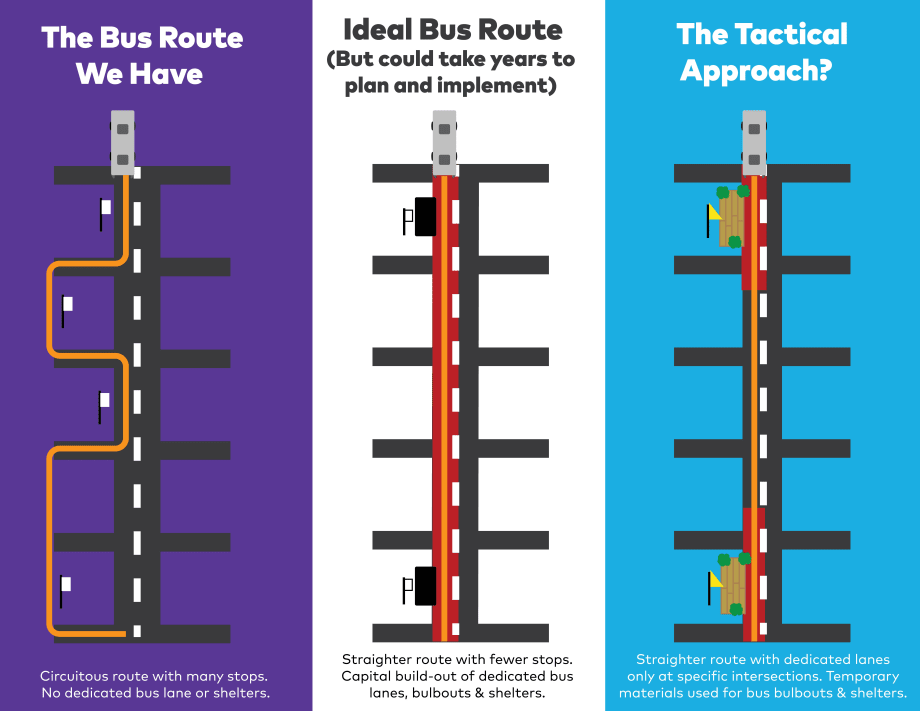
How tactical transit could shift transportation planning. Graphic via TransitCenter
How tactical transit could shift transportation planning. Graphic via TransitCenter
The raffish, worldwide movement known as tactical urbanism appears poised to take on a meatier role in improving transit in bus corridors. By providing low-cost, agile alternatives to lengthy street improvement processes, “tactical transit” has the ability to jumpstart virtuous cycles of increasing bus ridership by speeding up travel times, improving passenger experience, and enhancing overall perceptions of riding the bus.
Tactical urbanism has proven itself particularly adroit in demonstrating the efficacy and public support for protected bike lanes and plazas — the pedestrianization of Times Square, of course the most visible, pioneering example. It now presents enormous potential to begin transforming the way that transportation agencies implement bus-related projects. Instead of undergoing lengthy procurement processes or depleting financial or political resources, transit agencies can begin improving the physical environment in which buses operate with the tools that can deliver in the near-term. Indeed, some cities are already leading the way.
In Everett, Mass., a pilot project recently transformed a parking lane in a heavily congested portion of Broadway/Route 99 into bus-only lane during rush hour. Requiring no engineering investment, the project merely relies on orange safety cones and temporary signage to demarcate the lane. Initial data indicates that commute times have been reduced anywhere from four to eight minutes, and both bus riders and car commuters have embraced the project because it has improved traffic flow overall. According to City Transportation Planner Jay Monty, Everett has decided to extend the pilot indefinitely and is exploring ways to expand the route.
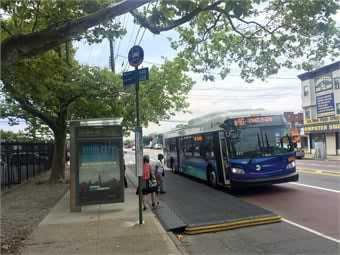
Testing out a temporary bulbout along Utica Avenue in Brooklyn. Image: TransitCenter
The New York City Department of Transportation has been using what could be considered tactical techniques since 2008, when it debuted the Select Bus Service program in partnership with the MTA. The first effort on the Bronx’ Fordham Road was rapidly implemented with painted bus lanes and repurposed parking meters (for curbside fare collection). Recently, the city expanded its “quick delivery” repertoire for bus corridors with a rubber bus bulbout (curb extensions that align the bus stop with the parking lane, allowing buses to stop and board passengers without ever leaving the travel lane) along the Utica Avenue corridor rather than traditional cement. The agency is waiting to see how the hardware survives the winter before expanding their use.
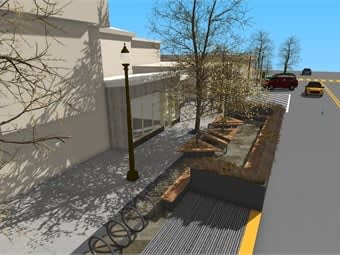
Architectural rendering of AC Transit’s stoplet. Image: TransitCenter
Another agency exploring tactical bulbouts is AC Transit in Albany, Calif., a city north of Oakland. The agency plans to debut a “stoplet” in March of 2017, which is part bus bulbout, part parklet. According to Project Manager Stephen Newhouse, “the relatively low cost and quick delivery timeline of the stoplet helps the agency establish credibility with the public. It allows us to demonstrate that we are frugal, action-oriented, and adaptable.” Additionally, the agency hopes that this marriage of parklets and bus stops will improve overall operations in a dense commercial corridor with many competing interests for right-of-way. By creating something that both passengers and adjacent businesses will see as an amenity, “the stoplet model could turn what is traditionally thought of as a zero-sum game into a win-win for transit agencies, communities, and our customers,” says Newhouse.
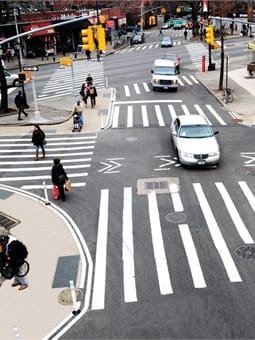
“Tactical” sidewalk extensions in Brooklyn. Image: TransitCenter
An agency that used the stoplet or modular bulbout at bus stops, in combination with proven safety and walkability enhancements such as sidewalk extensions or intersection simplification, could forge great transit corridors from unwelcoming, car-oriented arterials within a year’s time. This kind of combined deployment would be particularly well-suited to cities with transit aspirations such as Nashville, Tenn. or Charlotte, N.C., but has clear application throughout the U.S.
Temporary materials can also provide an alternative to glacial-paced placement when it comes to bus shelters. In Louisville, Ky., the Trick Out My Trip initiative, developed by nonprofit "neighborhood project" platform, Ioby, recently allowed a coalition of community members to quickly construct two bus stops that are both aesthetically pleasing and designed with a passenger’s comfort in mind.
According to project organizer Julienne Chen, “we wanted to make a visible statement about the role that buses have to play in our community and that they are also valued modes of transport. We hope that the project shows that there are small, tangible improvements that can be made to start shifting the conversation about how people think about taking buses — and what their experience is once they decide to take a bus.”
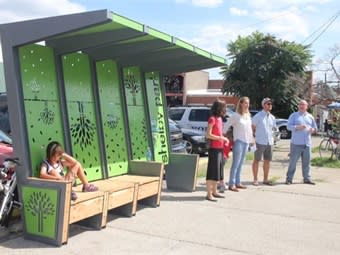
Louisville “TransporStation” Project. Image: TransitCenter
What might ensure the scalability and ultimate success of these types of initiatives? Chen highlighted the importance of engaging early on with stakeholders and building ownership. She says it’s also critical to quickly address the “unsexy” things like maintenance, liability, engineering, and design standards, right of way requirements and installation — things that tend to get lost amidst the excitement of a novel project. Regrettably, in Louisville additional bus stops will have to be citizen rather than agency-led, as the local transit authority TARC already has an existing contract for bus shelters. However, while perhaps not yet a policy adoption, Chen says that the project has ignited dialogue between the public and government agencies about how to best put the users at the center of bus stop design.
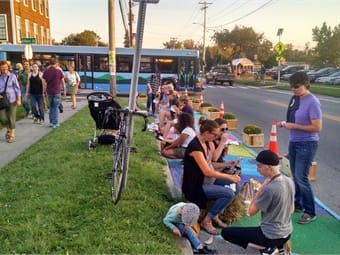
Streets getting tactical in Burlington, Vt. Image: TransitCenter
Over at AC Transit, however, Newhouse is optimistic about the scaling prospects for his stoplet and expects that the completion of the first one will pave the way for agency-wide adoption of this method. “I think the greatest challenge to adopting tactical urbanism is internal,” says Newhouse. “Overcoming fear of failure and restrictive procurement processes is key. The best thing transit agencies and governing bodies can do to capitalize on tactical urbanism is create a safe space for innovation from within.”
(This article was originally published by TransitCenter.)
Hayley Richardson is the communications associate for TransitCenter, a nonprofit foundation that supports advocacy, research and leadership development for transportation reform across the U.S.
More Blog Posts
Building a Winning FTA Grant Proposal: Why Propane Autogas is the Pragmatic Choice for Fleet Resilience
With $610 million available through the FY 2026 Buses and Bus Facilities Competitive Program and the Low or No Emission Grant Program, agencies must build a compelling case before the September 21 deadline that balances environmental compliance with operational feasibility.
Read More →
Velo-city Conference 2026: Latest Trends in Cycling as Part of Urban Mobility
The global cycling conference highlighted how cities are integrating bicycles into multimodal transportation networks, expanding cycle tourism and reshaping urban mobility.
Read More →
Kindness Isn’t Soft...It’s Strategic.
Mike Bismeyer — often known as “The Kindness Guy” — has spent more than 17 years in public transit and mobility, serving in industry leadership roles, speaking across North America, and advocating for stronger workplace cultures. But his message doesn’t come from theory. It comes from lived experience.
Read More →
Inside ITF 2026: Transport Reacts to A Challenging World
Transport leaders from around the world gathered in Leipzig, Germany, for the 2026 International Transport Forum to discuss resilience, climate impacts, supply chains and the future of sustainable mobility.
Read More →
Every Ride Tells a Story — But You’re Not Just Selling the Ride
You’re selling the moment, the meaning, and the emotion behind it.
Read More →
How Digital Signage is Reshaping the Traveler Experience at Transportation Hubs
What was once a landscape of static signs has evolved into a responsive, immersive environment powered by real-time visual communication.
Read More →
Latest Trends in Urban Mobility from Polis Conference 2025
Polis comprises cities and regions, as well as corporate partners, from across Europe, promoting the development and implementation of sustainable mobility. This year’s event had over a thousand attendees across various policy forums and an exhibition.
Read More →
Why Transit Leaders Require Better Tools for Operational Clarity In Today’s Tech-Fragmented Environment
Across North America and beyond, transit agency officials are contending with a perfect storm of operational headaches and strategic challenges that hamper daily service and long-term progress.
Read More →
The Powerless Brokers: Why California Can’t Build Transit
It is no secret that transit in the U.S. is slow and expensive to build.
Read More →
Why Transport Sustainability Should Focus on People Instead of Cars
Simply incentivizing electrification is not enough to make a meaningful impact; we must shift our focus toward prioritizing public transportation and infrastructure.
Read More →