



New mobility, autonomous and e-tech upfront at BusCon 2019
Take a look at what you missed ... Uber execs talk, new vehicle offerings, and how to conquer issues in maintenance.

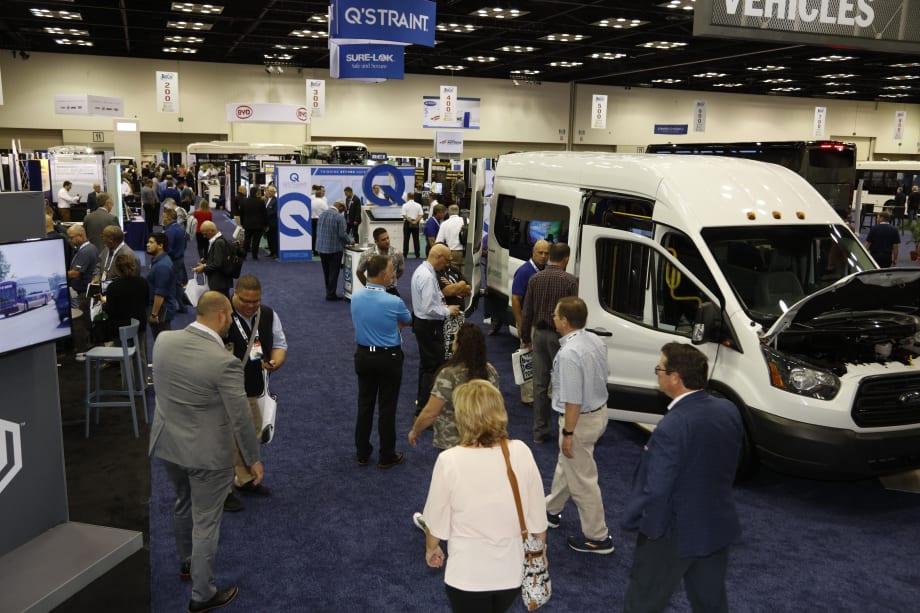
The BusCon show floor featured all of the latest vehicles, technologies, and products available on the market today.
The BusCon show floor featured all of the latest vehicles, technologies, and products available on the market today.
How the bus industry can find its role in the changing mobility landscape was a key focus of BusCon 2019, which was held at the Indiana Convention Center in Indianapolis Sept. 23 to 25.
During the Keynote Address, “The Changing Face of Mobility,” Uber’s Head of Global Policy for Public Transportation Chris Pangilinan discussed some of the ways the TNC is partnering with public transit agencies to boost mobility by providing first-, last-mile connections to home, work, and schools, as well as on-demand transportation services for late-night employment centers and paratransit customers. Pangilinan explained the latter has proven to be a game-changer, because paratransit customers no longer have to schedule trips 24 hours in advance the way they typically have in the past, and instead, have the freedom to travel with more spontaneity. He also added that the need for late-night options is steadily increasing throughout the nation, since many transit agencies either do not currently operate services or are slashing services that operate late into the evening.
A key to the partnerships being formed with transits, Pangilinan said, is the ability to not only offer services like on-demand transportation, TNC services, and bike-share programs alongside typical bus and rail services, but also give users the chance to plan and pay for their trips all in one mobile app. He cited the program in Denver, where the Regional Transportation District teamed with Uber, Transit, and Masabi to enable passengers to plan and pay for their entire multimodal trip on one single platform, which includes either the agency’s Mobile Tickets app, the Transit app, or Uber’s app.
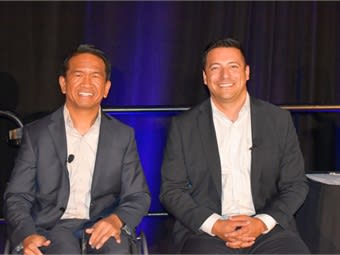
Uber’s Head of Global Policy for Public Transportation Chris Pangilinan and the Des Moines Area Regional Transit Authority's Luis Montoya delivered the Keynote Address.
Pangilinan also explained that Uber is currently working with its transit partners to offer more data, including key metrics that highlight the impact of public transit’s role in the mobility landscape, while adding that their still an issue of privacy associated with some of the data being provided.
Also on hand to discuss the process from a transit agency perspective was Luis Montoya, from the Des Moines Area Regional Transit Authority (DART), which is currently embarking on a project with Uber to provide on-demand transportation to and from its existing bus services.
Montoya also discussed the new mobility model and how it is impacting smaller agencies like DART, as well as how partnerships with transportation providers like Uber are enabling transits around the nation to more nimbly fill transportation gaps while also boosting the services they can offer to their customers. Keys to getting these types of partnerships off the ground, Montoya said, is to identify funding and work with key stakeholders to attain buy-in at all levels.
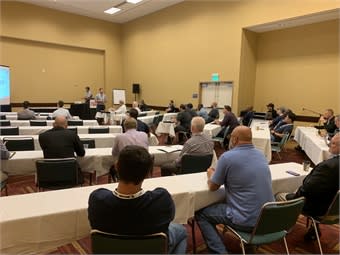
Many of this year's educational offerings touched on the new mobility model that is emerging in cities through the nation.
Autonomous tech
Bestmile’s Warren Perry and First Transit’s Jeff Peterson discussed the impact of autonomous vehicle technology and how they may be integrated into the typical transportation services that are already being provided.
Focusing primarily on the study of autonomous shuttles, Perry and Peterson discussed the ideal applications for the eight-person shuttles, including providing first- and last-mile connections in city centers and circulator service in and around closed campuses, such as at universities, office parks, or hospitals.
Perry discussed how Bestmile’s technology is being used in partnerships with various vehicle suppliers, including Navya, beep, and Easy Mile, and discussed an interesting project in Fribourg, Switzerland where AVs are being used to connect the Marly Innovation Center, which includes a business and conference center, restaurants, and more, to a city bus line.
Peterson also discussed several pilots that have either been completed or are currently in the works for First Transit, including programs with Houston METRO, the Jacksonville Transit Authority, and the Minnesota Department of Transportation.
Peterson also discussed the numerous considerations for implementing AVs, including the type of tech that will be used (SAV versus stack); route characteristics and how AVs will integrate with other transportation modes and services; customer and road user safety; and cybersecurity issues.
Re-optimizing routes, microtransit
During the “How to Provide Better, More Efficient Transportation Options” session, Harford Transit Link’s Gary Blazinsky and Jodi Glock discussed how the Maryland-based agency revamped its services, which included re-optimizing routes, adding more employees, increasing the number of vehicles it operated, and simplifying bus schedules and signage.
The results of Link’s two-year effort, which included employee and community buy-in, was an increase in customer satisfaction, an improvement of more than 20% in on-time performance, and an increase in bus operator morale.
Also during the session, Via’s Jason Starr discussed how the company’s technology is helping its partners provide on-demand transportation programs, commonly known as microtransit, to provide first- and last-mile connections, grow public transit ridership, expand access, and fill transportation deserts in rural areas.
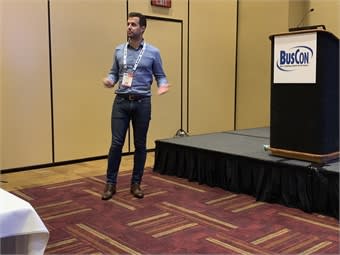
Via’s Jason Starr discussed how the company’s technology is helping its partners provide on-demand transportation programs, commonly known as microtransit, to provide first- and last-mile connections, grow public transit ridership, expand access, and fill transportation deserts in rural areas.
He also discussed the nuances of these types of partnerships, including choosing a transportation as a service (TaaS) model, where Via provides a turnkey solution that includes the software technology, plus drivers, vehicles, and operations management, or a software as a service (SaaS) model, where Via supplies the tech, but the partner provides its own drivers, vehicles, and operational management. A key aspect in that decision, is examining which model could provide the most cost savings, as well as how much control the partner chooses to maintain in the service being provided.
Via was also on hand to receive one of METRO’s Innovative Solutions Awards for its work with the City of Sacramento, Calif. and Colo.’s City of Lone Tree.
Another Innovative Solutions winner, Moline, Ill.’s MetroLINK discussed its battery-electric bus program with Proterra, which includes the usage of a ceiling-mounted charging system, enabling the best usage of its space, while also limiting the need to have employees move the vehicles back and forth to the charging area.
Another electric bus session presenter was ChargePoint’s Mark Kerstens, who suggested operators should “think big and start small” when making the transition to electric vehicles. He also discussed how going electric includes a comprehensive project management with multiple stakeholders to be successful, as well as best practices for implementing charging infrastructure and getting the most from the technology solution chosen to keep charging costs low.
Additional educational offerings included a session from Jeff Cassell, who discussed how an operation can benefit by complying with new CDL requirements; how operators can get the most out of their ELDs now that they have been fully implemented; keys for retaining rather than recruiting drivers; which alternative fuel is best for which application; and a look at rural and tribal transportation networks by National RTAP’s Robin Phillips.
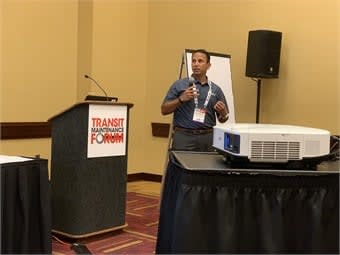
This year's TMF sessions featured talks from Allison Tranmission, Cummins, the Altoona Bus Testing Program, and more.
Transit Maintenance Forum
The Transit Maintenance (TMF) also returned to BusCon, featuring several presentations on technology and some of the latest issues techs are facing in the shop.
The program kicked off with presentations from Cummins, who discussed best practices for the maintenance of diesel engines, and Allison Transmission, who spoke about the benefits of prognostics and telematics in the maintenance shop.
BusCon Innovation Award winners Connixt and L.A. Metro provided a presentation on how cloud-based mobile technology is making maintenance easier for the transit agency to manage its rolling stock, facilities and assets, and contractors and infrastructure. The solution also enabled L.A. Metro to go paperless and move to automated reporting of key analytics and KPIs, as well as meet mandated MAP-21 goals, state of good repair, and more.
The TMF also hosted officials from the Penn State Bus Research and Testing Program, who discussed the history of the program and how testing has evolved as battery-electric and hydrogen fuel-cell bus technology has begun to take hold.
Officials said the testing program needs additional resources and that the funding shortage has resulted in deferred repair and replacement of equipment. They added that the program has been funded at $3 million per year from 1998 through 2018, and that for the program to continue to operate beyond 2021, the program will require $5 million per year.
Additional TMF sessions this year focused on what maintenance personnel need to know about all-electric buses and an eye-opening session on how to manage risk in a world of emerging outbreak from CURIS.
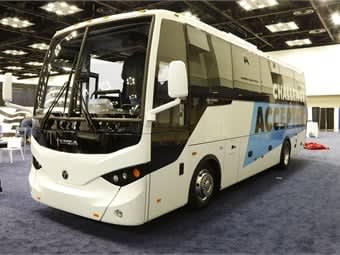
TEMSA North America unveiled its new TS30 coach on the show floor on Tuesday.
Vehicle highlights
On the show floor, TEMSA North America introduced its new TS30 30-foot motorcoach during an event on the show floor on Tuesday, Sept. 24, and then re-wrapped the bus to present the first delivery of the TS30 to David Benedict, president of David Thomas Trailways, on the show floor the following day.
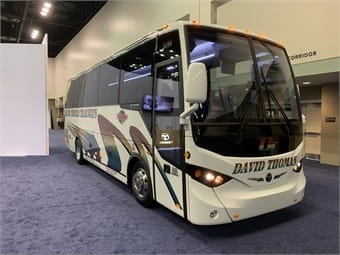
And on Wednesday, TEMSA re-wrapped the bus to deliver the first TS30 to Philadelphia's David Thomas Trailways.
“The 30-foot coach with seating for 34 passengers has a lot of different applications,” explained Randy Angell, national sales manager, North America, for TEMSA. “It’s also an opportunity for us to have something that is unique to the industry, and it is our vision now to not only work with the successful models we have, but maybe even go smaller in the future.”
Featuring a 100% stainless steel structure, the new TS30 features new updates, including increased luggage capacity and an extra step in the front that makes boarding and de-boarding the coach easier and safer. The company is now also offering only MCC’s HVAC system to make it simpler for the end-user and to move to a more uniform approach across its entire product line, according to company officials.
MCI showcased its 35-foot J3500 motorcoach, which features all the styling and comfort hallmarks of the J4500, with seating for up to 44 passengers, a powerful Cummins engine, shared J-coach components, and a turning radius of under 33 feet that makes it a natural for high-traffic situations that call for top maneuverability. The coach features an electric cooling (e-fan) system for fuel efficiency improvements and the latest-generation of Advanced Driver Assistance Systems (ADAS), plus 360-degree camera systems as options.
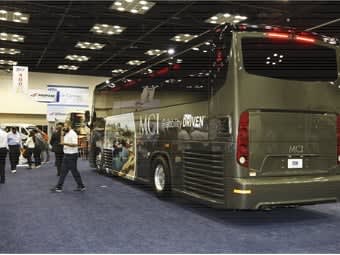
MCI showcased its J3500 motorcoach on the BusCon show floor.
While MCI plans to introduce all-electric coaches in the very near future, there were several electric vehicles on the show floor, including Micro Bird’s D-Series, CCW’s retrofitted offering for the Indianapolis airport, and transit buses from BYD and Proterra.
Proterra also highlighted its Energy™ fleet solutions initiative, which is a full suite of options that enable turnkey delivery of a complete energy ecosystem for heavy-duty electric fleets, including design, build, financing, operations, maintenance, and energy optimization, while BYD touted its leasing program that provides options with no upfront costs and a low cost per month.
Next year, the show will move from its Indianapolis digs to the Pennsylvania Convention Center in Philadelphia, Nov. 15 to 17.
More Bus

New York MTA Plans Largest Bus Fleet Upgrade in More Than a Decade
The agency is seeking manufacturers for 650 new CNG buses to replace aging vehicles, improve reliability, and advance its broader fleet modernization strategy.
Read More →
Building a Flexible Path to Transit Electrification
John Hroncich discusses BAE Systems’ modular and scalable approach, lessons learned from decades of real-world operations, and how agencies can identify electrification strategies that fit their fleets.
Read More →
Bus Tech Talk: Keeping Transit Technicians Ahead of the Technology Curve
LA Metro’s Obed Mejia discusses technician training, evolving maintenance technology, fleet replacement, and strategies for getting the most out of today’s transit fleets.
Read More →
Biz Briefs: RIPTA Unveils New Frontrunners, Clevland RTA Adds New Siemens, and More
In METRO's latest installment, we take a look at recent news from Siemens, Prevost, Dodge, and more partnerships making headlines across the transportation sector.
Read More →
People Movement: Holly Arnold Joins Transdev and More
In this edition, we also cover recent appointments and announcements at Pace, CamTran, MCI, and more, showcasing the individuals helping to shape the future of transportation.
Read More →
The High Cost of Transit Buses: Industry Leaders Look to Procurement Reform
Transit leaders and policymakers examine how standardized bus designs, streamlined procurement, and predictable funding could help agencies stretch budgets and deliver better service.
Read More →
The Business Voice Behind Public Transportation
As chair of APTA’s Business Members Board of Governors, Ray Melleady explains how more than 850 business members are partnering with transit agencies to advance funding, innovation, and industry-wide collaboration.
Read More →
From Surviving to Thriving: Building Stronger Transportation Organizations
Bus Business Consultants founder Brian Dickson shares lessons on leadership, organizational health, and creating options for long-term success in a changing transportation industry.
Read More →
Finding the ‘Happy Medium’: Optimizing Maintenance Without Sacrificing Reliability
The key to maintenance optimization isn’t doing less work—it’s doing the right work at the right time on the right assets.
Read More →
LA Metro, City of West Hollywood, and Partners Advance Smarter Bus Lane Enforcement
The award-winning partnership combines AI-powered detection with human oversight to improve bus reliability, accessibility, and enforcement efficiency.
Read More →