MTA New York City Transit President Bianco to retire
Carmen Bianco, 63, became acting president of New York City Transit in April 2013 and was permanently appointed to the position in September 2013 following a nationwide search. He had previously served since March 2010 as sr. VP, Department of Subways.
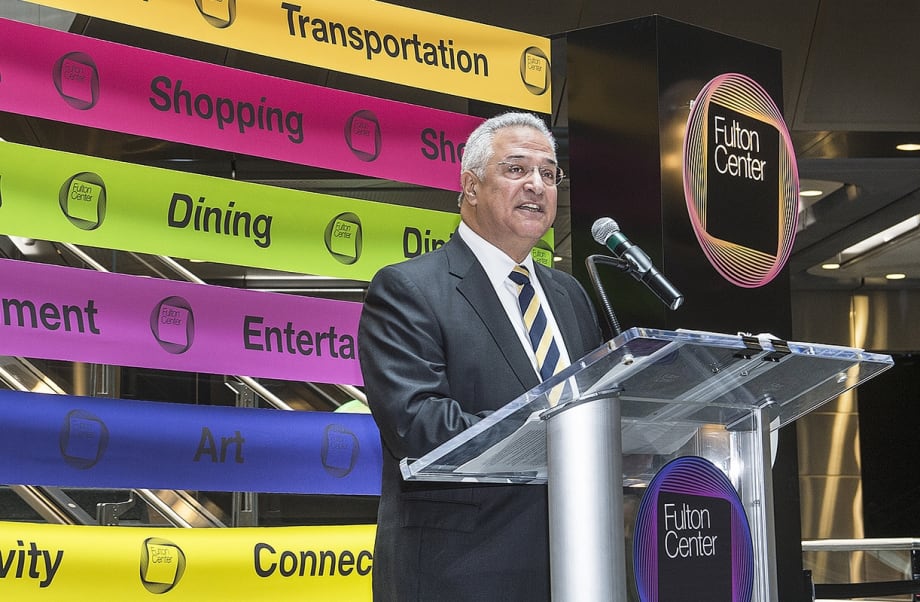
MTA NYCT President Carmen Bianco speaking at the unveiling of the Fulton Center transit and retail hub. Photo: Metropolitan Transportation Authority / Patrick Cashin
2 min to read
MTA NYCT President Carmen Bianco speaking at the unveiling of the Fulton Center transit and retail hub. Photo: Metropolitan Transportation Authority / Patrick Cashin
Carmen Bianco, president of Metropolitan Transportation Authority (MTA) New York City Transit (NYCT), announced he plans to retire later this year from his position running the largest mass transit system in North America. In his time as president, Bianco transformed the agency’s organizational culture to align management strategies, enhance safety and improve customer service to advance the subways, buses, paratransit and Staten Island Railway in New York City.
Bianco and his team guided the agency through significant snowstorms, Hurricane Irene and Superstorm Sandy, which took a critical toll on significant areas of the 110-year-old infrastructure. Despite more than $4 billion in Sandy-related damage, 80% of subway service was restored within five days.
Ad Loading...
As NYCT works to deliver consistent service to daily ridership that has steadily expanded to more than 8.2 million people, Bianco’s leadership team is planning service for the future by evaluating ways to deliver higher-capacity, more environmentally friendly and technologically advanced trains and buses, and improved levels of customer service.
“There is no more challenging job in the American transportation industry than keeping New York City moving every day and positioning it well to serve our customers for decades to come,” Bianco said. “It has been a privilege to lead our 48,000 employees who work so hard around the clock. I owe each of them a debt of gratitude, and it’s been an honor to have served New York City Transit.”
Bianco, 63, became acting president of NYCT in April 2013 and was permanently appointed to the position in September 2013 following a nationwide search. He had previously served since March 2010 as sr. VP, Department of Subways.
“Carmen Bianco is a one-of-a-kind leader as well as a trusted friend, and while I understand why he is ready to retire now, we will all miss his detailed experience, his thoughtful perspective and his constant drive to make transit better for both our customers and our employees,” said MTA Chairman/CEO Thomas F. Prendergast. “Through initiatives like establishing the FASTRACK program for subway maintenance and aggressively bringing new technology into the system, Carmen made the organizational culture of New York City Transit reflect the priorities that our customers expect. He will be missed.”
Bianco was the seventh person to serve as New York City Transit President since the position was created in 1980. He previously served as head of New York City Transit’s Department of System Safety from 1991 to 1995. Bianco has also held senior safety positions at Amtrak and NJ Transit.
Bianco has submitted a retirement letter effective in August 2015, to allow the MTA to conduct a nationwide search for his replacement and ensure a seamless transition.
Created in partnership with Walsh-VINCI Transit Community Partners, the contractor for CTA’s historic $5.7 billion RLE project, the new $250,000 scholarship program will provide three students a year from 2026 to 2030 with $3,000 scholarships.
The Foundation produces the report each quarter, using data collected from surveys of major motorcoach manufacturers that sell vehicles in the US and Canada.
The new mobile booking platform and backend system aim to streamline operations, improve communication, and better serve riders across a 20,000-square-mile region.
BRIT patrols are over and above those already occurring within the district. For example, the agency experienced three copper wire thefts along the G Line in April, followed by others later in the month and in early May.
The company partners with manufacturers such as Kiel Seating, Camira Fabric, and TSI Video, focusing on areas that directly impact both passenger experience and operational performance.
Erin Hockman will officially assume the role on May 7, as current CEO Amanda Wanke departs to take a leadership position with Metro Transit in the Twin Cities.
The survey showed that commute trips still make up the majority of ridership, with most riders boarding 2 to 3 days a week, reflecting hybrid work schedules. Two-thirds of Caltrain riders have access to a car, while 37% of Caltrain riders are considered low-income.