



JTA has $198M impact on city's economy, report finds
The Jacksonville Transportation Authority's services saved customers more than $23.4 million in transportation-related expenses.

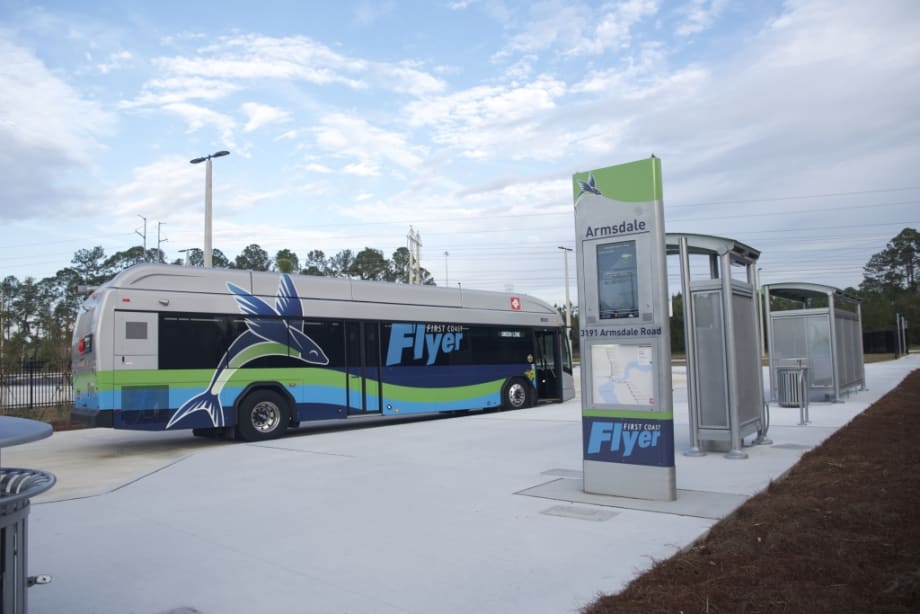
JTA customers rode a total of 64,332,545 miles in 2018, taking more than 12 million trips, according to the report.
JTA
JTA customers rode a total of 64,332,545 miles in 2018, taking more than 12 million trips, according to the report.
JTA
The Jacksonville Transportation Authority (JTA) commissioned a study in partnership with University of North Florida’s Coggin College of Business to look at the impact transit has on Northeast Florida’s economy.
The “Economic Impact Study of Jacksonville Transportation Authority (JTA) Operations, 2018,” report concluded that JTA’s total economic output exceeded $198.8 million in 2018, and that JTA services saved customers more than $23.4 million in transportation-related expenses.
The study was completed by UNF Professor of Economics and Director of the Local Economic Indicator Project at UNF’s Coggin College of Business, Chung-Ping (Albert) Loh. His work is based on figures from the 2018 fiscal year that concluded Oct. 1, 2018.
Loh’s study measured the economic contribution of JTA’s operations to the five-county Jacksonville Metropolitan Statistical Area (MSA), including output, employment, labor, compensation, and tax payments. He also measured several economic benefits of JTA’s operations to JTA customers and other Jacksonville citizens.
Some of the highlights of the report include:
Labor - JTA’s employment roster generated $43.7 million in direct labor income for the area, and $112.5 million in direct economic output. Additionally, JTA’s operations are supported by other industries within the Jacksonville MSA, and their employees. This indirect impact represented more than $14.1 million in labor compensation, and more than $37.3 million in indirect economic output.
The study found that labor earnings by JTA employees and those in related sectors also led to the consumption of more goods and services like groceries, entertainment and retail shopping. This induced impact, due to JTA’s operations, added $15.7 million in labor compensation and $48.8 million in economic output.
Combined, the JTA’s operations led to more than $73.6 million in labor compensation, $118.6 million in total added value, and $198.8 million in economic output.
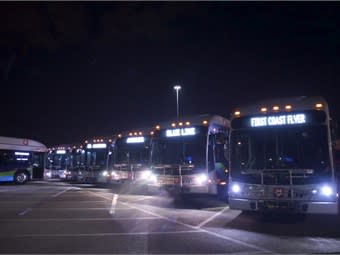
The study concluded that customers saved more than $23.4 million by using JTA services instead of driving their own vehicle.
JTA
Savings for Customers
JTA customers rode a total of 64,332,545 miles in 2018, taking more than 12 million trips. According to the study, if those customers traveled the same distance in their own vehicles, the cost of doing so would be significantly higher compared to using JTA services.
As a benchmark, Loh used data from a 2017 AAA study, “Your Driving Costs,” which calculated the annual expenses of owning, operating, and maintaining a personal vehicle, based on driving 15,000 miles annually. The AAA data calculated expenses ranging between $6,354, $8,171, and $9,399, depending on the size of the vehicle.
“Based on the unweighted average of costs across these three vehicle types, the cost of operating a car per mile is 53 cents,” Loh writes. “This implies that the total cost of traveling 64,332,545 miles would have amounted to $34,096,249 through passengers driving themselves.”
Compared with the $10.7 million JTA received in FY-2018 from passenger fares and passes, Loh concluded that customers saved more than $23.4 million by using JTA services instead of driving their own vehicle.
Reducing Congestion
Loh utilized data reported in the 2017 and 2018 North Florida TPO Annual Mobility Reports, which indicate traffic delay, traffic congestion, and traffic volume trended upward from 2010 to 2016.
Drivers spent an estimated 37,979 hours in traffic delays in 2016, according to the North Florida TPO. About 10.6 % of their total driving time in 2016 was spent in severely congested traffic situations.
Loh found that about 18% of JTA customers surveyed in 2016 said they would’ve driven their own cars if not for JTA services. Based on that figure, and others, Loh concluded that without JTA services, those additional drivers would’ve increased traffic delays by 20.84 vehicle hours per day.
More Management

METRO Opens Submissions for 2026 Motorcoach Awards
Nominations are now being accepted for METRO Magazine’s Operator of the Year and Innovative Operator of the Year awards.
Read More →
New York MTA Advances Final Contract for Second Avenue Subway Expansion
Contract Four is the largest in the Second Avenue Subway Phase 2 project and includes construction of station infrastructure, tracks, and signals for the subway expansion, MTA officials said. Work on Contract Four will begin in 2027.
Read More →
Transit Agencies Highlight Safety Gains at National Summit
Leaders from 15 major transit systems shared crime-reduction results and safety initiatives while discussing the role of continued federal support.
Read More →

NITA Names New Leadership, Expands Reduced-Fare Program at First Board Meeting
The new regional transit authority appointed its first board chair and interim executive director while extending reduced fares across CTA, Metra, and Pace for eligible riders.
Read More →
Beyond the Checklist: A Structured Approach to Transit Maintenance
Reliability-Centered Maintenance helps transit agencies move beyond routine checklists to focus limited resources on the assets and failures that have the greatest impact on safety, reliability, and service.
Read More →
APTA 2026 Nominating Committee Selects Leadership Slate, Names Chair and Vice Chair Nominees
Leadership changes will help shape the association’s priorities and its representation of the transportation industry during the 2026–2027 term.
Read More →
DART Launches Major Security, Fare Enforcement Initiative
The 90-day demonstration will deploy coordinated security teams at five light rail stations while testing controlled access and gathering data to guide future investments.
Read More →
Advancing Fare Collection Through Technology and Innovation
Learn about delivering 1300 gates at 91 stations while managing fare evasion. Explore the large scale deployment, solution customization and real-world results that affect the region. Prepare for deployment in your region now.
Read More →
Game Day in Motion: Moving Millions During the 2026 World Cup
Between packed transit stations and team motorcoaches, see how agencies and operators across North America tackled the transportation demands of the 2026 FIFA World Cup.
Read More →
Surface Transportation Extension Averts Shutdown, Leaves Transit Funding Gap
The stopgap keeps federal transportation programs moving, but missing advance funding could complicate the transit and rail projects agencies are planning next.
Read More →