



House Dems issue $760B infrastructure framework proposal
The proposal calls for an investment of $434 billion in surface transportation over five years, including $105 billion for public transit and $55 billion for passenger rail.
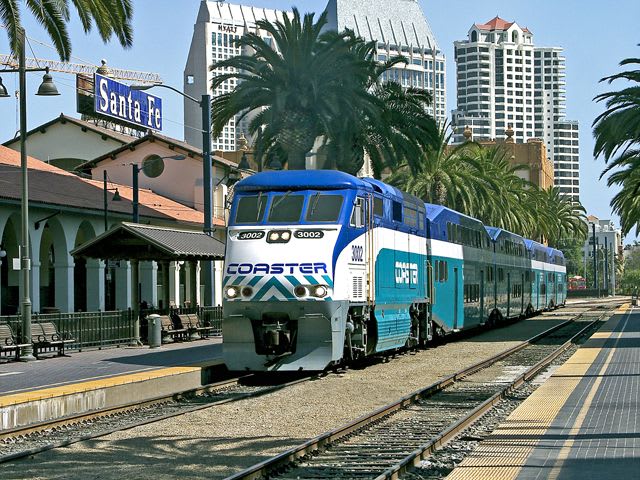
The proposal calls for an investment of $434 billion in surface transportation over five years, including $105 billion for public transit and $55 billion for passenger rail.
NCTD
The proposal calls for an investment of $434 billion in surface transportation over five years, including $105 billion for public transit and $55 billion for passenger rail.
NCTD
Speaker of the House Nancy Pelosi (D-CA), House Transportation and Infrastructure Committee Chairman Peter A. DeFazio (D-OR), House Ways and Means Committee Chairman Richard E. Neal (D-MA), other House leaders, and the House Democratic Caucus released a new $760 billion framework proposal to address America's growing infrastructure needs.
The proposal calls for an investment of $434 billion in surface transportation over five years, including $105 billion for public transit and $55 billion for passenger rail. In addition to surface transportation, the proposal addresses other transportation modes, including airports, ports, and inland waterways, as well as clean energy and broadband issues. It also includes provisions to tackle climate change through the development of green infrastructure, such as zero-emission vehicles.
“The American Public Transportation Association (APTA) applauds House Democratic leaders proposed framework to rebuild and expand America’s infrastructure, particularly the focus on critical funding for public transit and passenger rail infrastructure,” said APTA President/CEO Paul P. Skoutelas in a statement. “This framework includes important provisions for maintaining and expanding our public transportation infrastructure, and represents a commitment to growing our communities, supporting jobs, and providing expanded mobility options.”
“APTA has emphatically urged lawmakers that now is the time to invest more in our nation’s public transportation infrastructure to help our communities provide critical public transit services. Public transportation provides millions of Americans with access to jobs, education, and health care. We applaud House leaders for jump starting the infrastructure debate and look forward to working with Congress on a bipartisan basis to move forward with legislation that will repair, maintain and improve our public transit and passenger rail systems today and in the future.”
Some of the specific goals stated by the Democrats: (To view the proposal click here)
Brings existing infrastructure into a state of good repair and enables the completion of critical projects through long-term, sustainable funding.
Sets a path toward zero carbon pollution from the transportation sector, creating jobs, protecting natural resources, promoting environmental justice, and increasing resiliency to climate change.
Ensures a transportation system that is green, affordable, reliable, efficient, and provides access to jobs.
More Management

METRO Opens Submissions for 2026 Motorcoach Awards
Nominations are now being accepted for METRO Magazine’s Operator of the Year and Innovative Operator of the Year awards.
Read More →
New York MTA Advances Final Contract for Second Avenue Subway Expansion
Contract Four is the largest in the Second Avenue Subway Phase 2 project and includes construction of station infrastructure, tracks, and signals for the subway expansion, MTA officials said. Work on Contract Four will begin in 2027.
Read More →
Transit Agencies Highlight Safety Gains at National Summit
Leaders from 15 major transit systems shared crime-reduction results and safety initiatives while discussing the role of continued federal support.
Read More →

NITA Names New Leadership, Expands Reduced-Fare Program at First Board Meeting
The new regional transit authority appointed its first board chair and interim executive director while extending reduced fares across CTA, Metra, and Pace for eligible riders.
Read More →
Beyond the Checklist: A Structured Approach to Transit Maintenance
Reliability-Centered Maintenance helps transit agencies move beyond routine checklists to focus limited resources on the assets and failures that have the greatest impact on safety, reliability, and service.
Read More →
APTA 2026 Nominating Committee Selects Leadership Slate, Names Chair and Vice Chair Nominees
Leadership changes will help shape the association’s priorities and its representation of the transportation industry during the 2026–2027 term.
Read More →
DART Launches Major Security, Fare Enforcement Initiative
The 90-day demonstration will deploy coordinated security teams at five light rail stations while testing controlled access and gathering data to guide future investments.
Read More →
Advancing Fare Collection Through Technology and Innovation
Learn about delivering 1300 gates at 91 stations while managing fare evasion. Explore the large scale deployment, solution customization and real-world results that affect the region. Prepare for deployment in your region now.
Read More →
Game Day in Motion: Moving Millions During the 2026 World Cup
Between packed transit stations and team motorcoaches, see how agencies and operators across North America tackled the transportation demands of the 2026 FIFA World Cup.
Read More →
Surface Transportation Extension Averts Shutdown, Leaves Transit Funding Gap
The stopgap keeps federal transportation programs moving, but missing advance funding could complicate the transit and rail projects agencies are planning next.
Read More →