



90% using alternative Chicago Red Line services
The CTA recently completed an analysis of ridership trends of customers whose commute was affected by the Red Line South Reconstruction Project, a $425 million rebuilding of 10.2 miles of tracks and refurbishment of eight stations along the route.


Photo courtesy Daniel Schwen
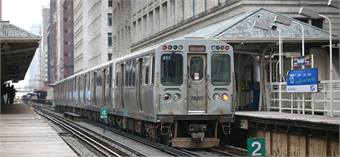
Photo courtesy Daniel Schwen
More than 90% of Red Line South customers have been using the extensive alternate service the Chicago Transit Authority (CTA) is providing during the historic reconstruction project.
The CTA recently completed an analysis of ridership trends of customers whose commute was affected by the Red Line South Reconstruction Project, a $425 million rebuilding of 10.2 miles of tracks and refurbishment of eight stations along the route. The project completely closed the Red Line South from Cermak-Chinatown to 95th Street from May 19 through late October 2013.
To handle the diversion of Red Line South customers, the CTA implemented an extensive alternative-service plan that includes free shuttle buses between the Garfield elevated and southernmost Red Line stations; a local shuttle bus serving all stations between 95th and 63rd Streets; an express shuttle between Roosevelt and Chinatown-Cermak; and expanded bus service on several regular bus routes.
Since the project start, the CTA has continued to closely analyze rail station entries on nearby train lines as well as relevant bus and shuttle bus boardings to ensure enough rail and bus service is being provided to meet demand and provide efficient, reliable transportation to affected customers. More than 42,000 customers are using the alternative service on an average weekday — more than the entire average daily ridership of either the Purple or Pink Lines.
The impact of the project on ridership is a slight 0.6% decrease in overall CTA average weekday rail ridership. Looking at the Red Line South project area specifically, the CTA estimates a ridership decline of approximately 9.8% when comparing with Red Line South ridership in April 2013 of about 46,000 station entries to post-construction entries of 42,103. This is in line with CTA expectations for a project of this size and impact as well as with temporary ridership declines from major CTA rail construction projects over the past decade.
For most of CTA’s recent construction projects, ridership not only returned to pre-construction levels once the project ended, but saw noticeable increases.
More Management
Financing, Fleet Replacement Require a More Strategic Approach
Executives from ABC Companies and MCI discuss how rising costs, changing market conditions, and post-pandemic challenges are prompting motorcoach operators to rethink financing strategies, fleet replacement cycles, and long-term planning.
Read More →
Bringing Austin’s First Light Rail System to Life
Austin Transit Partnership CEO Greg Canally discusses the city's nearly 10-mile light rail project, its collaborative approach to project delivery, the importance of community engagement, and the milestones ahead as construction approaches in 2027.
Read More →
ETA CEO John Maglio on Transit Technology, Innovation, and Building Agency Trust
ETA founder and CEO John Maglio explores the evolution of transit technology, the importance of reliable systems, and how stronger partnerships can help agencies improve operations and the passenger experience.
Read More →
Metra Draft Plan Outlines Costs, Service Improvements for Regional Rail
The Systemwide Network Plan identifies infrastructure needs and potential investments to expand all-day, bidirectional rail service across the Chicago region.
Read More →
New Orleans RTA Names Augustine III as New CEO
In this edition, we also spotlight recent personnel moves at HDR, PATH, STV, and more, highlighting the people taking on new roles across the transportation industry.
Read More →
How Transit Agencies Are Using Free Rides to Improve Voting Access
Transit agencies are using fare-free service, trip-planning tools, and targeted rides to improve voting access. See what other agencies can learn from these efforts.
Read More →
Caltrain’s Electrification Drives a New Era of Ridership Growth
The railroad’s shift to electric service has brought more frequent trains, stronger customer satisfaction, and increased ridership, earning it APTA’s Outstanding Public Transportation System award.
Read More →
Chicago, Charlotte Transit Agencies Expand Rider Support Programs
CTA launched crisis intervention teams as CATS prepares to deploy fare ambassadors, expanding customer assistance and security efforts across both systems.
Read More →
New York MTA Launches Historic $1.9B Signal, Track Modernization Project
Funded in part by congestion pricing revenue, the project will replace nearly century-old signals along the A and C lines in Brooklyn and Queens.
Read More →
Brian Dickson on Building Stronger, More Resilient Transportation Organizations
Bus Business Consultants Founder Brian Dickson discusses the leadership principles, operational discipline, and strategic planning that separate transportation companies positioned for long-term success from those stuck in survival mode.
Read More →