



AC Transit GM/CEO Michael Hursh to Transition to New Role
As one of the longest-tenured GM’s in AC Transit's nearly 65-year history, he leaves a legacy of visionary initiatives, innovations, and steadfast commitment to advancing the agency’s venerable bus network beyond its mission of safe, reliable, and sustainable transit services.

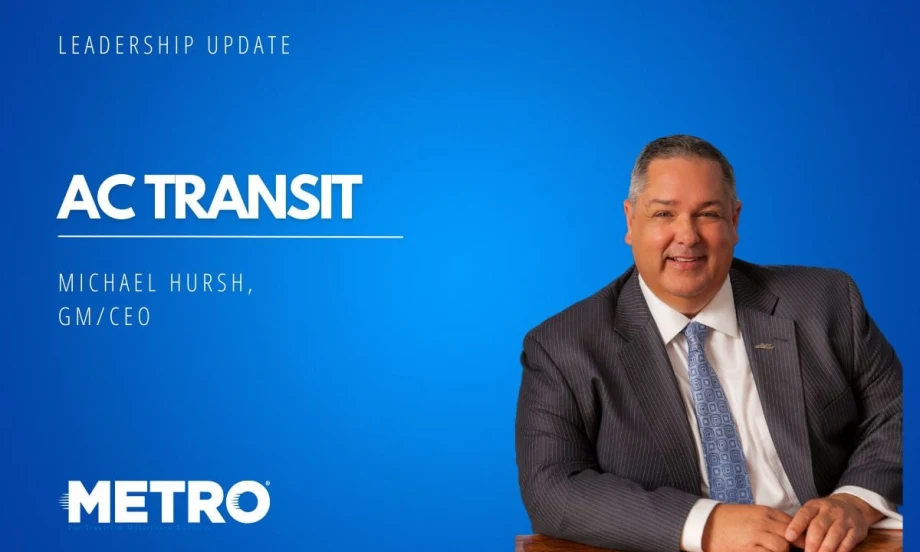
Under Michael Hursh's guidance, AC Transit maintained nearly a decade of balanced budgets, often achieving a surplus, and garnered numerous prestigious accolades, including the 2023 Outstanding Public Transportation System Award from the American Public Transportation Association.
Photo: AC Transit
Oakland, Calif.’s Alameda-Contra Costa Transit District (AC Transit) announced GM/CEO Michael Hursh will be transitioning from his leadership role to a Senior Advisor with the transit district, effective Dec. 14.
As one of the longest-tenured GM’s in AC Transit's nearly 65-year history, Hursh leaves a legacy of visionary initiatives, innovations, and steadfast commitment to advancing the agency’s venerable bus network beyond its mission of safe, reliable, and sustainable transit services.
Hursh’s Impact
Over the past nine years of his leadership, AC Transit achieved groundbreaking advancements, including the construction and successful launch of the Tempo BRT system, the opening and re-launch of the iconic Salesforce Transit Center, and leading the way as the first transit agency to provide personal protective equipment (PPE) for frontline employees and riders.
Under his guidance, AC Transit maintained nearly a decade of balanced budgets, often achieving a surplus, and garnered numerous prestigious accolades, including the 2023 Outstanding Public Transportation System Award from the American Public Transportation Association.
Since his arrival in September 2015, Hursh has eschewed titles or accolades. Instead, he has led the workforce of 2,100-plus with humility and accountability, consistently prioritizing customer service and the well-being of staff, fostering their personal and professional growth.
From day one, Hursh recognized the challenges posed by a retiring workforce and the shortage of young people entering the transit profession. To address this, he established a forward-thinking partnership with AC Transit’s labor unions to explore innovative ways to recruit entry-level employees and support their advancement to Journey-Level Mechanics.
The Mechanics Helper and Career Ladders Programs, born from necessity, have evolved into a model now being adopted by transit agencies across the country.
Similarly, the Bus Operator Mentorship Program, which individually paired senior transit operators with new hires, took flight under Hursh's leadership.
At its 2018 inception, the transit district's retention rate of new Bus Operators was 75%. By tapping into in-house guidance and support from experienced colleagues, behind-the-wheel skill acquisition skyrocketed and so did retention, soaring to 93% pre-pandemic.
Innovating at AC Transit
Hursh's drive to challenge the status quo led to innovative fleet management systems, predictive analytics, and customer engagement platforms.
He also championed Assembly Bill 917, allowing transit agencies statewide to use forward-facing cameras for issuing citations at bus stops and in transit-only lanes.
This year, he enhanced safety for all AC Transit riders — especially seniors, youth, and ADA passengers — by expanding the use of AI-powered automated cameras to detect illegal stopping and parking at bus stops throughout our bus network.
Known for thinking ahead of the curve, Hursh has led AC Transit to become a pioneer in zero emission transit.
Recently, he joined Gov. Newsom for the launch of the Alliance for Renewable Clean Hydrogen Energy Systems (ARCHES), where AC Transit is set to receive $144 million to expand its hydrogen fueling infrastructure and bus fleet.
Hursh also championed the creation of Zero Emission Bus University (ZEBU), a trailblazing partnership with Chabot College. His commitment to zero emission technologies secured two consecutive Federal Transit Administration Low or No Emission grants totaling over $40.5 million, funding the nation's first transit-collegiate program to train workers, and so doing, will unlock new jobs for the region and state.
“While the pandemic posed significant challenges, particularly in service delivery, it did not halt our forward momentum,” said Hursh.” Now, as I enter the 10th year of my tenure, I look forward to finalizing the transformative journey of this ten-year strategic plan as Senior Advisor, which includes assisting the District in identifying its next visionary leader to build on our foundation of success and lead AC Transit into the future.”
More Management

Castro to Lead RTC of Southern Nevada and More in People Movement
In this edition, we also cover recent appointments and announcements at the STV, MCI, and more, showcasing the individuals helping to shape the future of transportation.
Read More →
STraffic Expands North American Presence with Fare Collection Technology
John Moon, Associate Director, Product Strategy at STraffic, discusses the company's growth in North America, its efforts to reduce fare evasion, and more.
Read More →
Study: Denver RTD Generates $2.1 Billion in Annual Economic Activity
An economic impact study finds the agency supports approximately 17,500 jobs, delivers $1.6 billion in annual community and mobility benefits, and generates $2.42 in economic value for every dollar invested.
Read More →
Mark Aesch Nominated to Lead Federal Transit Administration
The former Rochester transit chief and TransPro founder, who has also contributed to METRO Magazine, brings decades of industry experience and a focus on performance, accountability, and financial sustainability to the nomination.
Read More →
Best and Worst U.S. Cities for Public Transportation in 2026
A new analysis of 50 major U.S. urban areas ranks public transit systems based on accessibility, affordability, usefulness, and safety, highlighting where transit performs best and where challenges remain.
Read More →
Laketran Cuts Fuel Costs, Boosts Efficiency with Propane-Powered Fleet
The Ohio transit agency is using propane-powered vehicles and on-site fueling infrastructure to cut fuel and maintenance costs while meeting growing demand for paratransit services.
Read More →
Canada’s Public Transit Supports $65.6 Billion in Annual GDP
New research from the Canadian Chamber of Commerce examines transit's economic contributions, including job creation and the financial implications of transportation investment.
Read More →
Pierce Transit Moves to Expand Fleet Following Proposition 1 Approval
The agency authorized the purchase or refurbishment of up to 60 buses to support a 47% service expansion, as voters nationwide approved billions in new transit funding.
Read More →
Right-Sizing Rural Transit: Lessons from North Grenville’s On-Demand Model
A small municipality shows how flexible service, rider needs, and public accountability can expand mobility with limited resources.
Read More →
Transit Ballot Victories Signal Strong Voter Support: What Comes Next?
Voters approved billions in public transportation investments in 2026, giving agencies opportunities to preserve service, expand operations, and strengthen regional connections amid a changing political landscape.
Read More →