



APTA Bus & Paratransit Show opener touts successes, urges fed outreach
Industry’s ability to share the facts with congressional leaders to help them understand how much impact public transportation investment can have will be key.

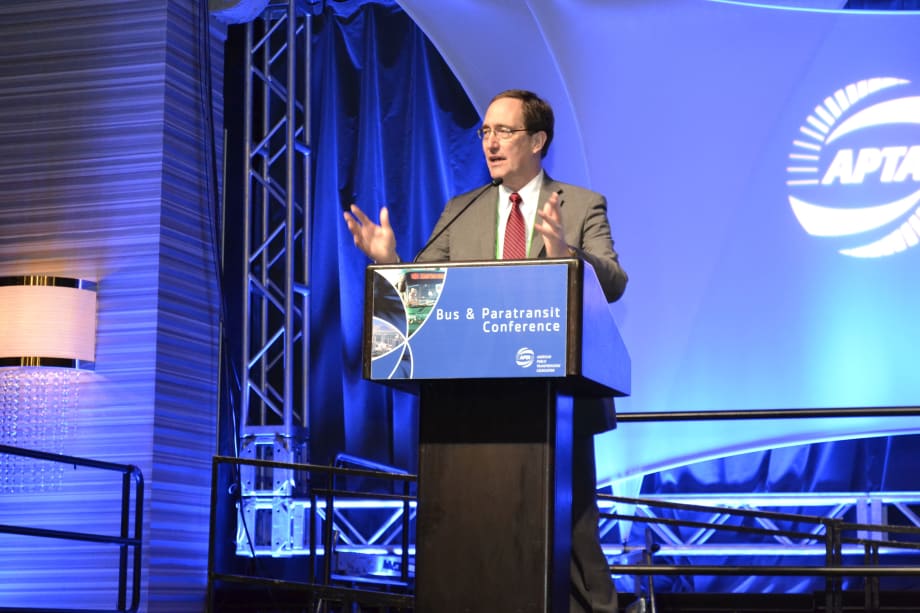
RTC of Washoe County’s Executive Director Lee Gibson spoke at the opening session for APTA's 2017 Bus and Paratransit Conference in Reno, Nev.
RTC of Washoe County’s Executive Director Lee Gibson spoke at the opening session for APTA's 2017 Bus and Paratransit Conference in Reno, Nev.
Realizing the fight to maintain funding for public transportation isn’t over and seeing what infrastructure investment can do for a city firsthand were key themes of the Opening Session at APTA’s Bus & Paratransit Conference in Reno, Nev., on Monday morning.
Starting off the program, several Reno dignitaries, including the RTC of Washoe County’s Executive Director Lee Gibson, Reno Mayor Hillary Schieve, and Rep. Mark Amodei (R-NV), touted the growth the city has experienced due in large part to transportation investments made in the area, which have not only increased transportation options for residents of both Sparks and Reno but also improved decaying infrastructure after the region was hit hard by the Great Recession.
After playing a round of trivia with some of APTA’s attendees, Schieve said she was proud of the job the RTC has done to dramatically improve the region, and discussed how the city is turning around to become one of the fastest growing regions in the nation, including being the new home for Tesla.
Meanwhile during his comments, Amodei applauded the public transportation industry for the work it does, as well as its ability to effectively communicate the role public transit plays in their communities, while also challenging attendees to continue spreading the word on Capitol Hill. He also voiced his support for raising the Federal Gas Tax to help pay for public transportation in order to bring predictability and stability to the industry.
“When you can pay for it in a reasonable way, why wouldn’t you just do it?” said Amodei.
APTA’s Acting President/CEO Richard White discussed the industry’s recent victory in the FY2017 budget during the opening session of the 2017 Bus and Paratransit Conference.
Meanwhile, APTA’s Acting President/CEO Richard White discussed the industry’s recent victory in the FY2017 budget, which includes $2.4 billion for the previously threatened Capital Investment Grants program, before warning the crowd that their work isn’t done since the FY2018 budget recommendations are just a few weeks away.
Key to that outreach, White said, will be the industry’s ability to share the facts with congressional leaders to help them understand how much impact public transportation investment can have, as well as the impacts that would occur if those investments were not made.
More Management

METRO Opens Submissions for 2026 Motorcoach Awards
Nominations are now being accepted for METRO Magazine’s Operator of the Year and Innovative Operator of the Year awards.
Read More →
New York MTA Advances Final Contract for Second Avenue Subway Expansion
Contract Four is the largest in the Second Avenue Subway Phase 2 project and includes construction of station infrastructure, tracks, and signals for the subway expansion, MTA officials said. Work on Contract Four will begin in 2027.
Read More →
Transit Agencies Highlight Safety Gains at National Summit
Leaders from 15 major transit systems shared crime-reduction results and safety initiatives while discussing the role of continued federal support.
Read More →

NITA Names New Leadership, Expands Reduced-Fare Program at First Board Meeting
The new regional transit authority appointed its first board chair and interim executive director while extending reduced fares across CTA, Metra, and Pace for eligible riders.
Read More →
Beyond the Checklist: A Structured Approach to Transit Maintenance
Reliability-Centered Maintenance helps transit agencies move beyond routine checklists to focus limited resources on the assets and failures that have the greatest impact on safety, reliability, and service.
Read More →
APTA 2026 Nominating Committee Selects Leadership Slate, Names Chair and Vice Chair Nominees
Leadership changes will help shape the association’s priorities and its representation of the transportation industry during the 2026–2027 term.
Read More →
DART Launches Major Security, Fare Enforcement Initiative
The 90-day demonstration will deploy coordinated security teams at five light rail stations while testing controlled access and gathering data to guide future investments.
Read More →
Advancing Fare Collection Through Technology and Innovation
Learn about delivering 1300 gates at 91 stations while managing fare evasion. Explore the large scale deployment, solution customization and real-world results that affect the region. Prepare for deployment in your region now.
Read More →
Game Day in Motion: Moving Millions During the 2026 World Cup
Between packed transit stations and team motorcoaches, see how agencies and operators across North America tackled the transportation demands of the 2026 FIFA World Cup.
Read More →
Surface Transportation Extension Averts Shutdown, Leaves Transit Funding Gap
The stopgap keeps federal transportation programs moving, but missing advance funding could complicate the transit and rail projects agencies are planning next.
Read More →