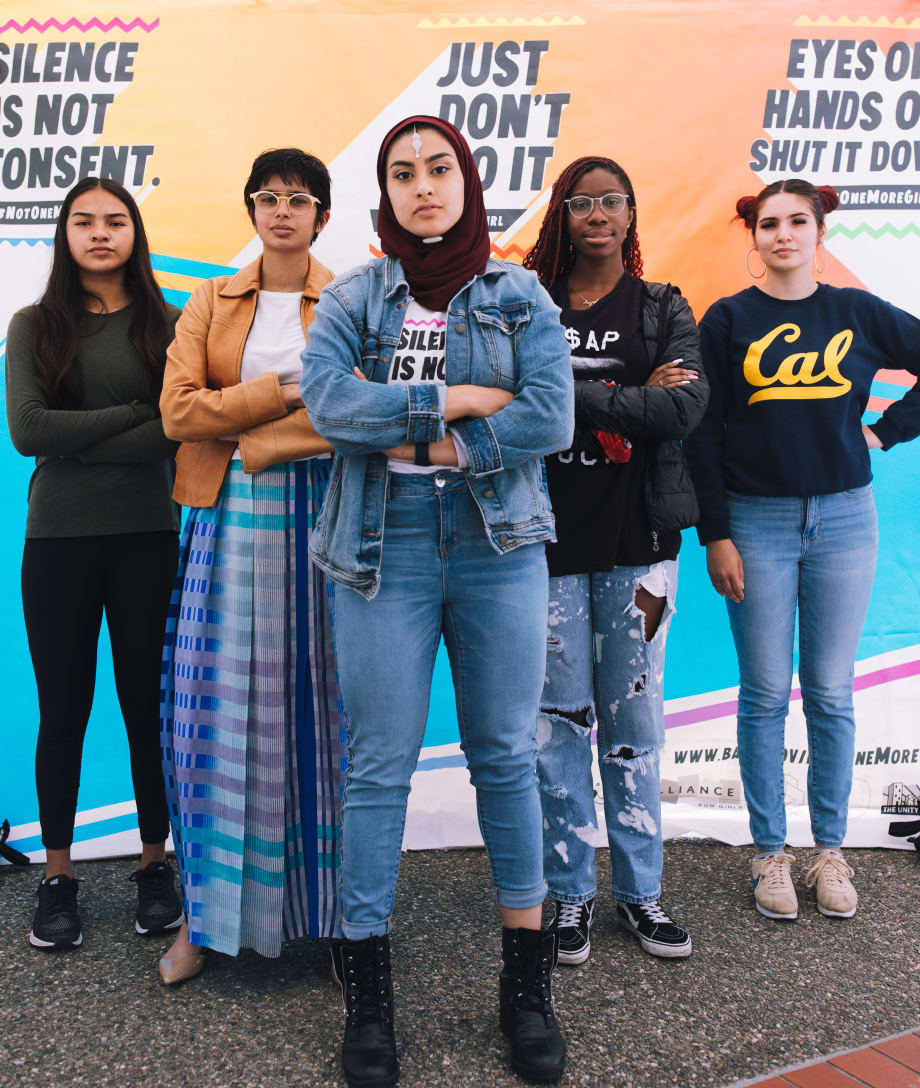
The second phase of the award-winning initiative places emphasis on enabling people to have a greater sense of empowerment in a harassment situation and exhibits tools that fellow riders can use to provide support when harassment occurs.
Credit:
BART
6 min to read
The groundbreaking, youth-driven Not One More Girl initiative that addresses sexual harassment and gender-based violence on the San Francisco BART system is expanding with new strategies to build a culture of supporting girls, which refers to gender-expansive youth, when riding transit.
Not One More Girl is a BIPOC youth-led initiative in partnership with community-based organizations and BART to end gender-based violence. Not One More Girl has become a model in the transit industry. It provided inspiration for SB 1161, which was signed into law in 2022, as well as SB 434, which is currently moving through the Legislature, to address harassment on transit and collect survey data to inform safety efforts.
Ad Loading...
The Not One More Girl initiative was first launched in 2021, and rider survey data has indicated the project is helping reduce harassment and improve the perception of safety on BART.
Credit:
BART
Phase 2 of Not One More Girl
The second phase of the award-winning initiative places emphasis on enabling people to have a greater sense of empowerment in a harassment situation and exhibits tools that fellow riders can use to provide support when harassment occurs.
The new tools being offered to the public are the product of a partnership between BART, The Betti Ono Foundation, and The Unity Council’s Latina Mentorship and Achievement Program, who worked together to engage local high school and college students about their experiences on transit and their ideas for action-based strategies to enhance safety and support people experiencing sexual harassment on transit.
The approach for the second phase of Not One More Girl is to deepen the reach and impact of the ongoing work to increase safety at BART.
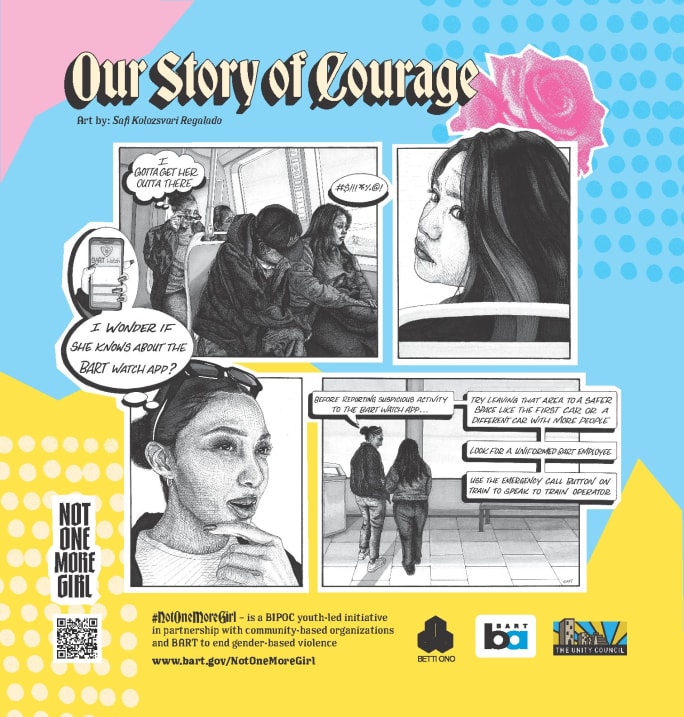
The Betti Ono Foundation, led by Anyka Howard, developed an Arts & Civic Engagement Fellowship, offering paid opportunities for transitional-age youth (ages 16-24) to guide this phase of the initiative and to amplify the voices of BIPOC and gender-expansive youth. The fellows attended design workshops in Spring 2023 and curated the theme, “Our Story of Courage,” for this phase of Not One More Girl to educate the public about safe bystander intervention as a method of preventing and interrupting harassment and other safety tips for riding BART.
The latest phase includes:
Ad Loading...
Three distinct art posters outlining safety tips.
300 train car posters and 60 station posters.
New bystander intervention cards are now available to riders to discreetly pass to people to prompt bystander intervention actions and report harassment when it is taking place.
These cards are now available at all Station Agent booths and are being distributed by community partners.
Beginning September 11, BART will size trains for safety and run shorter trains to eliminate empty cars, where girls fear being targeted for harassment and assault. The schedule change also increases service on nights and weekends, so riders spend less time waiting on platforms.
Moving forward:
BART will work with the Alliance for Girls in fiscal year 2024 to develop a youth-informed BART rider safety evaluation framework, as it pertains to sexual harassment, to define safety metrics and evaluation strategies that will guide BART’s preventative and interventional safety efforts.
BART will develop and roll out training for frontline staff to give them tools on how best to handle situations involving riders experiencing trauma from harassment and gender-based violence, with a special focus on engaging marginalized community members.
Empowering Local Girls
“A big part of harassment is the devaluing of another person,” said Karol Suarez, a senior at Oakland School of the Arts. “And in this culture, we often don’t value people’s voices, especially women, especially women of color.”
This past spring, Suarez served as a youth fellow guiding this latest phase of Not One More Girl and helped develop the theme, “Our Story of Courage.”
Ad Loading...
“This project understands the importance of making people feel comfortable on public transit, a place that is meant for everyone,” said Suarez. “Being a part of this has made me hopeful; it shows me we’re not that messed up as a society. Even this small group is making a big impact.”
The Unity Council, under the leadership of Gabby Guzman, helped connect BART with youth and offered social-emotional support to the fellows throughout the process.
BART’s Chief Communications Officer Alicia Trost and BART Art Program Manager Jennifer Easton led the effort for BART and began the process of internalizing the initiative at BART to involve frontline workers, including Station Agents, Train Operators, Ambassadors, and Crisis Intervention Specialists.
The Not One More Girl initiative was first launched in 2021, and rider survey data has indicated the project is helping reduce harassment and improve the perception of safety on BART. The launch of the second phase of the initiative coincides with BART boosting its safety presence on trains as a direct response to rider concerns.
The latest phase includes a powerful new art campaign by local artist Safi Kolozsvari Regalado that will appear throughout the BART system, including onboard trains and in stations.
Credit:
BART
New Art Posters to Educate the Public
The latest phase includes a powerful new art campaign by local artist Safi Kolozsvari Regalado that will appear throughout the BART system, including onboard trains and in stations. Regalado worked with youth fellows to conceptualize and design the artwork, which was inspired by the long tradition of Chicano-style ballpoint pen art. The posters depict steps people can take if they witness or experience harassment and promote the use of the BART Watch app for reporting, Train Operator call boxes on every train car, and suggestions, such as sitting in the first train car near the Train operator.
Ad Loading...
Bystander Intervention Cards for Riders
Two distinct wallet-size cards are now available to riders to discreetly hand to people to signal they need help or support, or to notify someone being harassed that you are there to help and support them.
These new bystander intervention cards are a concept developed by the youth design team, who expressed the need for options when asking for help or approaching a situation of potential harm. The cards include the slogans “I Got You” and “You Got Me?” with a list of actionable items riders can take to help a situation, from reporting the harassment to simply standing with someone.
As young people are still trying to find their voices and figuring out how to navigate and decipher harassment, a physical card you can hand someone is an effective tool to precipitate the shift from being a bystander to becoming an agent of change.
The cards are available for pick up at each Station Agent booth at BART, and Ambassadors and Crisis Intervention Specialists will carry the cards and give them out when engaging riders. BART and the Betti Ono Foundation will also work to distribute the cards to youth through community organizations, events, and schools.
Framework to Evaluate Safety Metrics
In the coming year, BART will work with the Alliance for Girls, one of the original leads of Phase I of Not One More Girl, and Evaluation Studio to develop the first youth-informed evaluation framework focusing on rider safety as it pertains to sexual harassment and assault prevention and intervention on BART.
Ad Loading...
Rooted in how girls and gender-expansive youth define safety, in Alliance for Girls’ Radical Visions of Safety research report published in 2021, the framework will draw from learnings, input, and recommendations from youth themselves on how BART can best collect data and measure impact of its initiatives to create actionable and effective policies and processes around sexual harassment and assault intervention.
The Call for Papers is now open, allowing transit agency professionals and industry experts to help shape the PTC educational program by submitting session ideas for consideration.
Proposed legislation would link federal transit dollars to safety measures while requiring security investments, onboard cameras, and new fare collection standards.
The federal agency closed its remaining special directive to the Massachusetts Department of Public Utilities following a safety review that began in 2022.
The 90-day demonstration will deploy coordinated security teams at five light rail stations while testing controlled access and gathering data to guide future investments.
The app expands on RTD’s existing NextRide web application and allows customers to view real-time vehicle locations and service alerts, purchase and store digital fares, and access customer support.
The revamped program addresses 26 OSHA standards for maintenance facilities, with TAPTCO pointing to training, documentation, and everyday shop hazards as continuing challenges for transit operations.
The award-winning partnership combines AI-powered detection with human oversight to improve bus reliability, accessibility, and enforcement efficiency.