



Denver RTD commuter rail campaign wins APTA AdWheel Grand Award
This campaign resulted in over 255 million multimedia impressions over a three-month period, drew 100,000 people to opening events and introduced the phrase "Train to the Plane" into the public lexicon.

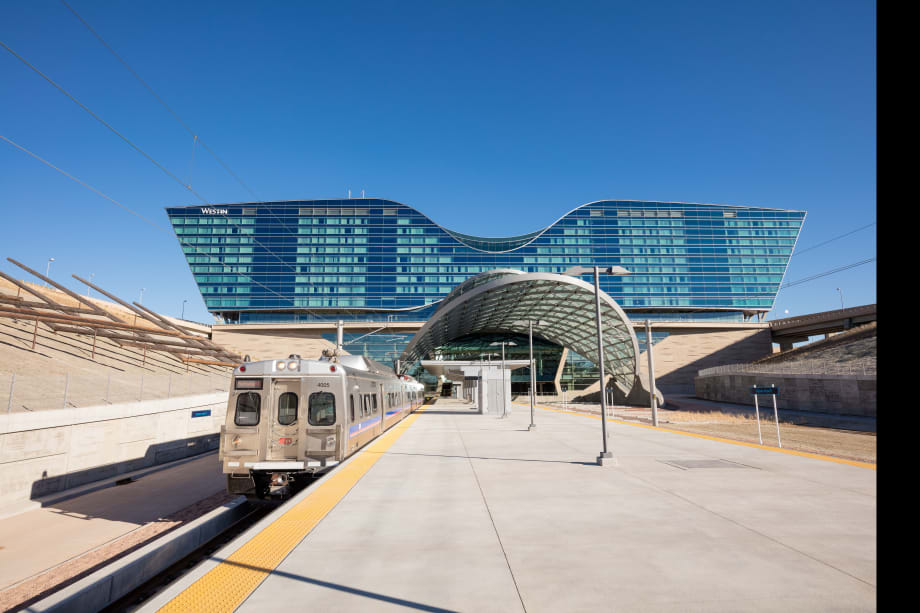
University of Colorado A Line Denver Airport Station pictured. Denver RTD's campaign was designed to increase service awareness, educate the public about commuter rail, promote grand opening events, and encourage ridership.
University of Colorado A Line Denver Airport Station pictured. Denver RTD's campaign was designed to increase service awareness, educate the public about commuter rail, promote grand opening events, and encourage ridership.
Denver's Regional Transportation District (RTD)’s “Train to the Plane” marketing and communications campaign for its University of Colorado A Line service received APTA's AdWheel Grand Award.
This campaign — designed to increase service awareness, educate the public about commuter rail, promote grand opening events, and encourage ridership — resulted in over 255 million multimedia impressions over a three-month period, drew 100,000 people to opening events and introduced the phrase "Train to the Plane" into the public lexicon. The efforts were illustrative of the extensive, thoughtful campaigns RTD introduces when offering new public service.
“We are honored to receive this award that nationally recognizes the creative work of our communications team,” said CEO/GM Dave Genova. “The bold blue train design and tagline, ‘Train to the Plane’ really resonated with the entire Denver metro region.”
News coverage was provided internationally and ruled the market. In addition, RTD has seen a 30% increase over ridership projections since opening. Ridership on the University of Colorado A Line has reached 22,500 on an average weekday as of August 2017.
Eleven winners were chosen by APTA during their annual meeting in Atlanta this week. The awards recognize APTA member public transportation systems and business members for their outstanding marketing and communications campaigns.
"I am pleased to recognize the 2017 AdWheel Award winners, who have advanced public transportation with their exceptional marketing and communications efforts," said APTA Acting President/CEO Richard A. White. "These eleven Grand Award winners showed the strategic value of communications and marketing within the public transportation industry by boosting ridership and increasing support, as well as accomplishing key organizational goals."
RTD competed with nearly 350 entries, evaluated by more than 100 industry experts. Awards were presented in three categories: efforts to increase ridership or sales, efforts to highlight transit needs and funding, and educational efforts. Honors were awarded in four groups, based on system size.
The RTD's buses, rail lines, shuttles and additional services provide 100 million annual passenger trips in the Denver metro region.
More Management

METRO Opens Submissions for 2026 Motorcoach Awards
Nominations are now being accepted for METRO Magazine’s Operator of the Year and Innovative Operator of the Year awards.
Read More →
New York MTA Advances Final Contract for Second Avenue Subway Expansion
Contract Four is the largest in the Second Avenue Subway Phase 2 project and includes construction of station infrastructure, tracks, and signals for the subway expansion, MTA officials said. Work on Contract Four will begin in 2027.
Read More →
Transit Agencies Highlight Safety Gains at National Summit
Leaders from 15 major transit systems shared crime-reduction results and safety initiatives while discussing the role of continued federal support.
Read More →

NITA Names New Leadership, Expands Reduced-Fare Program at First Board Meeting
The new regional transit authority appointed its first board chair and interim executive director while extending reduced fares across CTA, Metra, and Pace for eligible riders.
Read More →
Beyond the Checklist: A Structured Approach to Transit Maintenance
Reliability-Centered Maintenance helps transit agencies move beyond routine checklists to focus limited resources on the assets and failures that have the greatest impact on safety, reliability, and service.
Read More →
APTA 2026 Nominating Committee Selects Leadership Slate, Names Chair and Vice Chair Nominees
Leadership changes will help shape the association’s priorities and its representation of the transportation industry during the 2026–2027 term.
Read More →
DART Launches Major Security, Fare Enforcement Initiative
The 90-day demonstration will deploy coordinated security teams at five light rail stations while testing controlled access and gathering data to guide future investments.
Read More →
Advancing Fare Collection Through Technology and Innovation
Learn about delivering 1300 gates at 91 stations while managing fare evasion. Explore the large scale deployment, solution customization and real-world results that affect the region. Prepare for deployment in your region now.
Read More →
Game Day in Motion: Moving Millions During the 2026 World Cup
Between packed transit stations and team motorcoaches, see how agencies and operators across North America tackled the transportation demands of the 2026 FIFA World Cup.
Read More →
Surface Transportation Extension Averts Shutdown, Leaves Transit Funding Gap
The stopgap keeps federal transportation programs moving, but missing advance funding could complicate the transit and rail projects agencies are planning next.
Read More →