Denver RTD's Report Determines 'Zero Fares' Made Positive Environmental Impact
The final report shows an increase in customer boardings and estimates a reduction of approximately nine million vehicle miles traveled during July and August.
During the zero-fare initiative, RTD conducted a comprehensive intercept survey of individuals using the system to better understand ridership decisions, commuting trends, and customer behaviors.
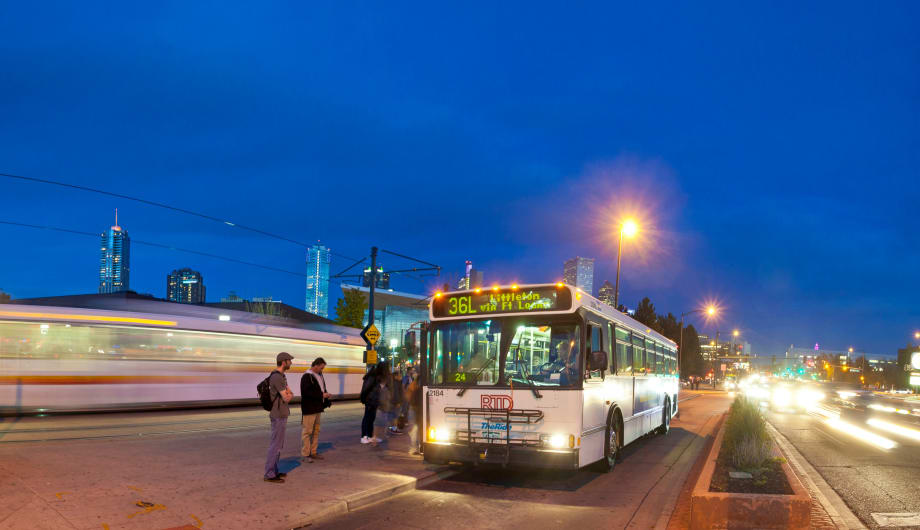
Photo: Denver RTD
5 min to read
Denver’s Regional Transportation District (RTD) submitted its final evaluation report to the Colorado Energy Office outlining the overall impacts of the two-month Zero Fare for Better Air (ZFBA) initiative.
The final report shows an increase in customer boardings and estimates a reduction of approximately nine million vehicle miles traveled during July and August. Additionally, estimates show more than six million pounds of greenhouse gases were eliminated when individuals opted to use public transit instead of a single occupancy vehicle.
Ad Loading...
RTD’s Zero Fare Report
To assess the environmental impact of the 2023 ZFBA initiative, RTD partnered with the Regional Air Quality Council (RAQC). RAQC is the lead air quality planning agency for the nine-county Denver Metro/North Front Range Ozone Nonattainment Area.
RAQC’s analysis utilized the Greenhouse Gases, Regulated Emissions and Energy use in Transportation (GREET) model to estimate the initiative’s overall impact on the region’s air quality.
According to RAQC, the Zero Fare for Better Air initiative helped reduce both ozone precursors, volatile organic compounds (VOCs), and nitrogen oxides (NOx), which in the presence of heat and sunlight, combine to form invisible but harmful ground-level ozone.
"When public transit is easy to use, people use it more,” said Mike Silverstein, RAQC Executive Director. “Increased public transit use also reduces the top two sources of ground-level ozone precursors in the Front Range: emissions from cars and light trucks, and fuel production by the oil and gas industry to fill those tanks. RTD’s Zero Fare for Better Air initiative helps reduce both our fossil fuel use and the demand for its production, making a positive impact on our local air quality during peak ozone season.”
During the zero-fare initiative, RTD conducted a comprehensive intercept survey of individuals using the system to better understand ridership decisions, commuting trends, and customer behaviors. The survey directly engaged RTD’s customers onboard buses and trains and at key stops and stations.
Ad Loading...
The intercept survey was distributed across the entire Denver metro region to align responses with ridership numbers. One of the survey questions asked what mode of transportation a customer would have used had they not taken RTD for that specific trip. Responses to the question were used as an input into the GREET model.
Based on the GREET model, which used ridership data and survey responses among other variables as inputs, the RAQC estimates that RTD’s zero-fare initiative led to a total reduction of 9,014,370 vehicle miles traveled, 2,583 pounds of volatile organic compounds, 2,385 pounds of nitrogen oxides, and 6,161,772 pounds of greenhouse gases. This equates to a daily reduction of 145,393 vehicle miles traveled and 99,383 pounds of greenhouse gases.
For context, the Denver Regional Council of Governments estimated that daily vehicle miles traveled in the Denver metro region were approximately 83 million in 2022.
“The second year of the Zero Fare for Better Air initiative affirmed extensive support for public transit. Moreover, staff garnered valuable lessons related to travel patterns, security resource deployment, and customer preferences for mobility options,” said GM/CEO Debra A. Johnson. “I once again extend my thanks to the Colorado Energy Office, whose assistance and partnership made this second year possible.”
In addition to having an environmental impact, the Zero Fare for Better Air initiative also experienced a 10% increase in the overall number of boardings on bus, rail, and paratransit services.
Photo: Denver RTD
Zero Fare Ridership
The Zero Fare for Better Air initiative also experienced a 10% increase in the overall number of boardings on bus, rail, and paratransit services. When compared with the same period last year, the agency had an additional 1,106,567 customer boardings on RTD’s system during July and August 2023.
Ad Loading...
Boardings during the two-month initiative reflect the largest number of customers RTD has had on its system since the COVID-19 pandemic impacted ridership in March 2020.
Mode
July 2022*
August 2022
July 2023
August 2023
Bus
3,199,117
4,055,264
3,935,371
4,472,626
Light Rail
1,222,832
1,393,608
1,153,929
1,134,846
Commuter Rail
724,454
832,433
882,657
894,360
Paratransit
51,417
68,992
82,450
98,445
Total
5,197,820
6,350,297
6,054,407
6,600,277
*The Zero Fare for Better Air initiative in 2022 did not include the month of July.
In comparison with the same period last year, mode-specific highlights include:
Bus saw a 16% increase in boardings.
Commuter rail experienced a 14% increase in boardings.
Ridership on the A Line increased 14% year-over-year, and it accounted for nearly three-fourths of commuter rail’s boardings during July and August.
Light rail saw a 13% decrease in boardings, much of which can be attributed to months-long planned maintenance projects that impacted the E, H, and R lines.
Major findings from the customer intercept survey include:
Ad Loading...
74% of respondents said that the zero-fare initiative influenced their decision to use RTD’s services on the day they were surveyed.
84% of respondents said that cost savings was an important factor regarding their decision to use RTD’s services.
85% of respondents indicated that the environmental benefits of the initiative influenced their decision to take a bus or train.
72% of respondents planned to increase their usage of RTD’s services during the initiative.
33% of respondents said that the primary purpose of their trip was work related.
23% of respondents indicated that they would have driven themselves if they were not using RTD’s services.
The collaborative, statewide initiative was funded through a grant program created by Colorado Senate Bill 22-180 in an effort to reduce ground-level ozone during peak periods by increasing the community’s use of public transit.
In 2023, RTD expanded its zero-fare offering from one month to two, to align with Colorado’s highest ozone months of July and August and leveraged available state funding appropriated for the Ozone Season Transit Grant Program.
RTD’s Zero Fare for Better Air 2023 Evaluation Report is available here.
See how three Gillig battery-electric buses powered festival stages while the agency’s new Park & Ride service carried approximately 1,000 attendees, demonstrating another potential use for transit agencies’ electric fleets.
The new name represents a renewed vision for the nonprofit focused on advancing clean, equitable, and affordable transportation solutions that move people and goods.
John Hroncich discusses BAE Systems’ modular and scalable approach, lessons learned from decades of real-world operations, and how agencies can identify electrification strategies that fit their fleets.
UB, transportation solutions provider WeDriveU, and fleet electrification specialist Zenobē marked the deployment in the presence of students, university administrators, and local officials.
From manufacturers and suppliers to transit agencies and motorcoach operators, these updates offer a snapshot of the projects, partnerships and business moves driving the industry forward.
The agency’s maintenance chief discusses leadership, workforce development, zero-emission technology, and preparing technicians for the future of public transportation.
The firm will work with CTDOT and RVT to define the facility layout, operational requirements, and long-term flexibility for RVT’s growing electric fleet.
The fast-charging infrastructure will help extend electric bus range, improve fleet utilization, and support DASH's goal of transitioning to a fully zero-emission fleet.