




Ticket Validation Hardware Secures Payments for a Smoother Transit Ride
Denver’s RTD introduces Tap-n-Ride Fare Payments
A growing industry shift to contactless payment options via a physical card or mobile wallet allows customers to pay fares quickly and securely.
November 26, 2025
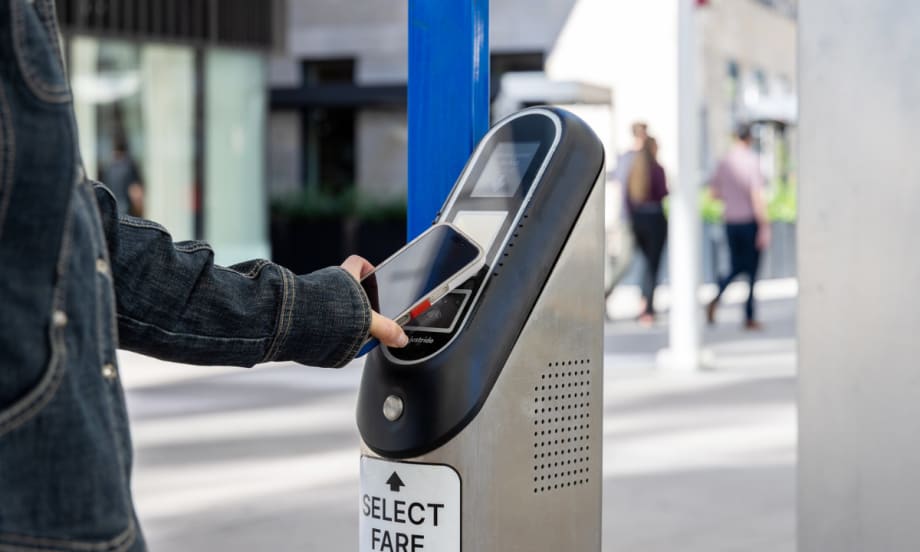
RTD’s ability to provide Tap-n-Ride was made possible in 2022 with the introduction of account-based ticketing and installation of the agency’s current validators.
Photo: Regional Transportation District
3 min to read
The Regional Transportation District (RTD) is introducing Tap-n-Ride, the agency’s new fare payment option that provides a "quick, secure, and convenient" way for customers to pay their fare at any validator.
Customers can now tap a Visa or Mastercard credit, debit, or prepaid card, or a Visa or Mastercard loaded into a mobile wallet, directly on a bus or rail validator to ride.
Mobile wallet payment options include Apple Pay, Google Pay, and Samsung Pay, and are available on a mobile phone or a smartwatch. RTD plans to add American Express and Discover card options to its Tap-n-Ride program in 2026.
The addition of this technology allows riders to forgo using a ticket vending machine (TVM), carrying cash, visiting a sales outlet, buying a mobile ticket, or preloading fare into their MyRide account.
According to an agency release, all other existing fare payment methods will remain available for customers. Tap-n-Ride just provides an additional option that functions similarly to the agency’s MyRide card process.
“The introduction of Tap-n-Ride provides an experience that is easy to navigate, equitable, and accessible for everyone who relies on RTD,” said Debra A. Johnson, RTD’s General Manager and CEO. “This new fare payment option is focused on removing barriers and offering customers a seamless, straightforward experience where they can simply tap and ride.”
A Faster Tap for Riders, a Bigger Shift for Transit
For other U.S. agencies, a Tap-n-Ride system receives payments from validators via a certified, secure open payment system, and transactions are processed without storing card numbers.
RTD’s move reflects a broader industry shift toward open-loop, contactless fare payment, as agencies modernize systems to speed up boarding, reduce cash dependence, and give customers more flexible ways to ride.
For riders, a benefit of linking a credit, debit, or prepaid card to their MyRide account is the ability to view their trip history and daily cumulative charges in the account. Customers who do not use a MyRide account can view aggregate charges for their fare purchases on their bank statement.
Plus, Tap-n-Ride limits purchases to one card or mobile wallet per customer to enable transfers and fare capping, ensuring customers always pay the lowest possible fare.
Scaling Contactless: RTD’s Systemwide Launch
RTD’s ability to provide Tap-n-Ride was made possible in 2022 with the introduction of account-based ticketing and installation of the agency’s current validators. This allowed customers to load stored value to their MyRide accounts and tap the digital barcode or MyRide card on the validator to pay their fare.
Account-based ticketing enabled the agency to add the new, accessible Tap-n-Ride payment option as a convenience for paying fares. Fare validators are on board 952 RTD fixed-route buses and are available at 235 stations across the district.
As more people learn about and use the simple and accessible Tap-n-Ride payment option, RTD will seek customer feedback to refine the experience as needed and address any challenges early to promote its ease of use.
RTD plans to promote the new fare payment option in the coming months and anticipates a 15% adoption rate for 2026 based on an analysis of other transit agencies that offer a contactless payment option.
More Management

METRO Opens Submissions for 2026 Motorcoach Awards
Nominations are now being accepted for METRO Magazine’s Operator of the Year and Innovative Operator of the Year awards.
Read More →
New York MTA Advances Final Contract for Second Avenue Subway Expansion
Contract Four is the largest in the Second Avenue Subway Phase 2 project and includes construction of station infrastructure, tracks, and signals for the subway expansion, MTA officials said. Work on Contract Four will begin in 2027.
Read More →
Transit Agencies Highlight Safety Gains at National Summit
Leaders from 15 major transit systems shared crime-reduction results and safety initiatives while discussing the role of continued federal support.
Read More →

NITA Names New Leadership, Expands Reduced-Fare Program at First Board Meeting
The new regional transit authority appointed its first board chair and interim executive director while extending reduced fares across CTA, Metra, and Pace for eligible riders.
Read More →
Beyond the Checklist: A Structured Approach to Transit Maintenance
Reliability-Centered Maintenance helps transit agencies move beyond routine checklists to focus limited resources on the assets and failures that have the greatest impact on safety, reliability, and service.
Read More →
APTA 2026 Nominating Committee Selects Leadership Slate, Names Chair and Vice Chair Nominees
Leadership changes will help shape the association’s priorities and its representation of the transportation industry during the 2026–2027 term.
Read More →
DART Launches Major Security, Fare Enforcement Initiative
The 90-day demonstration will deploy coordinated security teams at five light rail stations while testing controlled access and gathering data to guide future investments.
Read More →
Sponsored•September 9, 2026
Advancing Fare Collection Through Technology and Innovation
Learn about delivering 1300 gates at 91 stations while managing fare evasion. Explore the large scale deployment, solution customization and real-world results that affect the region. Prepare for deployment in your region now.
Read More →
Game Day in Motion: Moving Millions During the 2026 World Cup
Between packed transit stations and team motorcoaches, see how agencies and operators across North America tackled the transportation demands of the 2026 FIFA World Cup.
Read More →
Surface Transportation Extension Averts Shutdown, Leaves Transit Funding Gap
The stopgap keeps federal transportation programs moving, but missing advance funding could complicate the transit and rail projects agencies are planning next.
Read More →