



L.A. Metro approves plan to improve Orange Line safety, capacity
The project is slated for groundbreaking in 2019 and opening in 2025.

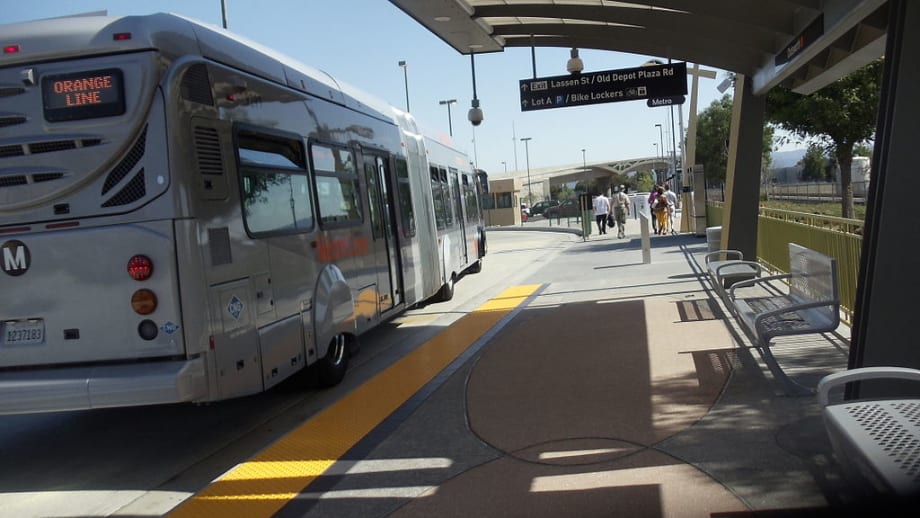
All improvements are expected to cut travel times by approximately 20% between North Hollywood and Chatsworth.
All improvements are expected to cut travel times by approximately 20% between North Hollywood and Chatsworth.
The Los Angeles County Metropolitan Transportation Authority (Metro) board approved plans for up to 35 crossing gates and two busway and bicycle grade separations for the San Fernando Valley’s Metro Orange Line. Plans will greatly improve both safety and performance and prepare the bus line for its future conversion to light rail.
The project, funded with $286 million in Measure M taxpayer funds and $75 million in SB-1 state gas tax funds, is slated for groundbreaking in 2019 and opening in 2025. Metro will install up to 35 at-grade railroad-type crossing gates along the 18-mile busway between North Hollywood and Chatsworth. Gates would be like those used on the Metro Gold, Blue, and Expo light rail lines and will be installed on all sides of the intersection to reduce or eliminate potential auto versus bus intrusions or collisions. Crossing gates will also enable buses to safely increase their intersection operating speeds from approximately 10 to 15 miles per hour to 25 to 45 miles per hour.
Plans also call for building two busway and bicycle grade separations at Van Nuys and Sepulveda boulevards — the two busiest Valley streets along the corridor. Stand-alone bridges will physically separate buses and bicyclists from automobile and pedestrian traffic below. New aerial stations would be built on the bridge.
All improvements are expected to cut travel times by approximately 20% between North Hollywood and Chatsworth.
Metro will work closely with the Los Angeles Department of Transportation to ensure crossing gates operate as efficiently as possible. Metro will explore operating buses at longer headways with two-vehicle platoons to increase passenger capacity while minimizing the frequency of gate activation and resulting delays to cross traffic.
“One of our strategic goals is to provide high-quality mobility options that enable our customers to spend less time traveling,” said Metro CEO Phillip A. Washington. “Our planned improvements for the Orange Line will save riders precious time as we continue to build fast, reliable, and high-capacity transit for the residents of the San Fernando Valley.”
The project is part of Metro’s Twenty-Eight by ’28 Plan to complete 28 major road, transit, and bicycle projects before the 2028 Summer Olympics and Paralympics in the L.A. area.
The State of California has made a commitment to fund more than $1.8 billion in projects for Metro over several years as part of SB-1, the state’s “gas tax” and vehicle fee transportation funding program approved by the Legislature in 2017 and signed into law by Gov. Jerry Brown. Funding awards represent the largest allocation of SB-1 funds in California to date.
The Orange Line itself is scheduled to be converted to light rail by 2057. Metro is now exploring ways to accelerate conversion of the line via public-private partnerships.
More Management

METRO Opens Submissions for 2026 Motorcoach Awards
Nominations are now being accepted for METRO Magazine’s Operator of the Year and Innovative Operator of the Year awards.
Read More →
New York MTA Advances Final Contract for Second Avenue Subway Expansion
Contract Four is the largest in the Second Avenue Subway Phase 2 project and includes construction of station infrastructure, tracks, and signals for the subway expansion, MTA officials said. Work on Contract Four will begin in 2027.
Read More →
Transit Agencies Highlight Safety Gains at National Summit
Leaders from 15 major transit systems shared crime-reduction results and safety initiatives while discussing the role of continued federal support.
Read More →

NITA Names New Leadership, Expands Reduced-Fare Program at First Board Meeting
The new regional transit authority appointed its first board chair and interim executive director while extending reduced fares across CTA, Metra, and Pace for eligible riders.
Read More →
Beyond the Checklist: A Structured Approach to Transit Maintenance
Reliability-Centered Maintenance helps transit agencies move beyond routine checklists to focus limited resources on the assets and failures that have the greatest impact on safety, reliability, and service.
Read More →
APTA 2026 Nominating Committee Selects Leadership Slate, Names Chair and Vice Chair Nominees
Leadership changes will help shape the association’s priorities and its representation of the transportation industry during the 2026–2027 term.
Read More →
DART Launches Major Security, Fare Enforcement Initiative
The 90-day demonstration will deploy coordinated security teams at five light rail stations while testing controlled access and gathering data to guide future investments.
Read More →
Advancing Fare Collection Through Technology and Innovation
Learn about delivering 1300 gates at 91 stations while managing fare evasion. Explore the large scale deployment, solution customization and real-world results that affect the region. Prepare for deployment in your region now.
Read More →
Game Day in Motion: Moving Millions During the 2026 World Cup
Between packed transit stations and team motorcoaches, see how agencies and operators across North America tackled the transportation demands of the 2026 FIFA World Cup.
Read More →
Surface Transportation Extension Averts Shutdown, Leaves Transit Funding Gap
The stopgap keeps federal transportation programs moving, but missing advance funding could complicate the transit and rail projects agencies are planning next.
Read More →