



Metro Transit Focuses on Community Collaboration, Building for the 21st Century
Metro Transit GM Brian Lamb says the agency’s APTA award is an accomplishment shared by all of its employees as well as the community.

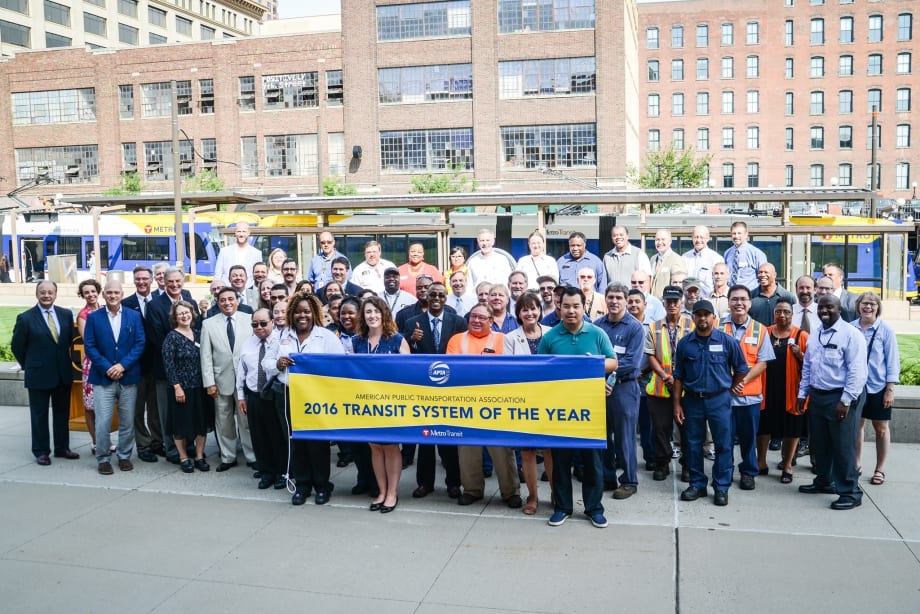
When Minneapolis’ Metro Transit was named APTA’s “Outstanding Public Transit System” (20 million or more annual trips) for 2016, the success was one shared with the agency’s employees and community, according to GM Brian Lamb.
“Throughout our organization, when I talk with operators, mechanics, frontline people or the people in finance, everybody shares that pride because they know that it really is reflective of the culture that we try to build here at Metro Transit,” says Lamb. “The reflection of our success is how much our community accepts what we do and [in turn] treats us as community partners.”
The emphasis on community partnership is a key part of how Metro Transit operates. The agency works closely with the communities it serves, listening to their concerns and building positive relationships with them. As a result, it is able to respond to their needs, which aids the agency in planning effective transit solutions and improving operations.
“We really work at the neighborhood level to better understand what that community needs from transit and how they can best utilize transit,” says Lamb.
Ridership growth, Safety
Metro Transit’s responsiveness to the needs of its communities helps drive the agency’s record ridership numbers. It’s ahead of its goals in that area: ridership has grown in 11 of the past 12 years. “The last time that we had that kind of sustained growth in transit ridership was the era that ended in 1916,” says Lamb.
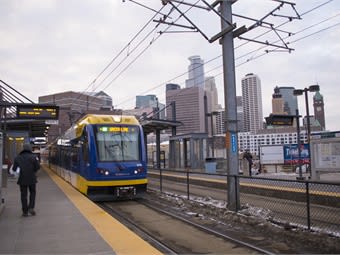
There has been growth in both bus and rail, but new light rail lines, in particular, have exceeded the agency’s expectations. The Blue Line, which began operating in 2004, achieved within three years the ridership goals that had been projected for 2025. More recently, the Green Line, which opened in 2014, frequently reaches 40,000 riders per day — a goal that had been projected for 2030.
The popularity of the Green Line has had a revitalizing effect on the communities it serves. The light rail line connects downtown Minneapolis with the University of Minnesota, travels through an active economic corridor on University Avenue and terminates in downtown St. Paul. As an urban connecter between the cities, the line has helped encourage growth in areas that had previously fallen on hard times due to suburbanization, according to Lamb.
“It has stimulated a tremendous amount of development along that corridor,” he explains. “In the 11-mile stretch between the two downtowns, over four billion dollars of new development happened.”
The new rail line has helped Metro Transit improve the efficiency of its surrounding bus lines as well. Bus lines have been reconfigured around the Green Line to work in conjunction with the rail line, allowing the agency to establish a more effective transit system. This has been another cause of increasing ridership Lamb explains.
“One of the benefits of implementing a rail line, especially in the urban core, is that it allows you to realign your connecting bus service,” he says. “We really were able to more firmly establish a grid network of our urban local routes so that there are stronger crosstown and connecting services with the Green Line.”
Metro Transit’s work to improve safety also focuses on collaborating with the community. The agency has added extensively to its police force, as well as emphasizing public awareness campaigns, such as Operation Lifesaver’s “See Tracks?, Think Train!” campaign. Adverse weather conditions can negatively affect safety, but Metro Transit’s safety efforts have resulted in a low accident rate for both buses and trains despite this challenge. In 2014, Metro Transit received APTA’s Gold Award for Safety Excellence.
Sustainability
When it comes to sustainability, Metro Transit has a long history of seeking new ways to improve its performance. “One of the things that we have really focused on is being a leader in the industry when it comes to looking at next-generation transit vehicles,” says Lamb.
The agency first added hybrid buses to its fleet in 2002 and has recently added new models, including a hybrid bus that operates similarly to a Toyota Prius, turning itself off when the bus comes to a stop. This investment in hybrid technology has significantly improved the fleet’s fuel economy, with average miles per gallon going from 3.8 to 4.7 in the last seven years, which has resulted in significant savings for the agency.
The agency works on sustainability in its facilities too, reducing energy consumption with geothermal heating when possible and building an extensive solar panel plan for both its support and customer facilities. Metro Transit expects to add even more sustainable technology going forward. It’s an important part of the agency’s focus on supporting communities into the future, according to Lamb.
“We haven’t reached a terminus,” he says. “We’re really on a journey toward building a transit system for the 21st century. And, we’re going to continue to challenge ourselves to do it in an environmentally sustainable way.”
More Management

METRO Opens Submissions for 2026 Motorcoach Awards
Nominations are now being accepted for METRO Magazine’s Operator of the Year and Innovative Operator of the Year awards.
Read More →
New York MTA Advances Final Contract for Second Avenue Subway Expansion
Contract Four is the largest in the Second Avenue Subway Phase 2 project and includes construction of station infrastructure, tracks, and signals for the subway expansion, MTA officials said. Work on Contract Four will begin in 2027.
Read More →
Transit Agencies Highlight Safety Gains at National Summit
Leaders from 15 major transit systems shared crime-reduction results and safety initiatives while discussing the role of continued federal support.
Read More →

NITA Names New Leadership, Expands Reduced-Fare Program at First Board Meeting
The new regional transit authority appointed its first board chair and interim executive director while extending reduced fares across CTA, Metra, and Pace for eligible riders.
Read More →
Beyond the Checklist: A Structured Approach to Transit Maintenance
Reliability-Centered Maintenance helps transit agencies move beyond routine checklists to focus limited resources on the assets and failures that have the greatest impact on safety, reliability, and service.
Read More →
APTA 2026 Nominating Committee Selects Leadership Slate, Names Chair and Vice Chair Nominees
Leadership changes will help shape the association’s priorities and its representation of the transportation industry during the 2026–2027 term.
Read More →
DART Launches Major Security, Fare Enforcement Initiative
The 90-day demonstration will deploy coordinated security teams at five light rail stations while testing controlled access and gathering data to guide future investments.
Read More →
Advancing Fare Collection Through Technology and Innovation
Learn about delivering 1300 gates at 91 stations while managing fare evasion. Explore the large scale deployment, solution customization and real-world results that affect the region. Prepare for deployment in your region now.
Read More →
Game Day in Motion: Moving Millions During the 2026 World Cup
Between packed transit stations and team motorcoaches, see how agencies and operators across North America tackled the transportation demands of the 2026 FIFA World Cup.
Read More →
Surface Transportation Extension Averts Shutdown, Leaves Transit Funding Gap
The stopgap keeps federal transportation programs moving, but missing advance funding could complicate the transit and rail projects agencies are planning next.
Read More →